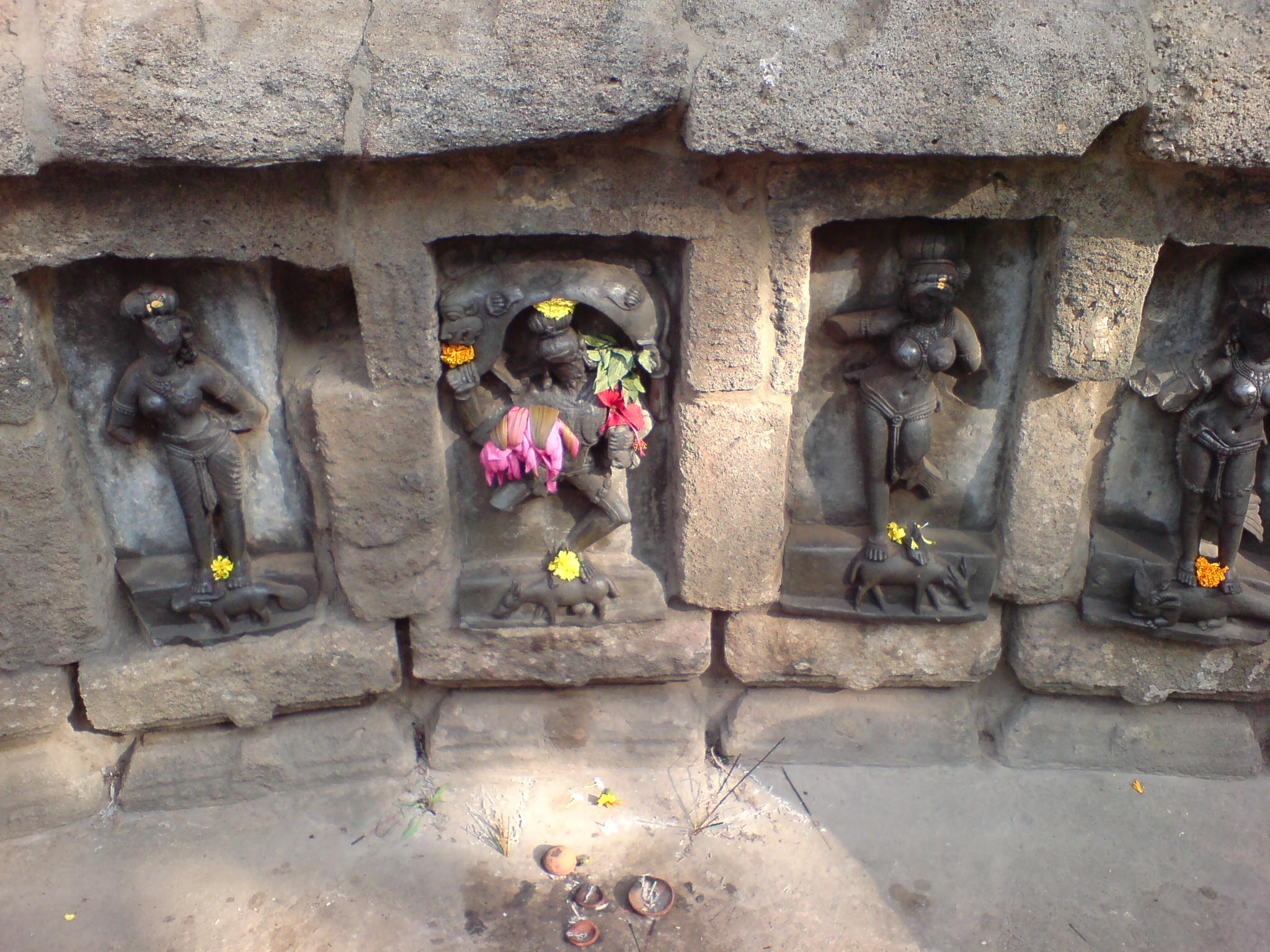
Chausath Yogini Temple, Hirapur
The temple has no roof, and that is the point. Twenty kilometers outside Bhubaneswar, in the village of Hirapur, a small circular shrine stands open to the elements -- rain, sun, wind, and the vast Odisha sky pouring directly into its 25-foot ring of carved goddesses. This is the Chausath Yogini Temple, a 9th-century tantric shrine built hypaethral by deliberate theological choice. The rituals practiced here required worshipping the bhumandala -- the complete environment of fire, water, earth, air, and ether. A ceiling would have blocked the fifth element. So the builders left it off, and for more than a thousand years, the yoginis inside have stood under open sky, getting rained on, baked by the sun, and visited by whatever birds happen to pass overhead.
Sixty-Four Faces of Power
The legend, as local priests tell it, runs like this: the goddess Durga once split herself into 64 demi-goddesses to defeat a demon. After their victory, the 64 asked Durga to commemorate them in stone. The temple is that commemoration. It is the first Chausath Yogini temple in India, and each niche in the circular sandstone wall once held a yogini idol -- 64 in all, though only 56 survive today. The figures, carved from black chlorite stone and standing roughly 40 centimeters tall, depict female figures on animal mounts, their bodies adorned with bejewelled girdles, bracelets, armlets, necklaces, and anklets. Their expressions range across the full spectrum of human emotion: rage, sadness, pleasure, joy, desire, and happiness. They represent Shakti, the eternal feminine power that Hindu mythology holds as the force behind all creation.
The Geometry of Devotion
From above, the temple's plan reveals its deeper meaning. The circular wall, reached through a protruding entrance passage, creates a shape scholars have noted resembles a yoni pedestal for a Shiva lingam. At the center of the circle stands the goddess Kali, positioned on a human head -- a symbol, the tradition holds, of the heart's triumph over the mind. Surrounding her in concentric rings are four yoginis and four Bhairavas, following a mandala plan that layers sacred geometry into every dimension of the space. The whole structure is barely 25 feet across, intimate enough that a visitor standing in the middle can see every one of the surviving goddesses simply by turning in place. It is a temple designed not for procession but for immersion -- step inside, and the divine surrounds you.
Tantric Worship Under Open Sky
The hypaethral design marks this as a specifically tantric shrine, distinct from the roofed temples that dominate Bhubaneswar's sacred landscape. Tantric worship traditions emphasize the unity of practitioner and cosmos, and the roofless architecture makes that unity literal. The yoginis themselves were believed capable of flight -- a detail that gives the open ceiling another layer of meaning. They needed room to come and go. The idols depict standing goddesses atop their vahanas, their animal vehicles. Some ride demons, others stand on human heads, each configuration signifying a different aspect of divine feminine victory. Despite the temple's small footprint, the density of its symbolic program is remarkable. Every surface carries meaning, from the placement of the central Kali figure to the specific arrangement of each yogini in her niche.
Surviving Against the Odds
Eight of the original 64 yogini statues have been lost over the centuries, but the 56 that remain are in striking condition for sculptures more than a thousand years old. The black chlorite stone has weathered to a dark polish that gives the figures an almost liquid quality in certain light. Fresh flowers still appear at the feet of individual yoginis, left by visitors and devotees who make the short trip from Bhubaneswar. The temple sits in a landscape that has changed enormously since the 9th century, but the shrine itself occupies the same ground, holds the same stones, and opens to the same sky. Among the handful of Chausath Yogini temples scattered across India -- at Bhedaghat, Ranipur Jharial, Mitaoli, and Khajuraho -- Hirapur's is the smallest and among the oldest. Its survival owes something to its modest scale. It was too small to attract the attention of armies, too remote to interest treasure hunters, and too strange to be easily repurposed.
From the Air
Located at 20.217N, 85.871E, approximately 20 km southeast of Bhubaneswar city center. The nearest major airport is Biju Patnaik Airport (VEBS). The temple is extremely small -- only 25 feet in diameter -- and not visible from cruising altitude. At lower altitudes, look for the village of Hirapur along rural roads south of the Daya River. The circular roofless structure is distinctive if flying low enough. The surrounding area is flat agricultural land typical of coastal Odisha.