Chauvet Cave
For roughly 29,000 years, no human being entered this cave. A collapsing cliff sealed its entrance sometime around 29,000 years ago, entombing the work of Aurignacian artists in perfect darkness -- until December 18, 1994, when three French speleologists squeezed through a narrow opening and aimed their headlamps at walls that had not reflected light since the last Ice Age. What Eliette Brunel-Deschamps, Christian Hillaire, and Jean-Marie Chauvet found inside would rewrite the history of art.
A Gallery Older Than Civilization
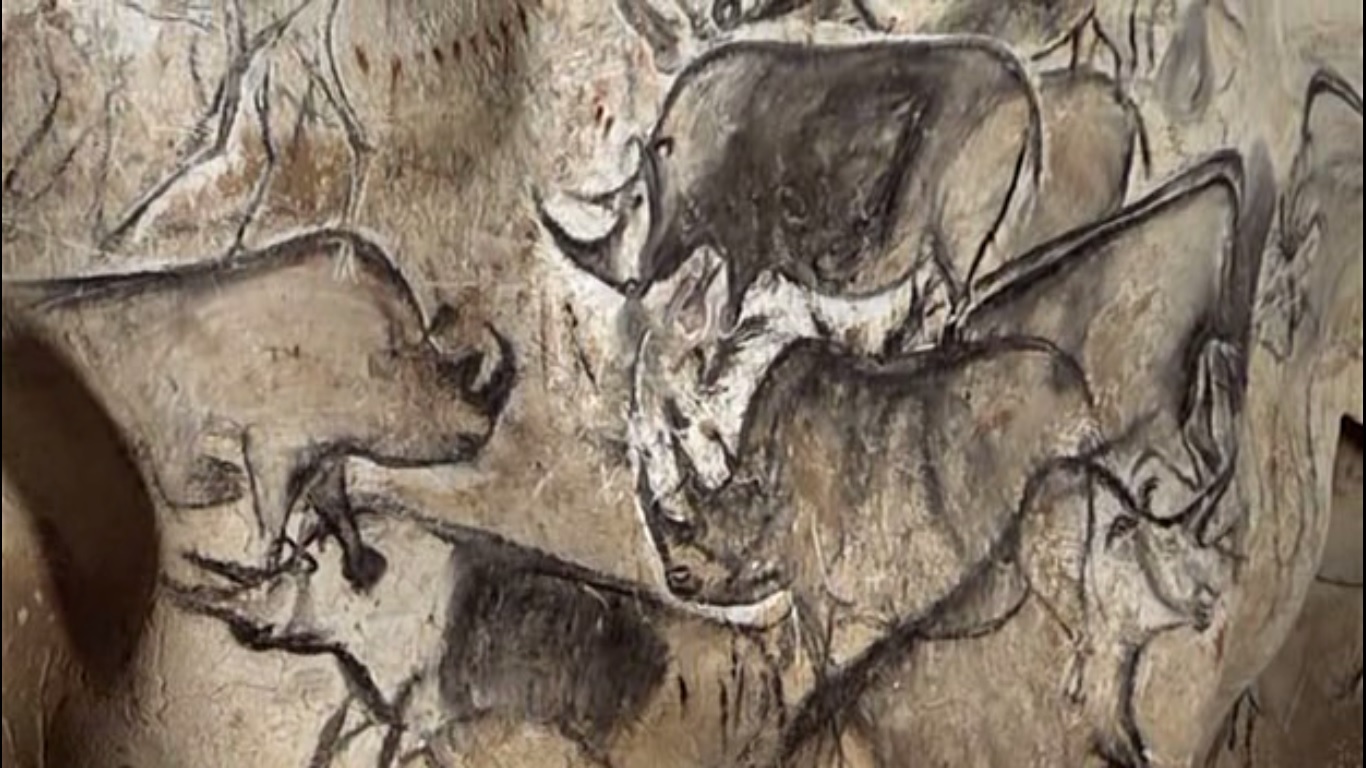
Hundreds of animal paintings cover the walls of Chauvet Cave, depicting at least thirteen different species. But what makes the cave extraordinary is not just its age -- radiocarbon dating places the oldest works at approximately 36,500 years old -- but what the artists chose to paint. Unlike most Paleolithic cave art, which favors horses, bison, and mammoths, the walls at Chauvet are dominated by predators: cave lions stalking in packs, leopards, cave hyenas, and woolly rhinoceroses locking horns. The artists scraped the limestone walls smooth before working, creating lighter surfaces that made their charcoal and ochre lines stand out. They etched outlines to give figures a three-dimensional quality, and they composed scenes -- animals interacting, competing, moving through space. One drawing may depict a volcanic eruption, which would make it the earliest known representation of such an event. These were not crude scratches in the dark. They were the work of people who understood perspective, movement, and composition millennia before those concepts had names.
Two Occupations, One Mystery
Research published in 2016 identified two distinct periods of human presence inside the cave: one spanning roughly 37,000 to 33,500 years ago, and a second from 31,000 to 28,000 years ago. Most of the black charcoal drawings date to the earlier phase. Between and after these visits, rockfalls sealed the entrance, preserving not only the art but the soft clay floor, which still bears the paw prints of cave bears and what may be a child's footprints -- possibly the oldest accurately datable human footprints in existence. Bear skulls litter the ground, and rounded depressions mark where the animals once slept. The cave was a shared space, used by humans and large predators at different times, each leaving behind traces that would survive unchanged for tens of thousands of years.
The Weight of a Handprint
Among the paintings are panels of red ochre handprints and stencils, made by pressing a palm against the rock and blowing pigment around it. There are abstract markings -- lines and dots -- whose meaning remains debated. Two partial female figures appear, and above one of them, a bison head creates a composite that some scholars have compared to a Minotaur. The combination of predator imagery, abstract symbols, and human forms has led researchers to consider whether the paintings served ritual or shamanic purposes. Whatever their function, the handprints carry an undeniable intimacy. Someone stood in the flickering torchlight, pressed their hand against cold stone, and left a mark that has survived longer than any kingdom, any language, any monument built by human ambition.
Sealed for Preservation
Learning from the fate of Lascaux and Altamira, where tourist crowds introduced mold that damaged irreplaceable paintings, French authorities sealed Chauvet Cave immediately after its discovery in 1994. No member of the public has ever walked its passages. Access is restricted to small teams of researchers who work in carefully controlled conditions. In 2015, the Caverne du Pont-d'Arc opened a few kilometers from the real cave -- a full-scale replica ten times larger than the Lascaux facsimile, reproducing the silence, darkness, temperature, and humidity of the original. It is the largest cave replica ever constructed. Werner Herzog's 2010 documentary, Cave of Forgotten Dreams, brought the paintings to a global audience, filming in 3D with a small crew granted rare access. The cave itself remains in darkness, its art visible only to those few scientists permitted to enter -- and to whatever meaning it held for the artists who painted it, then walked away into a world of glaciers and megafauna that no longer exists.
From the Air
Located at 44.39N, 4.42E in the Ardeche gorge of southeastern France. The cave entrance is on a limestone cliff above the former bed of the Ardeche River, near Vallon-Pont-d'Arc. Best viewed at 3,000-5,000 feet AGL. The Pont d'Arc natural stone arch is a prominent visual landmark nearby. Nearest airports: Montelimar (LFLQ), Aubenas (LFHO). The gorge itself is dramatic from the air, with steep limestone cliffs and the winding river below.