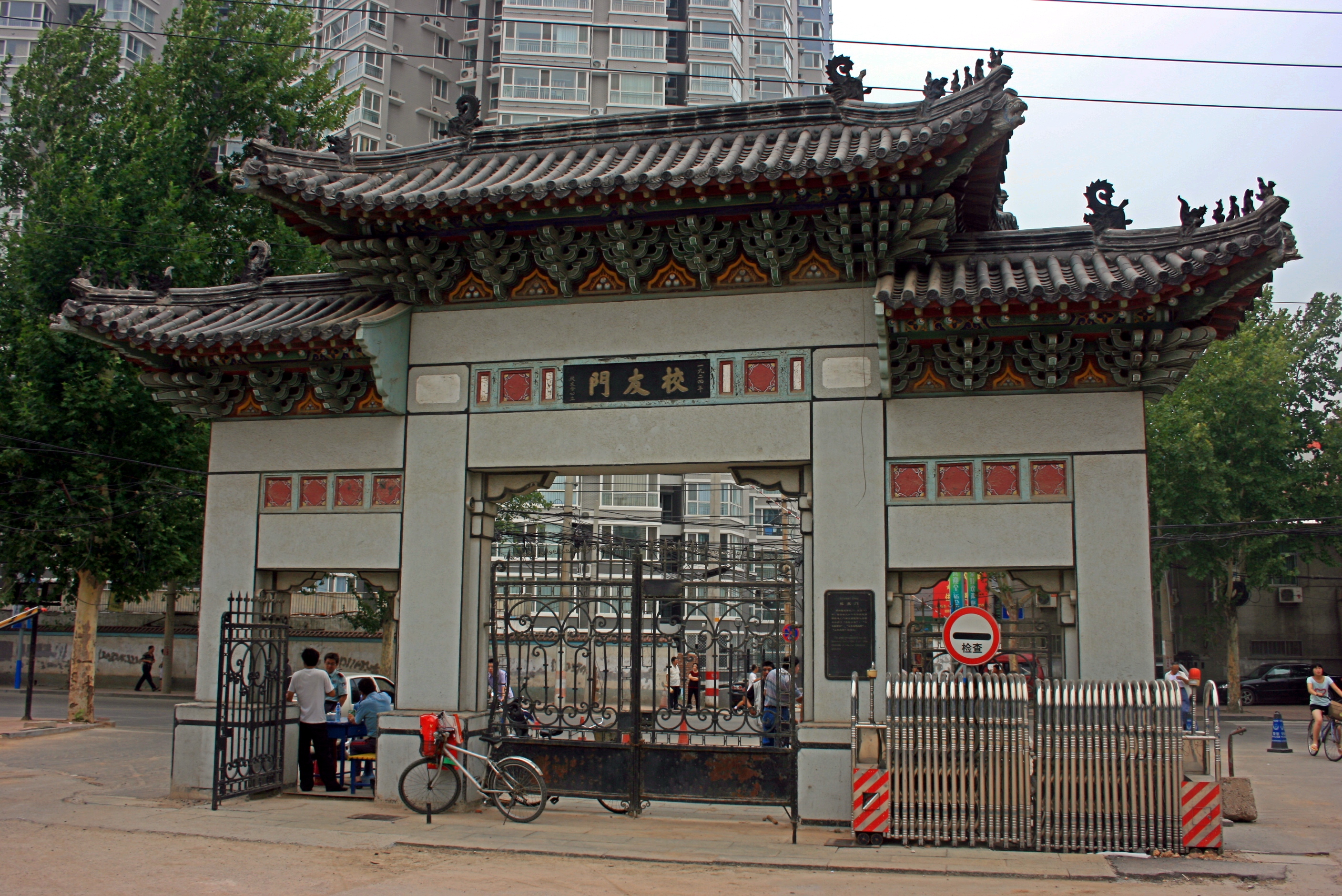
Cheeloo University
The campus that Chicago architects designed for Shantung Christian University still stands in Jinan, though the institution it was built for no longer exists. Cheeloo University, as it came to be known, grew from a boys' school founded in 1864 by the Presbyterian missionary Hunter Corbett into a full university by 1909 -- a collaboration between American Presbyterians, English Baptists, Anglicans, and Canadian Presbyterians that became one of China's premier centers of Western medicine. Its dissolution in 1952, just three years after the founding of the People's Republic, scattered its departments across half a dozen institutions. But for nearly a century, Cheeloo was where East met West in the classrooms of Shandong.
From Boys' Schools to a University
The story begins in 1864 with a modest school at Tengchow, established by Hunter Corbett for the education of Chinese boys. In 1882, Calvin Wilson Mateer converted it into Tengchow College in Dengzhou. Two years later, British Baptists founded their own theological school in Qingzhou. By 1902, the two traditions agreed to merge their Shandong operations, forming an arts college in Wei County, a theological school in Qingzhoufu, and a medical college in Jinan. The Wei County campus, known as the "Courtyard of the Happy Way," would later gain dark fame when the Japanese military converted it into a civilian internment camp during World War II. In 1909, all the colleges consolidated in Jinan as Shantung Protestant University, later renamed Shantung Christian University.
The Medical School That Drew a Nation
Between 1916 and 1923, medical departments from across China migrated to Jinan. The former Peking Union Medical College, the Medical Department of Nanking University, the Hankow Medical College, and the North China Union Medical College for Women all transferred their programs to Cheeloo. Dean Samuel Cochran oversaw their merger into the co-educational Cheeloo University School of Medicine. Women were admitted to dormitories and classes starting in 1923, and Eliza Ellen Leonard served as the first Dean of Women until illness forced her resignation in 1924 -- she died that same year. Construction on Cheeloo Hospital began in 1914 and was not completed until 1936, a pace that reflected the ambition of the project. The campus, designed by the Chicago firm Perkins, Fellows and Hamilton, centered on Bergen Science Hall, Mateer Science Hall, McCormick Hall, and Kumler Memorial Chapel.
War, Exile, and Dissolution
The Second Sino-Japanese War forced Cheeloo into exile. From 1938 to 1945, the university joined five other institutions to form West China Union University, retreating westward to continue educating students beyond the reach of Japanese occupation. After the war, Cheeloo returned to its Jinan campus. But the establishment of the People's Republic brought a different kind of transformation. In 1952, the government dissolved the university. Its College of Medicine merged with Shandong Provincial Medical College, eventually occupying the entire original campus. The College of Science went to the new National University in Nanjing. The College of Theology joined Nanking Theological Seminary. The College of Humanities was absorbed into Shandong University.
Ghosts in the Quadrangles
The roster of people who passed through Cheeloo reads like a cross-section of twentieth-century China. Lao She, one of the greatest modern Chinese novelists, taught there. Henry Winters Luce -- father of Time magazine founder Henry R. Luce -- was on the faculty. Helena Rosa Wright, a pioneer in birth control and family planning, worked at the university. Harold Balme served as Dean of the Medical School in the 1920s. The institution drew support from organizations as varied as the Rockefeller Foundation, the Harvard-Yenching Institute, and the Salt Merchants of Jinan. Though Cheeloo University existed for fewer than ninety years, its influence scattered like seeds through the institutions that absorbed its parts -- and through the students who carried its education into every corner of modern China.
From the Air
The former Cheeloo campus is located at approximately 36.65N, 117.01E in central Jinan. Jinan Yaoqiang International Airport (ZSJN) lies about 30 km northeast. The campus area is near Baotu Spring and the old city center. From the air, the university grounds are embedded within Jinan's dense urban fabric south of Daming Lake.