Cheese Board Collective
Alice Waters chose the location of Chez Panisse -- the restaurant that would help launch California cuisine -- partly so she could be near the Cheese Board. "I knew I would be among friends," she wrote. That a cheese shop on Shattuck Avenue could serve as a culinary compass for one of the most influential chefs in American history says something about what Elizabeth Magarian Valoma and Sahag Avedisian built when they opened a small European-inspired cheese counter on Vine Street in 1967. But the Cheese Board's real revolution was not gastronomic. It was structural.
The Decision That Changed Everything
In 1971, four years after founding the shop, Valoma and Avedisian did something that most business owners would consider irrational: they gave away their company. They distributed shares equally among themselves and their six employees, equalized everyone's wages, and converted the Cheese Board into a worker-owned collective. No boss. No hierarchy. Every decision made collectively, every worker an equal owner. The couple did not simply hand off a successful business -- they reinvented its operating system. The collective structure meant that the people who sliced the cheese and baked the bread also set the prices, chose the inventory, and decided the hours. It worked. More than five decades later, the Cheese Board still operates on those same principles.
Baguettes and the Birth of the Gourmet Ghetto
The Cheese Board was among the first gourmet establishments in north Berkeley, and its influence on the neighborhood was outsized. The shop helped popularize the French baguette among Bay Area consumers at a time when most Americans bought their bread pre-sliced in plastic bags. As the bakery side of the business grew, so did the variety -- sourdoughs, pastries, and baked goods that treated bread as craft rather than commodity. This was not a boutique affectation; the collective brought artisan techniques to a neighborhood storefront and made them accessible. Along with Peet's Coffee, the Cheese Board anchored what would become known as the Gourmet Ghetto, the stretch of North Shattuck that drew Alice Waters, attracted food pilgrims from across the country, and established Berkeley as a serious culinary destination.
One Pizza, No Substitutions
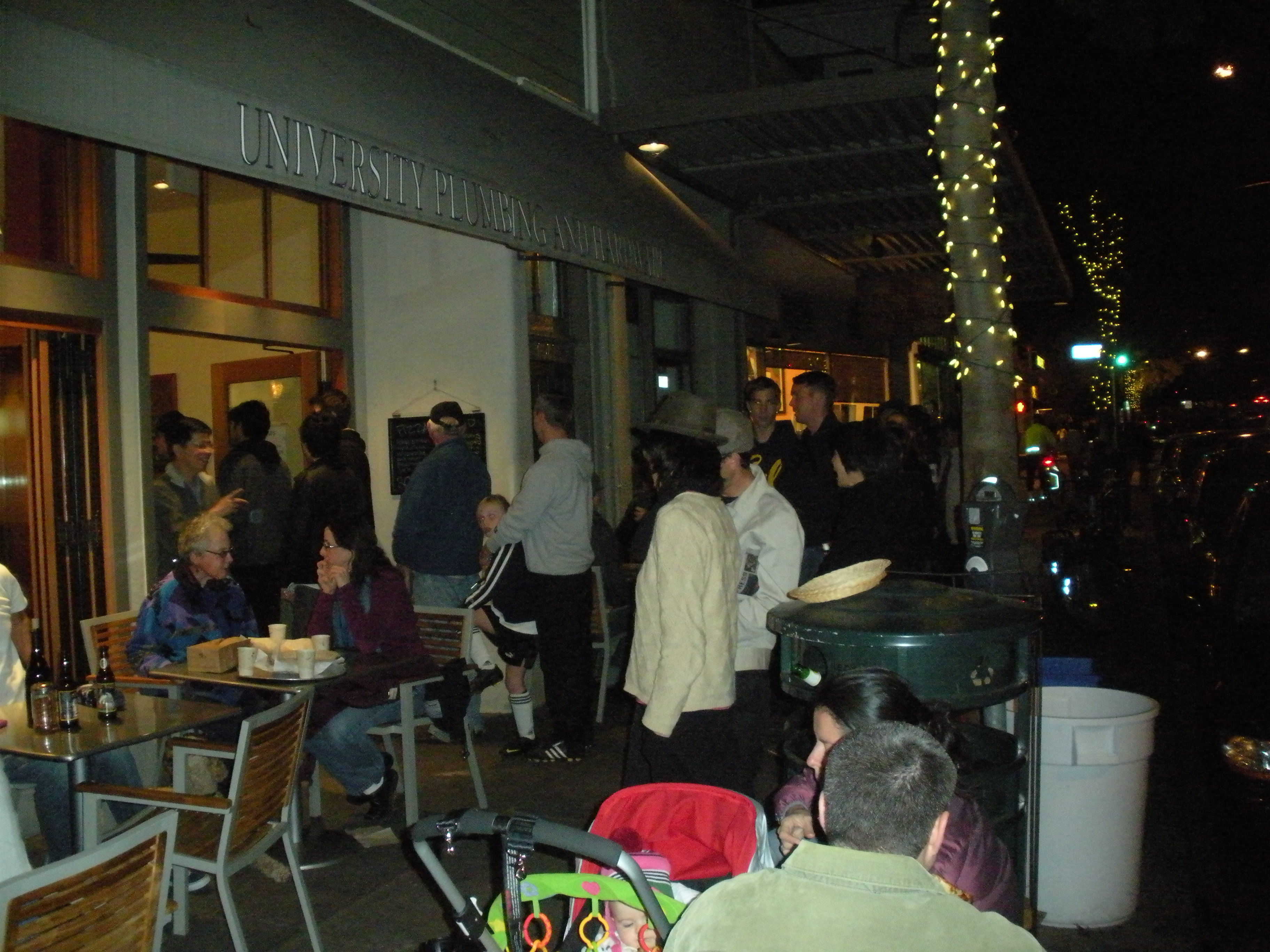
The pizzeria arrived two doors down from the original shop at 1512 Shattuck Avenue, and it operates on a principle so simple it borders on defiant: one pizza is made each day, and no substitutions are allowed. Because the same product runs continuously, every slice comes fresh from the oven without pre-ordering. Each order arrives with an extra thin sliver -- originally a way to compensate for uneven slicing, now a tradition that customers expect and love. While waiting, you draw a playing card instead of taking a number. The pizzeria was renovated in 2000 with wood-framed windows that open the dining room to the sidewalk, blurring the line between restaurant and street life. Jazz musicians often play outside during lunch, adding another layer to a scene that feels more like a daily neighborhood gathering than a commercial transaction.
Seeding the Cooperative Network
What truly distinguishes the Cheese Board is its impulse to replicate rather than expand. In 1971, the collective won the contract to operate the Swallow Collective Cafe in the Berkeley Art Museum, initially staffing it with Cheese Board members before spinning it off as an independent cooperative with as many as 30 members. In 1975, the collective funded and launched the Juice Bar Collective, then let it go its own way. In the 1980s, the Cheese Board contributed money and labor to the Intercollective, a Bay Area cooperative network that was the precursor to the present-day Network of Bay Area Worker Cooperatives. In the mid-1990s, the collective helped create the Arizmendi Association of Cooperatives, which used the Cheese Board's recipes and organizational structure to launch independent bakeries in Oakland, San Francisco, Emeryville, and San Rafael. Every Arizmendi bakery is independently owned and operated. Every one has won a local "Best Bakery" award.
The Counter on Shattuck
The Cheese Board sits at 1504 Shattuck Avenue, a storefront that has not tried to become a chain, a brand, or an empire. It has instead tried to become a template -- proving that a business can be owned equally by the people who do the work, that bread can be made with care and sold at neighborhood prices, and that success is measured not by growth but by replication. The collective published a cookbook in 2003, fittingly titled Collective Works. The members share land in Mendocino County where they built a cabin together. They hold annual beach parties and New Year's celebrations. After nearly six decades, the Cheese Board remains what it became in 1971: a workplace where nobody is the boss, the bread is excellent, and the model keeps spreading.
From the Air
The Cheese Board Collective is located at 37.880°N, 122.269°W on Shattuck Avenue in north Berkeley, in the heart of the Gourmet Ghetto neighborhood. From the air, the shop sits along the commercial corridor running north-south through Berkeley's flatlands, west of the Berkeley Hills. The nearest airport is Oakland International (KOAK), approximately 10 nm to the south. Buchanan Field (KCCR) in Concord lies about 15 nm to the northeast. The Shattuck Avenue commercial district is identifiable from moderate altitude by the dense low-rise building pattern between the UC Berkeley campus and the residential neighborhoods to the north.