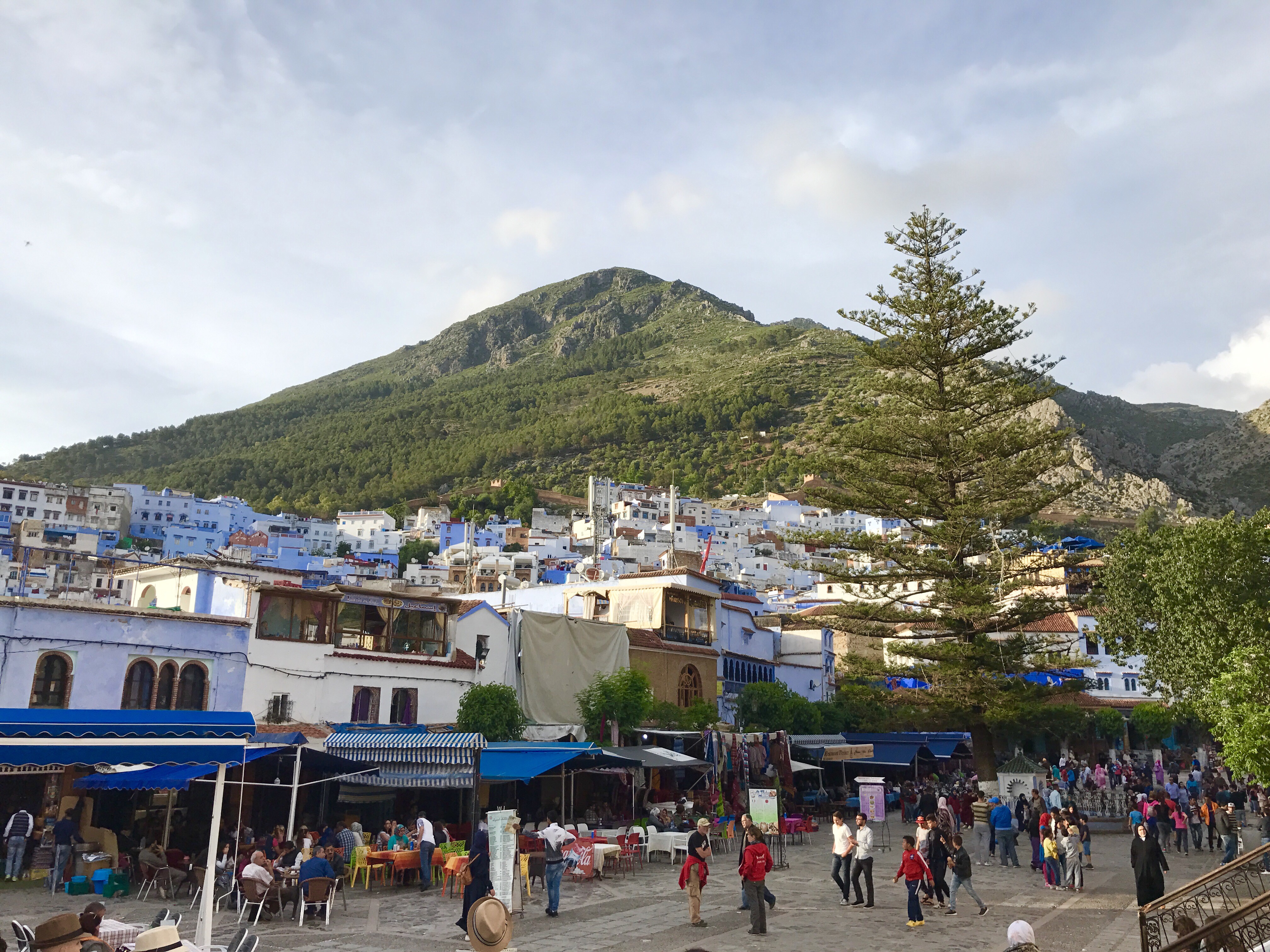
Chefchaouen
Chefchaouen is Morocco's blue city. Buildings here are painted in shades ranging from powder to indigo, creating a visual coherence no other medina can match. Founded in 1471 as a fortress against Portuguese invasion, the town grew as Andalusian refugees fled the Spanish Reconquista and Jewish settlers arrived - possibly introducing the blue painting tradition. Today 45,000 people live here, but until Moroccan independence in 1956, Chefchaouen remained largely closed to foreigners. That long isolation preserved what tourism has since discovered. The surrounding Rif Mountains enhance the architecture with dramatic backdrop, and while the region's cannabis cultivation remains present, it is not what draws most visitors.
The Blue Medina
Chefchaouen's medina is painted blue - not uniformly, but in shades that create a palette photographs can only partly capture. Why blue? The origin is debated. Some attribute it to Jewish settlers who associated blue with the sky and heaven. Others note that blue repels mosquitoes or reflects heat. Whatever the reason, the practice has intensified with tourism, the blue deepening and spreading as Chefchaouen has become a photography destination.
No other medina offers this kind of visual experience. Every surface is painted, each stair step individually blue, doorway frames competing in shade and saturation. The medina functions as a neighborhood even as it seems designed to be photographed. Residents maintain the blue partly for themselves, partly because visitors' photographs have made upkeep economically sensible.
The Mountains
Chefchaouen sits in a valley at 564 meters elevation, surrounded by the Rif Mountains. Peaks rise above the town, offering hiking trails that complement medina exploration. From a hill overlooking the blue rooftops, the Spanish Mosque provides the best viewpoint for appreciating the medina's full effect. Continue into the mountains and you find the kind of nature that visitors seeking escape from cities require.
The Rif is also Morocco's cannabis-growing region. Kif (marijuana) grows in fields hikers pass openly, cultivated by farmers in plain view. Morocco's cannabis industry operates in a gray zone - tolerated rather than legal, its complexity beyond what tourism materials address. Visitors who come for the blue may be offered hashish by touts. Those who come for the hashish find it available. The mountains hold both appeals.
The Plaza
Plaza Uta el-Hammam is Chefchaouen's central square. Cafes line its edges, providing spots where visitors rest and locals gather. On one side stands the Kasbah; nearby, the Grand Mosque raises its distinctive octagonal minaret. This is where the medina's life concentrates. Restaurants on the plaza charge more than those hidden deeper in the medina's alleys, but the convenience of visibility justifies the premium.
Here Chefchaouen reveals its true scale - a small town discovered by tourism, not a city overwhelmed by it. Visitors fill the cafe chairs, visible evidence of what the blue has attracted, while locals share the space without being displaced. The plaza remains genuinely public, a model of the kind of integration successful tourism allows.
The Jewish Heritage
After their expulsion from Spain, a Jewish community settled in Chefchaouen and shaped the town's character in ways that persist long after their departure. They developed a mellah (Jewish quarter), may have introduced the blue painting tradition, and practiced crafts that contributed to Chefchaouen's identity. Like most Moroccan Jews, they departed for Israel after independence. The heritage they left behind has since become a tourism product.
Morocco's relationship with its Jewish past is complicated by the present, so the heritage here is acknowledged rather than celebrated. Former synagogues still stand. The old mellah quarter is walkable. Traditions that may have originated with refugees are visible to those who know where to look. Chefchaouen's blue may well be a Jewish legacy, and the tourism it attracts is its modern continuation.
The Instagram Effect
Chefchaouen's blue medina has become an Instagram phenomenon. Travelers post photographs, which attract more travelers, who post more photographs. This self-reinforcing cycle has transformed the town: the blue intensifies, crowds grow, prices rise. A place isolated well into the 1950s is now firmly on the tourist circuit. Buses arrive daily from Fes and Tangier, filling the streets with visitors seeking shots they have already seen online.
The Instagram effect raises questions photogenic places face everywhere. Photography seeks authenticity, yet demands performance, and the attention it brings transforms the very thing it celebrates. Can simple beauty survive its own discovery? Chefchaouen is beautiful. Whether it remains authentically so as tourism reshapes it is the question social media success forces every such place to answer.
From the Air
Chefchaouen (35.17N, 5.26W) lies in the Rif Mountains of northern Morocco. The nearest airports are Tangier Ibn Battouta (GMTT/TNG), 115km northwest, and Tetouan Saniat R'mel (GMTN/TTU), 65km north. Tangier offers one runway, 10/28, at 3,500m. No airport serves Chefchaouen directly; access is by road only. From above, the blue medina stands out clearly in its mountain valley. Peaks over 2,000m rise throughout the surrounding Rif range. Expect Mediterranean weather with mountain influence - warm dry summers and cool wet winters, with snow possible at elevation during winter months.