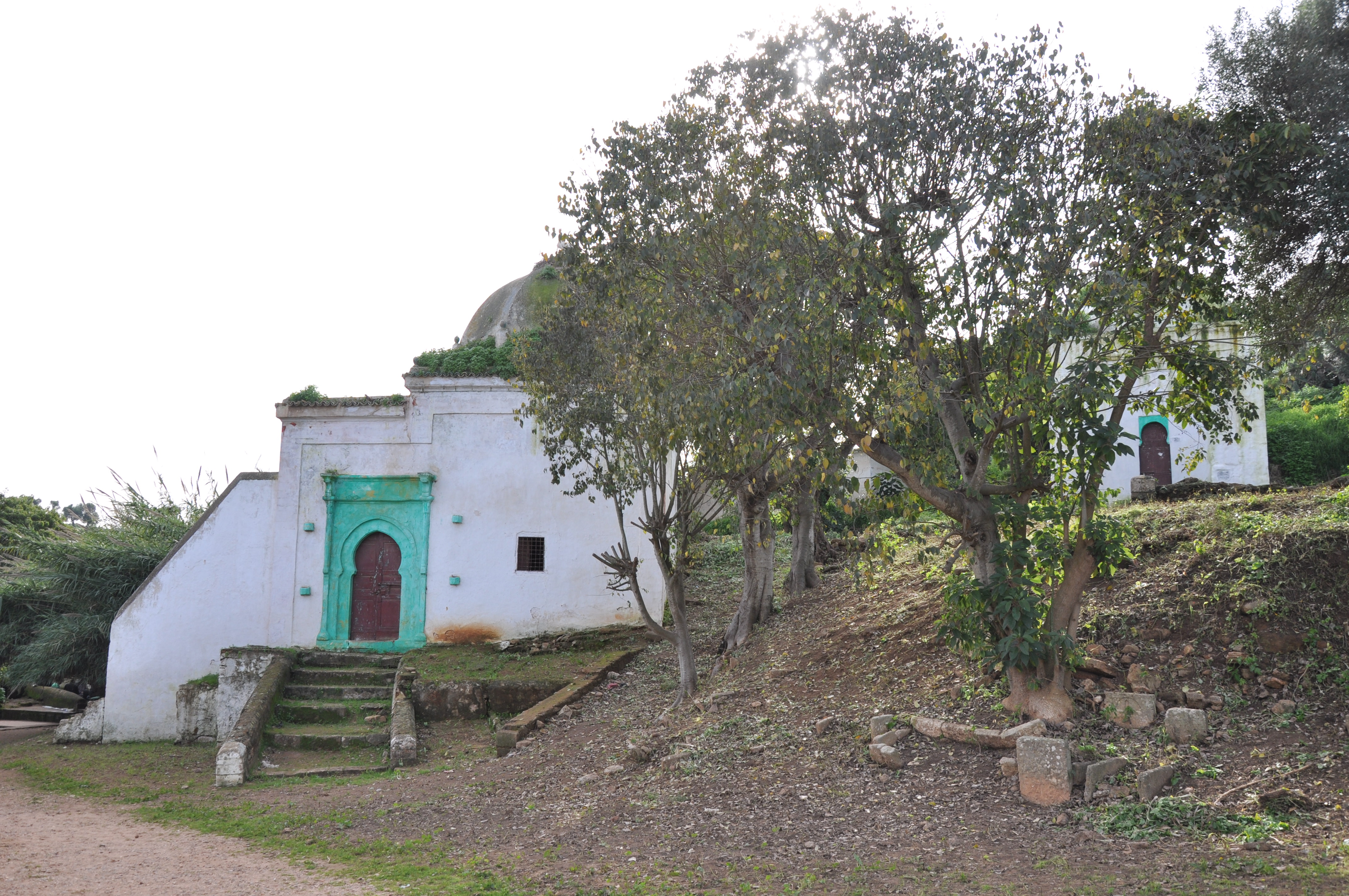
Chellah
A single tombstone in the Chellah tells the story of two thousand years in a slab of marble. One side bears a Roman inscription mentioning Aulus Caecina Tacitus, a governor of Hispania Baetica from the 3rd century AD. The other side carries the funerary inscription of a Marinid sultan, carved centuries later after the stone traveled from Roman Spain to an Umayyad fountain in Cordoba, then across the Strait of Gibraltar to this walled necropolis on the outskirts of Rabat. Every surface here has been written on, built over, and repurposed.
Sala Colonia and the Roman Footprint
Before the mausoleums, before Islam arrived in North Africa, this was Sala Colonia -- a Roman city whose monumental district covered about 1.2 hectares around a central forum. Phoenician traders had established a settlement here even earlier, drawn by the mouth of the Bou Regreg river and its access to Atlantic trade routes. The Romans formalized the site with public buildings, baths, and inscriptions honoring emperors. The excavated baths follow the classic Roman sequence: a changing room, a cold room, a warm room, and a hot room, heated by a hypocaust furnace system. Today, Roman column bases still poke through the grass at the eastern end of the site, backed by the rammed-earth walls the Marinid dynasty built eight centuries later.
The Sultan's Garden of the Dead
In the 13th century, the Marinid sultans transformed this abandoned Roman site into a royal necropolis. Sultan Abu al-Hasan built a religious complex here around 1339, complete with a mosque, a madrasa, and elaborate mausoleums. A fragment of a kiswah -- the sacred cloth that covers the Ka'ba in Mecca -- was draped over his tomb, a mark of extraordinary reverence. His son Abu Inan completed the madrasa and added the minaret that still rises, partly ruined, above the gardens. The complex was walled in rammed earth and pierced by a monumental main gate. Between 1360 and 1363, the Nasrid vizier Ibn al-Khatib visited during his master's exile from Granada and described the luxurious decoration of the tombs in his writings.
Treasure Hunters and Storks
Abu al-Hasan was the last sultan buried at Chellah. After his death, the necropolis began a long, slow decline marked by looting and neglect. The Alawi sultans stationed soldiers to guard against treasure hunters, but in the late 18th century an Arab tribe, the Sabbah, seized the enclosure and had to be forcibly removed by the governor of Sale on orders from Sultan Moulay Yazid in 1790. More looting followed. Legends of buried treasure prompted illegal excavations that pushed 20th-century authorities to relocate the most important artifacts to Rabat's museums. Henri Basset and Evariste Levi-Provencal conducted the first scholarly study of the Islamic remains in 1922. Through it all, a large colony of storks has made the ruins its own, nesting in the trees and on the broken minaret -- indifferent to the centuries passing beneath them.
Where Ancient Meets Contemporary
Today Chellah is both an archaeological park and a living cultural venue. The walled enclosure, part of Rabat's UNESCO World Heritage designation since 2012, contains shrines that still function alongside excavated ruins. The tomb of Sidi Yahya ibn Yunus, a mystic believed to have lived in the 7th century, draws visitors seeking spiritual connection. And each year, the gardens host a stage of the Mawazine music festival, filling the ancient space with contemporary sound. The juxtaposition is intentional and fitting. Chellah has never been just one thing -- Phoenician trading post, Roman forum, Marinid necropolis, contested treasure ground -- and its newest identity as a festival venue simply adds another layer to a site that has been accumulating them for millennia.
From the Air
Coordinates: 34.007N, 6.820W. Chellah sits on the southern edge of Rabat, visible from the air as a walled garden enclosure near the Bou Regreg river. The rammed-earth walls and minaret stub are identifiable at lower altitudes. Nearest airport: GMME (Rabat-Sale, 5 km north). The Hassan Tower and Mausoleum of Mohammed V are visible nearby along the riverbank.