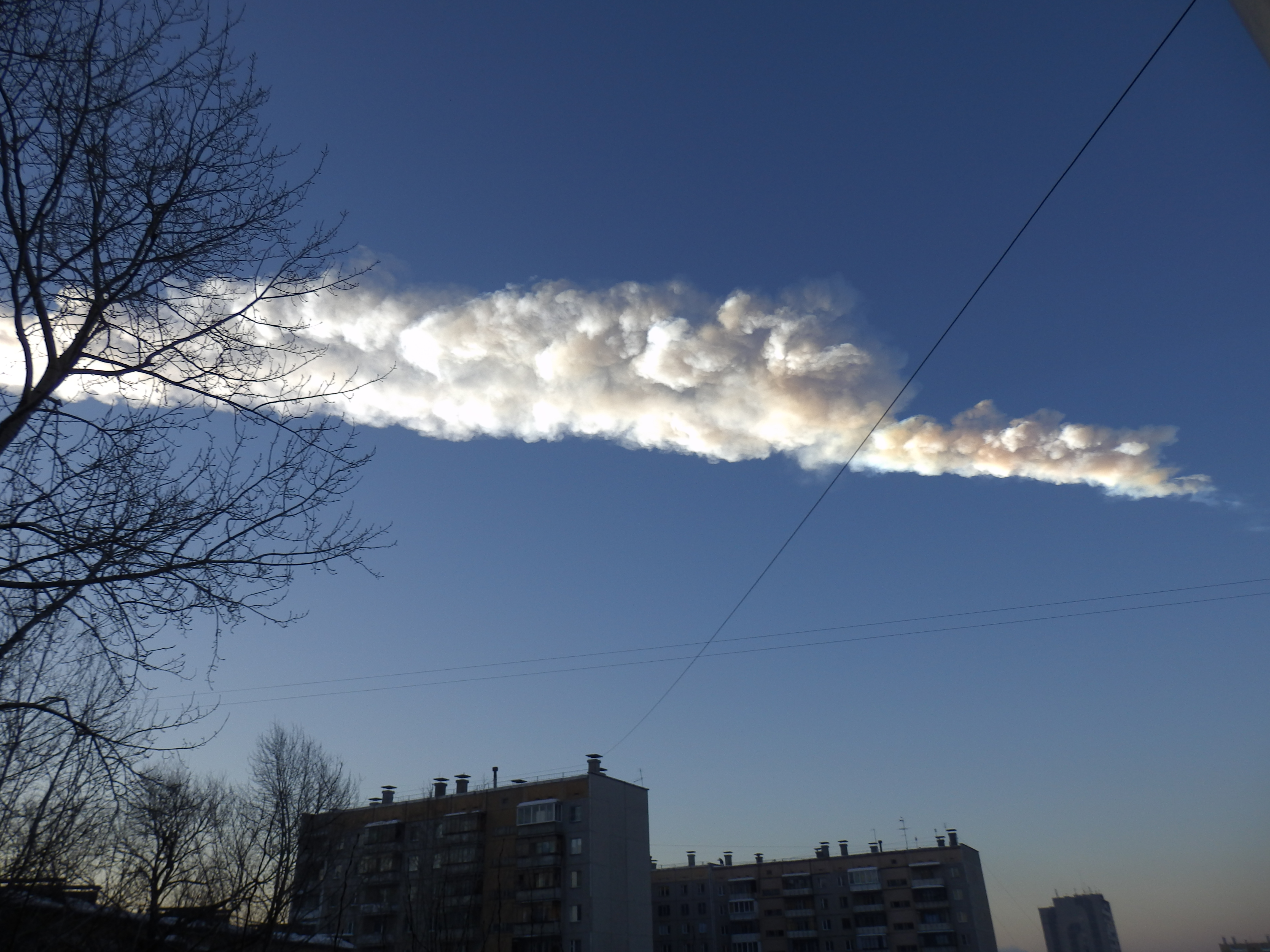
The Chelyabinsk Meteor: The Fireball That Shattered a City
At 9:20 AM on February 15, 2013, a 20-meter asteroid entered Earth's atmosphere at 40,000 miles per hour over the Russian city of Chelyabinsk. It exploded at an altitude of 18 miles, releasing energy equivalent to 30 Hiroshima bombs. The shockwave shattered windows across six cities, injuring approximately 1,500 people - mostly from flying glass. Dashcams, security cameras, and smartphones captured the event from hundreds of angles, making it the most documented meteor strike in human history. A fireball brighter than the sun crossed the morning sky, and for a terrifying moment, people wondered if they were under nuclear attack.
The Flash
The meteor appeared as a brilliant fireball in the morning sky, briefly outshining the sun. Witnesses described a second sun rising in the northeast, followed by an intense wave of heat. The fireball cast moving shadows across the snow-covered landscape. Cell phone videos show people stopping in disbelief.
The object was about 20 meters across and weighed roughly 12,000 metric tons - a small asteroid by cosmic standards. It had approached from the direction of the sun, invisible to telescopes. The first anyone knew of it was when it lit up the sky over Russia.
The Blast
The meteor didn't hit the ground - it exploded. The intense heat and pressure of atmospheric entry caused it to fragment about 30 kilometers up. The airburst released 500 kilotons of energy, 30 times the Hiroshima bomb. The fireball peaked at 2,500°C.
Then came the shockwave. About 90 seconds after the flash, a wall of pressure swept across the city. Windows exploded inward. Doors were blown off hinges. A factory roof collapsed. People who had rushed to windows to see the light were cut by flying glass. Over 7,000 buildings were damaged across six cities.
The Injured
Approximately 1,500 people required medical attention - the vast majority for lacerations from shattered glass. Two people were hospitalized with serious injuries. No deaths were attributed to the meteor. The injury toll could have been far worse.
The timing was crucial. Had the meteor arrived 20 seconds later, it would have exploded directly over Chelyabinsk's city center instead of the suburbs. Had it been slightly larger, or arrived at a steeper angle, the airburst would have been lower and more devastating. Scientists estimated a direct ground impact would have devastated a 100-kilometer radius.
The Documentation
The Chelyabinsk meteor became the most-documented impact event in history. Russian drivers commonly use dashcams to document accidents and corrupt police - those cameras captured the fireball from hundreds of angles. Security cameras, smartphones, and even a dashcam on a bus provided footage.
The documentation allowed scientists to precisely reconstruct the meteor's trajectory, speed, size, and composition with unprecedented accuracy. Fragments were recovered from a frozen lake, weighing over 600 kilograms. The main mass alone weighed 570 kilograms - the largest fragment of a witnessed meteor fall ever recovered.
The Warning
The Chelyabinsk meteor arrived on the same day that asteroid 2012 DA14 made a close pass of Earth - but the two were unrelated. The coincidence was pure chance, highlighting how busy near-Earth space actually is. Astronomers had been watching DA14 for a year; they never saw Chelyabinsk coming.
The event prompted renewed interest in asteroid detection and planetary defense. Objects the size of the Chelyabinsk meteor are difficult to spot before entry. Larger objects - potential city-killers - remain untracked by the thousands. The meteor that injured 1,500 people in 2013 was small. The next one might not be.
From the Air
Chelyabinsk (55.16N, 61.40E) lies in the southern Ural Mountains region of Russia. Chelyabinsk Airport (USCC) is the local facility. Yekaterinburg Koltsovo (USSS) is 200km north. The terrain is rolling steppe and industrial development. The meteor approached from the northeast and exploded over the southern suburbs. The main fragment was recovered from Lake Chebarkul, 70km west.