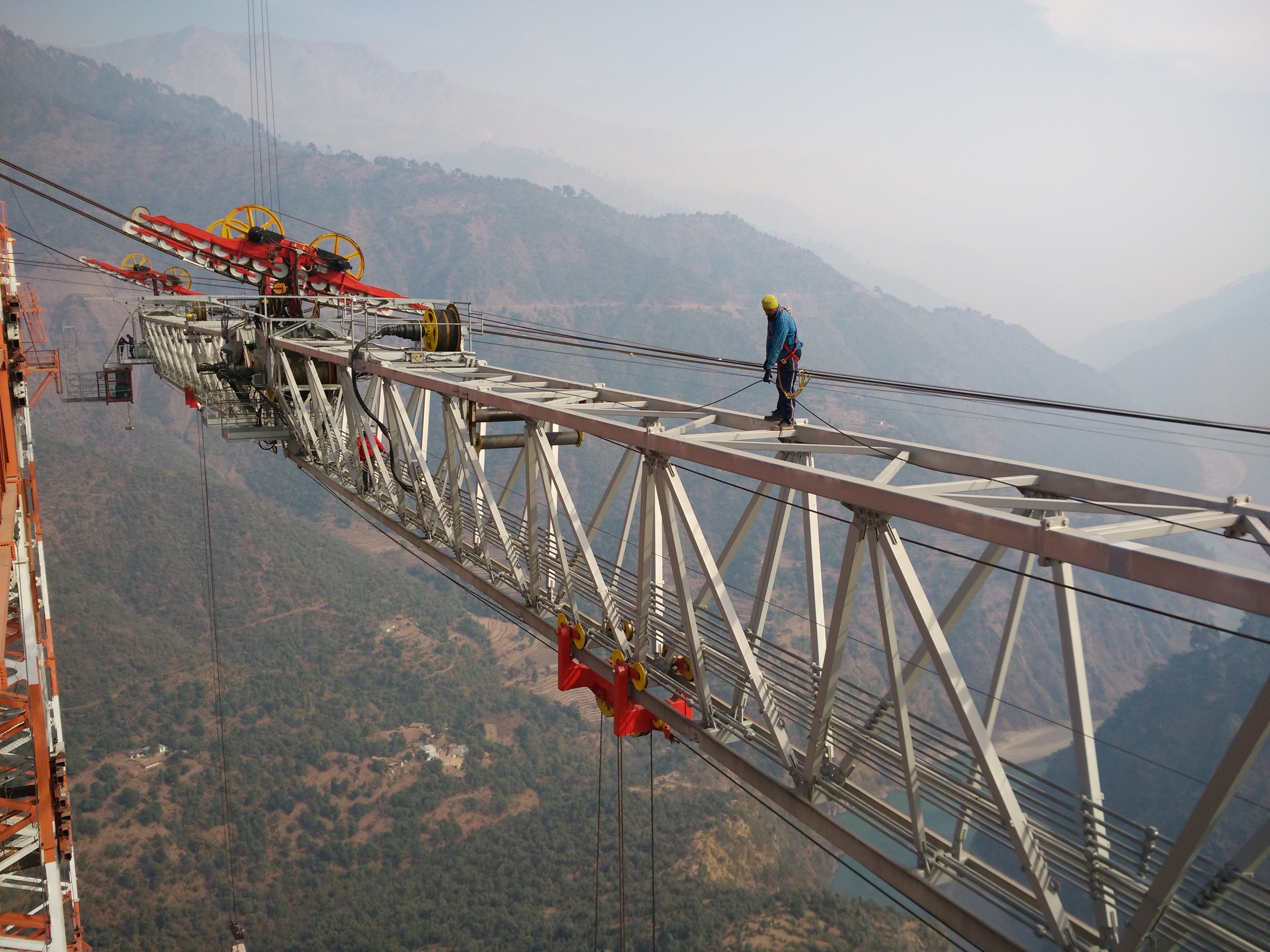
Chenab Rail Bridge
For forty years, Kashmir had no railway. The road from Jammu climbed through snowbound passes that closed every winter, cutting the valley off from the rest of India for weeks at a time. Engineers knew what a rail link would mean -- year-round access, economic connection, strategic certainty -- but the terrain between Katra and Banihal presented a problem that no Indian railway had ever faced: the Chenab River gorge, a chasm so deep that any bridge crossing it would need to stand higher than the Eiffel Tower. The Chenab Rail Bridge, opened for traffic on 6 June 2025, is the answer to that problem. Its steel arch rises from the fractured Himalayan geology of Reasi district, carrying a single rail line 359 meters above the riverbed -- the highest rail bridge on Earth.
A Dream Laid in Stone
The idea of connecting Kashmir by rail dates to the late 1970s, when the Government of India approved the Jammu-Baramulla line. The foundation stone was laid in 1983, but funding did not arrive until the mid-1990s, and the project advanced in painful increments. The Jammu-Udhampur section opened in April 2005. The Udhampur-Katra stretch followed nine years later, in July 2014. Meanwhile, a feasibility study in 1997 confirmed what surveyors had feared: the Chenab crossing, between Kauri and Bakkal stations in Reasi district, sat in India's highest seismic zone -- Zone V -- with fractured geology that made conventional foundations risky. The bridge was declared a national project, and the Indian Institute of Science was brought in to study how to anchor a structure of this scale in earth that could shake without warning.
Steel Across the Void
Konkan Railway Corporation oversaw the design: a two-part structure combining a long approach bridge with a 480-meter deck arch span. The construction contract went to Chenab Bridge Project Undertaking, a joint venture of Afcons Infrastructure, VSL India, and South Korea's Ultra Construction. Working amid the Himalayas brought logistical challenges that lowland bridges never encounter -- high winds, extreme cold, roads that themselves close in winter. Because the bridge sits exposed to harsh mountain weather, engineers developed a corrosion-resistant paint system rated for 15 years, triple the lifespan typical for Indian railway bridges. AkzoNobel handled the coating. Base supports were completed by November 2017, and the arch closed in April 2021 after years of missed deadlines and incremental progress -- by January 2020, only 83 percent of construction was finished.
The Long Wait to Cross
The bridge was structurally complete and inaugurated in August 2022, but completion of the bridge and running trains across it proved to be separate milestones. Track-laying began in February 2023 -- a single railway line across the span. Trial runs were initially targeted for January 2024, then pushed to late that year. Full-scale tests across the entire Katra-Banihal sector, including the bridge, finally took place in June 2024. An opening date of April 2025 was set and then postponed by adverse weather. On 6 June 2025, Prime Minister Narendra Modi inaugurated the bridge for regular service, launching train connections between Katra in the Jammu region and Srinagar in the Kashmir Valley. For the first time, passengers could travel by rail from the plains of India into the heart of Kashmir.
Higher Than Everything
At 359 meters above the Chenab riverbed, the bridge surpasses every other railway crossing on the planet in deck height. The scale is difficult to grasp from the ground -- from the bridge deck, the river below looks like a pale thread winding through dark rock. The gorge walls drop away sharply on both sides, and the mountains of Reasi district press in all around, their ridgelines cut by snow and cloud. The bridge was built in a region where earthquakes are a constant concern, in terrain where winter stops most construction, for a railway line that was first proposed before many of its eventual builders were born. What the Chenab Rail Bridge represents is not just an engineering record but a particular kind of stubbornness: the conviction that Kashmir should not remain isolated because the geography between it and the rest of India happens to be extraordinary.
From the Air
Located at 33.15N, 74.88E in the Chenab River gorge, Reasi district, Jammu and Kashmir. Best viewed from 5,000-8,000 feet AGL approaching from the south or west. The steel arch is visible against the gorge walls. Nearby airports include Jammu (VIJR) approximately 90 nm south and Srinagar (VISR) approximately 80 nm north. Terrain is mountainous Himalayan with elevations exceeding 10,000 feet in the surrounding area. Expect turbulence near the gorge in afternoon thermals.