Cheng Hoon Teng Temple
The incense never stops. Walk down Jalan Tokong in the heart of Malacca's old town, and the sweet haze of sandalwood and joss finds you before the temple does. Cheng Hoon Teng -- the Temple of Green Cloud -- has been burning offerings to the heavens since 1645, making it the oldest functioning temple in Malaysia. What the Portuguese built with fortresses and the Dutch with churches, the Chinese community of Malacca built with prayer halls and feng shui, and this temple has outlasted them all.
Kapitans and Carpenters
The temple's origins trace to the era of Dutch Malacca, when the Chinese community lived under the authority of appointed leaders known as Kapitans. Tay Kie Ki, a Kapitan, founded the temple site in 1645. Inscriptions within the building hint that a structure may have existed even earlier -- perhaps since 1600, during the Ming Dynasty's Wanli Reign -- though the evidence remains debated. What is certain is that in 1673, Kapitan Li Wei King brought construction materials from China to expand the complex, and in 1704, Kapitan Chan Ki Lock added the main hall that still anchors the site today. Each generation of Kapitans added something: a prayer room, a courtyard, a renovation. Kapitan Chua Su Cheong led a restoration in 1801. His son, Choa Chong Long, would go on to become the first Kapitan of Singapore, carrying the tradition of community leadership from one Straits Settlement to the next.
Three Teachings Under One Roof
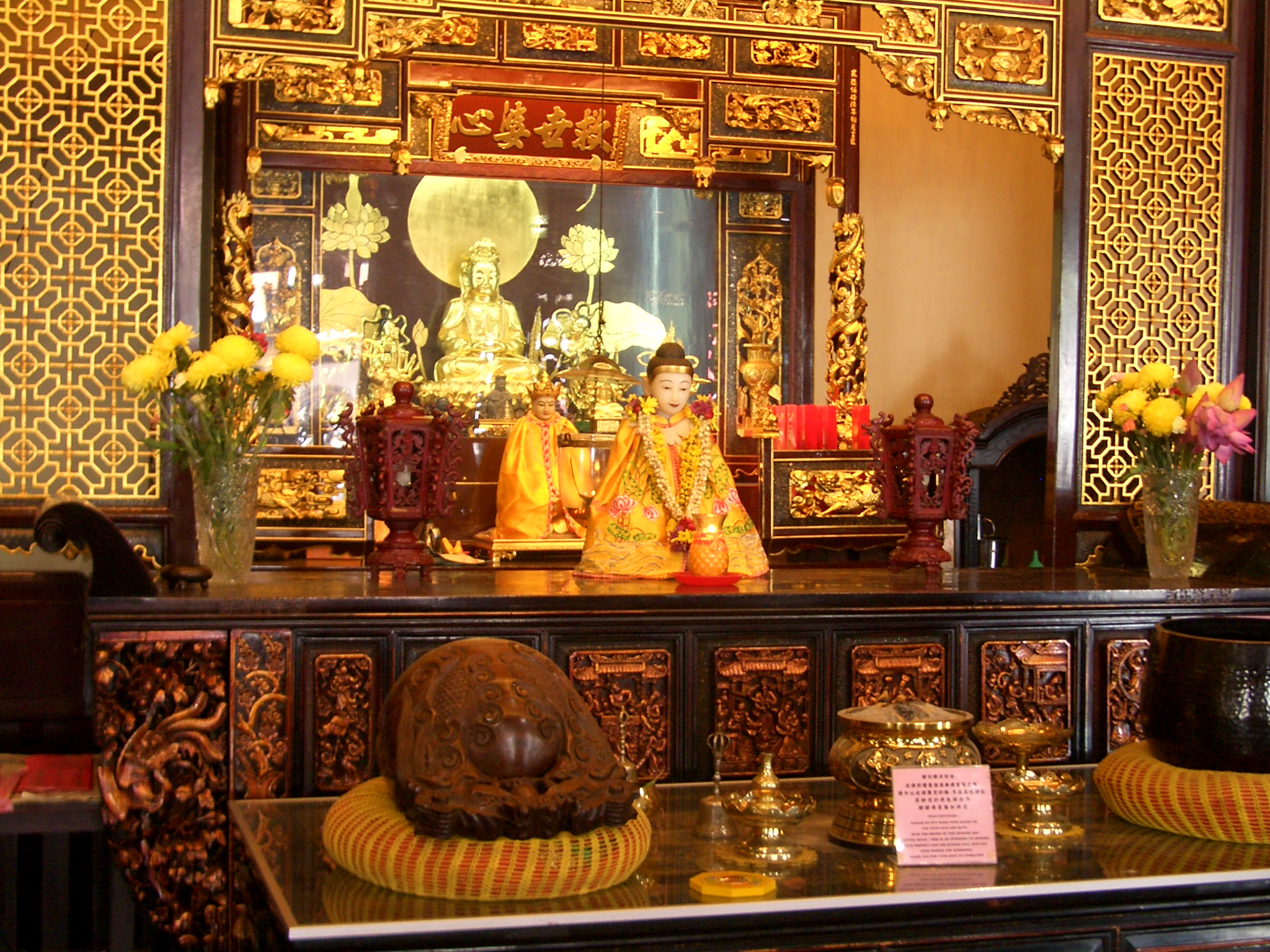
Cheng Hoon Teng practices the Three Doctrinal Systems -- Buddhism, Confucianism, and Taoism -- a syncretism that reflects how Chinese spiritual life actually works for many believers, despite what theology textbooks might insist. The main prayer hall is dedicated to Guan Yin, the Buddhist goddess of mercy, whose serene presence presides over the complex. Smaller halls honor the Chinese deities of wealth, longevity, and propagation, while another room houses ancestral tablets where families remember their dead. The temple served as the spiritual center for Malacca's Hokkien community, the Hoklo people who had sailed south from Fujian province for generations. For a diaspora community thousands of miles from ancestral villages, these halls were not just places of worship. They were anchors of identity.
Feng Shui in Stone and Timber
Nothing about the temple's placement is accidental. The entire complex follows feng shui principles, oriented to maintain a view of the river with elevated ground flanking each side. A pair of seven-meter-tall red flagpoles stands before the main prayer hall -- an uncommon feature in temple architecture that announces the building's significance from a distance. Across the road, a traditional Chinese opera theater completes the complex, a reminder that spiritual life and performance art were never separate in this culture. Stone guardians flank the entrances. The roofline erupts with ceramic dragons, phoenixes, and mythological scenes in the intricate Jian Nian style. In 2003, UNESCO recognized the temple with an award for outstanding architectural restoration, acknowledging the care that had kept these details alive across nearly four centuries.
Harmony Street
Jalan Tokong is sometimes called Harmony Street, and the name is not civic branding -- it is a statement of fact. Within a few hundred meters of Cheng Hoon Teng, you will find the Kampung Kling Mosque and the Sri Poyyatha Vinayagar Moorthi Temple, a Hindu shrine. Three faiths, three centuries of coexistence, one narrow street in a port town that has been trading goods and ideas since before the Portuguese arrived in 1511. Malacca's multicultural character was not an accident; it was the inevitable product of a harbor where Chinese, Malay, Indian, Arab, and European traders mixed for centuries. Cheng Hoon Teng is the Chinese chapter of that story -- and at nearly four hundred years old, it remains the longest-running one.
From the Air
Located at 2.197N, 102.247E in the historic center of Malacca City, on the western coast of Peninsular Malaysia facing the Strait of Malacca. The temple is in the dense old town district near the Malacca River. Nearest airport is Malacca International Airport (WMKM), roughly 8 nm to the north. From altitude, the Strait of Malacca stretches west toward Sumatra. The red rooftops of the Dutch Square area are visible nearby.