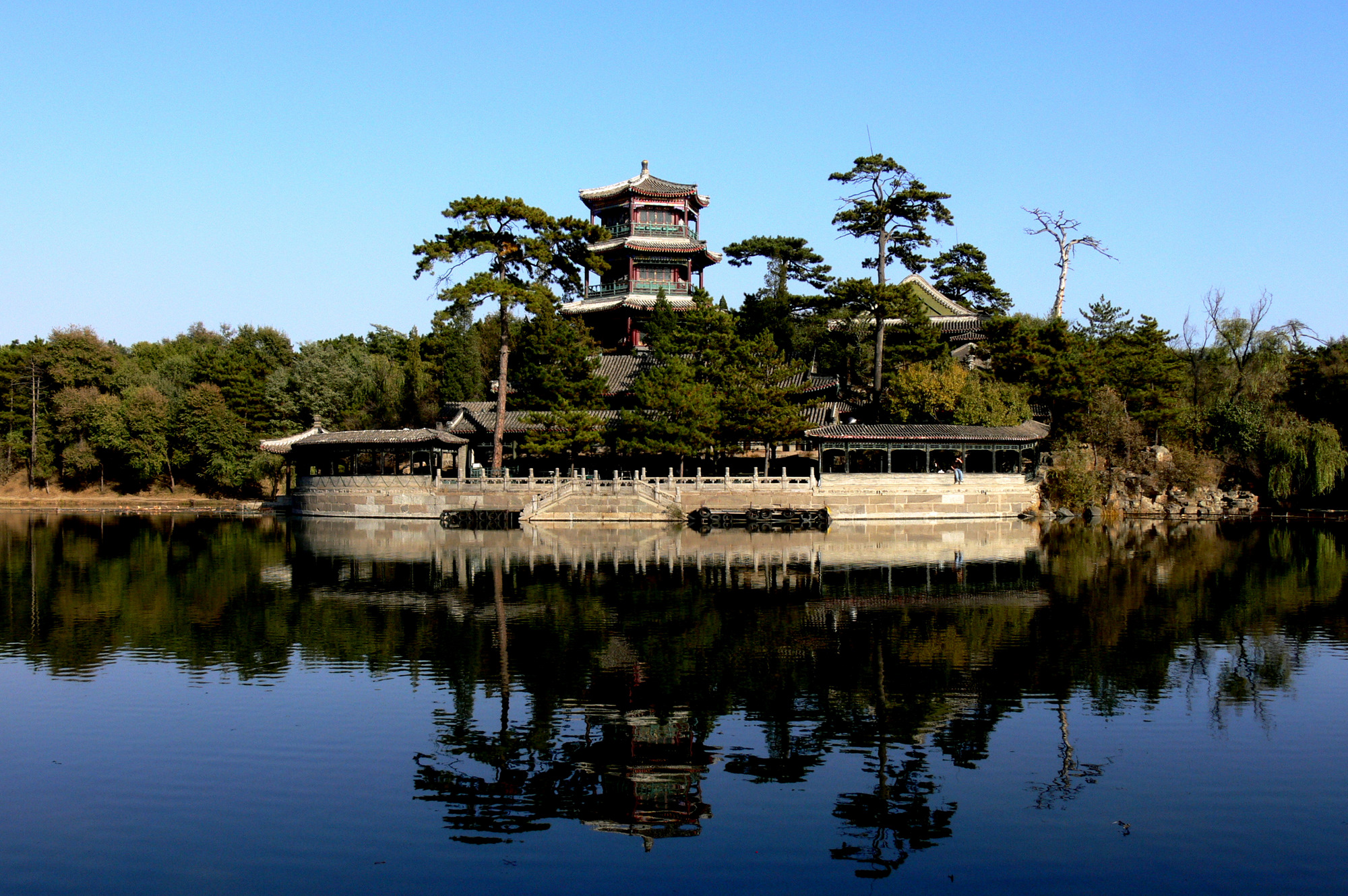
Chengde Mountain Resort
Two emperors died in the Yanbozhishuang Hall. The Jiaqing Emperor on September 2, 1820, and the Xianfeng Emperor on August 22, 1861 -- both in the same building, in the same summer retreat, 41 years apart. That hall stands within the Chengde Mountain Resort, a vast complex of imperial palaces and gardens that took 89 years to build and covered nearly half the urban area of Chengde. It was where the Qing dynasty's rulers came to escape the suffocating heat of Beijing summers. It was also, apparently, where some of them came to die.
Eighty-Nine Years of Construction
The Mountain Resort was built between 1703 and 1792, an enterprise spanning the reigns of multiple emperors and covering a total area of 5.6 square kilometers. The Kangxi Emperor initiated construction, and the Qianlong Emperor oversaw its completion and expansion. The complex was designed as more than a vacation property. The southern palace zone was modeled after the Forbidden City, creating a functioning seat of government where the emperor could receive officials, meet nobles from minority nationalities, and host foreign envoys. Behind the formal courts lay the imperial family's private quarters. Because the seat of government followed the emperor, Chengde became a political center of the Qing empire during the summer months -- a shadow capital nestled in the mountains, 225 kilometers northeast of Beijing.
Seventy-Two Named Views
The Mountain Resort is most famous for its 72 scenic spots, named personally by the Kangxi and Qianlong emperors. Many were deliberate reproductions of famous landscapes from southern China, transplanted to this northern valley as a kind of imperial greatest-hits collection. The main building on Green Lotus Island, called the Tower of Mist and Rain, was modeled after a tower at Nanhu Lake in Jiaxing, Zhejiang Province. The resort's plain area mimics the Mongolian grasslands, complete with pastureland where emperors held horse races and hunted. The lakes area encompasses eight individual lakes spread across nearly 500,000 square meters. And above it all, forested mountains and valleys contain hundreds of buildings, including a 70-meter stone pagoda built in 1751 during the Qianlong reign -- one of the tallest in China, its nine stories decorated with glazed tiles and crowned with a gilded spire.
A Miniature Empire in One Valley
The genius of the Mountain Resort lies in its ambition to condense the entire empire into a single landscape. Lakes evoke the waterways of Jiangnan. Grasslands recall the Mongolian steppe. Mountains echo the forested ranges of the north. Temples represent the religious traditions of Tibet, Mongolia, and Han China. This was not merely aesthetic variety for its own sake -- it was a political statement. The Qing rulers, who were Manchu rather than Han Chinese, governed a multiethnic empire that stretched from the Pacific coast to Central Asia. By recreating the landscapes and architectural traditions of their diverse domains within a single complex, they asserted a kind of geographical mastery, demonstrating that all of China's variety could be contained within the emperor's garden walls.
World Heritage in the Mountain Air
In December 1994, UNESCO listed the Chengde Mountain Resort as a World Heritage Site, recognizing it as a culmination of Chinese garden design and palace architecture. The resort benefits from a climate markedly different from Beijing's: located in the transition zone between warm and cold temperate regions, Chengde offers significantly cooler summers with large day-to-night temperature swings. Thundershowers are common in summer but extended heat waves are rare. The Kangxi Emperor spent 12 summers in the Yanbozhishuang Hall; the Qianlong Emperor spent 52. Their judgment about the climate was sound. Beyond the resort walls, the Eight Outer Temples -- including the Putuo Zongcheng Temple, modeled after the Potala Palace in Lhasa, and the Puning Temple with its colossal wooden statue of Avalokitesvara -- extend the complex's architectural and spiritual reach into the surrounding mountains, creating a cultural landscape that remains one of the most concentrated assemblies of imperial Chinese architecture anywhere in the world.
From the Air
Located at 40.99N, 117.94E in Chengde, Hebei Province, approximately 225 km northeast of Beijing. The resort complex is visible from altitude as a large green expanse with lake features within the urban area. The nearest airport is Chengde Puning Airport, located 19.5 km northeast. Beijing Capital International (ZBAA/PEK) is the nearest major international airport. The terrain is mountainous with the resort in a valley setting. Best viewed from 5,000-10,000 feet AGL to appreciate the full extent of the grounds.