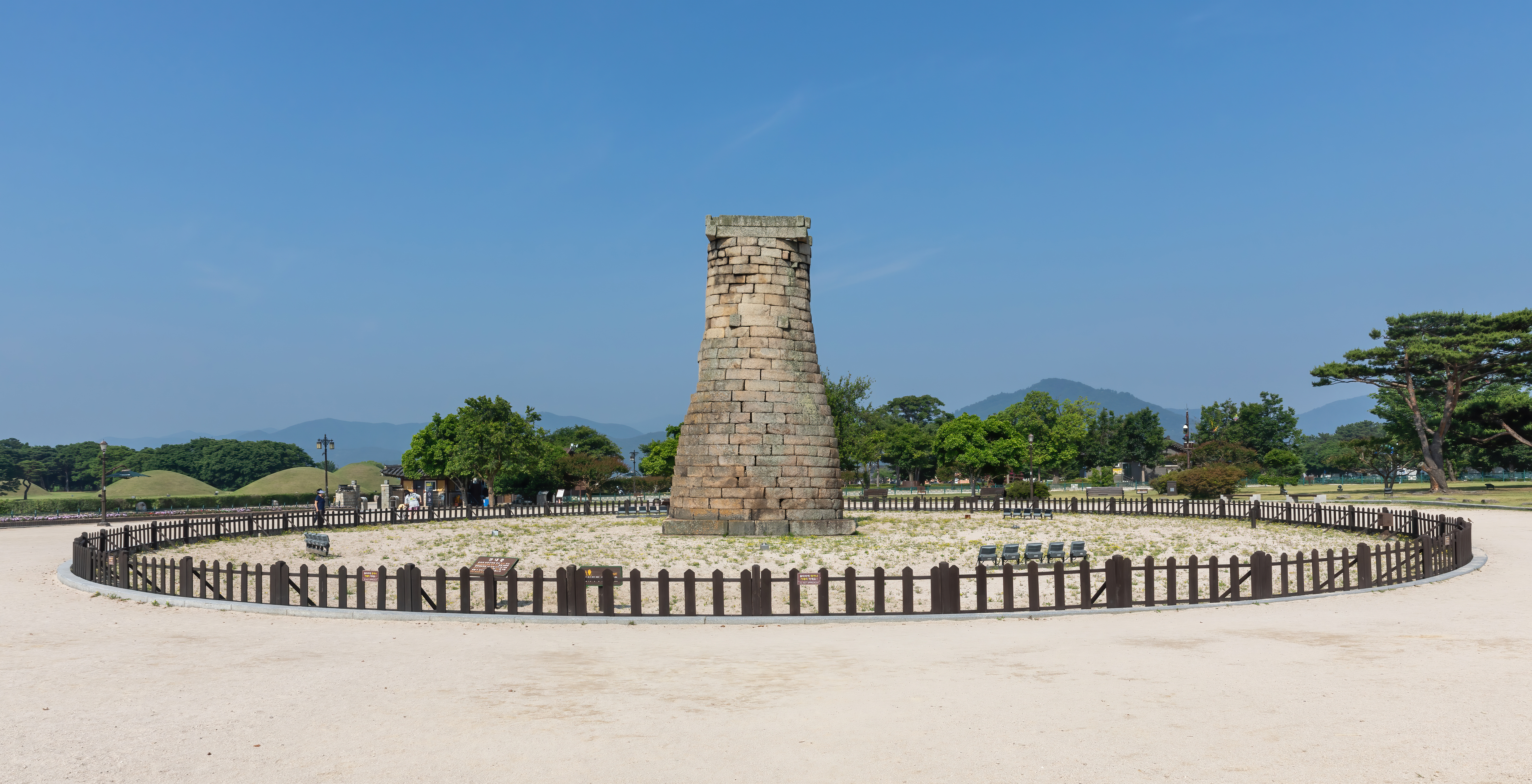
Cheomseongdae
It looks like a bottle. Nine meters tall, made of 362 cut granite stones stacked into a curved cylinder that tapers slightly toward the top, Cheomseongdae sits in an open field in Gyeongju, South Korea, looking nothing like what most people picture when they hear the word 'observatory.' There is no dome, no telescope, no obvious aperture pointed at the sky. Yet this bottle-shaped tower, built during the reign of Queen Seondeok between 632 and 647 AD, is the oldest surviving astronomical observatory in Asia and possibly in the world.
A Queen's Decree
Queen Seondeok ruled the Silla kingdom at a time when astronomy was not merely a science but a source of political power. Knowledge of celestial movements dictated the agricultural calendar, predicted eclipses, and -- critically -- legitimized royal authority. According to the popular Korean drama that bears her name, Cheomseongdae was her first act as princess: a deliberate decision to share astronomical knowledge with everyone rather than allow it to remain the monopoly of a single court figure. Whether the drama's account is historically precise matters less than what it reveals about how Koreans understand this structure. Cheomseongdae was not just a scientific instrument. It was a political statement -- the democratization of the sky.
Numbers in Stone
Every dimension of Cheomseongdae appears to encode meaning. The tower consists of roughly 362 stones, a number that some scholars link to the days of a lunar year. A square window cut midway up the body divides it into 12 layers of stones above and 12 below, corresponding to the 12 months and the 24 solar terms of the traditional Korean calendar. The square base is 5.7 meters wide, built from a single layer of 12 rectangular foundation stones. The top is also square, creating a visual riddle: a cylinder born from a square and crowned by another, as though the structure is mediating between the earth below and the heavens above. Whether these numerical relationships are intentional or coincidental has fueled academic debate since at least the 1980s, but the precision of the construction argues strongly for intent.
Observing Through Absence
How Cheomseongdae was actually used remains partially mysterious. The square window midway up the tower faces south, and it is large enough for a person to climb through, suggesting that astronomers may have observed the sky from the interior, using the opening to frame specific sections of the heavens. The window also allows sunlight to fall on the interior floor, and the shifting angle of that light through the seasons could have served as a kind of solar calendar. Some researchers believe the top of the tower, with its open square frame, served as a platform for astronomical instruments that no longer survive. The construction style parallels that of the nearby Bunhwangsa temple, suggesting that Cheomseongdae was built by the same tradition of stoneworkers who shaped Silla's sacred architecture.
Fourteen Centuries Standing
Cheomseongdae was designated South Korea's 31st National Treasure on December 20, 1962, and it forms part of the Gyeongju Historic Areas, a UNESCO World Heritage Site designated in 2000. The National Research Institute of Cultural Heritage has conducted regular inspections since 1981, and the Gyeongju municipal government oversees the site's preservation. The tower has never been rebuilt or substantially restored -- what visitors see is the same stonework that Silla-era masons set in place nearly fourteen hundred years ago. It has survived the fall of the Silla kingdom, the Goryeo and Joseon dynasties, the Japanese colonial period, and the Korean War. Standing in the field beside it, you are looking at one of the longest-running scientific instruments in human history -- older than any European observatory by roughly a millennium, and still perfectly upright.
From the Air
Coordinates: 35.83°N, 129.22°E in the historic center of Gyeongju, within the Wolseong Belt of the Gyeongju Historic Areas. The tower is small (9 meters) and best spotted at lower altitudes in the open field near the Wolseong Palace ruins. Nearest airports: RKTN (Daegu, ~80 km northwest), RKPU (Ulsan, ~40 km south). The surrounding Gyeongju basin contains numerous tumuli (burial mounds) visible as grass-covered domes from the air. Best viewed at 1,000-3,000 ft.