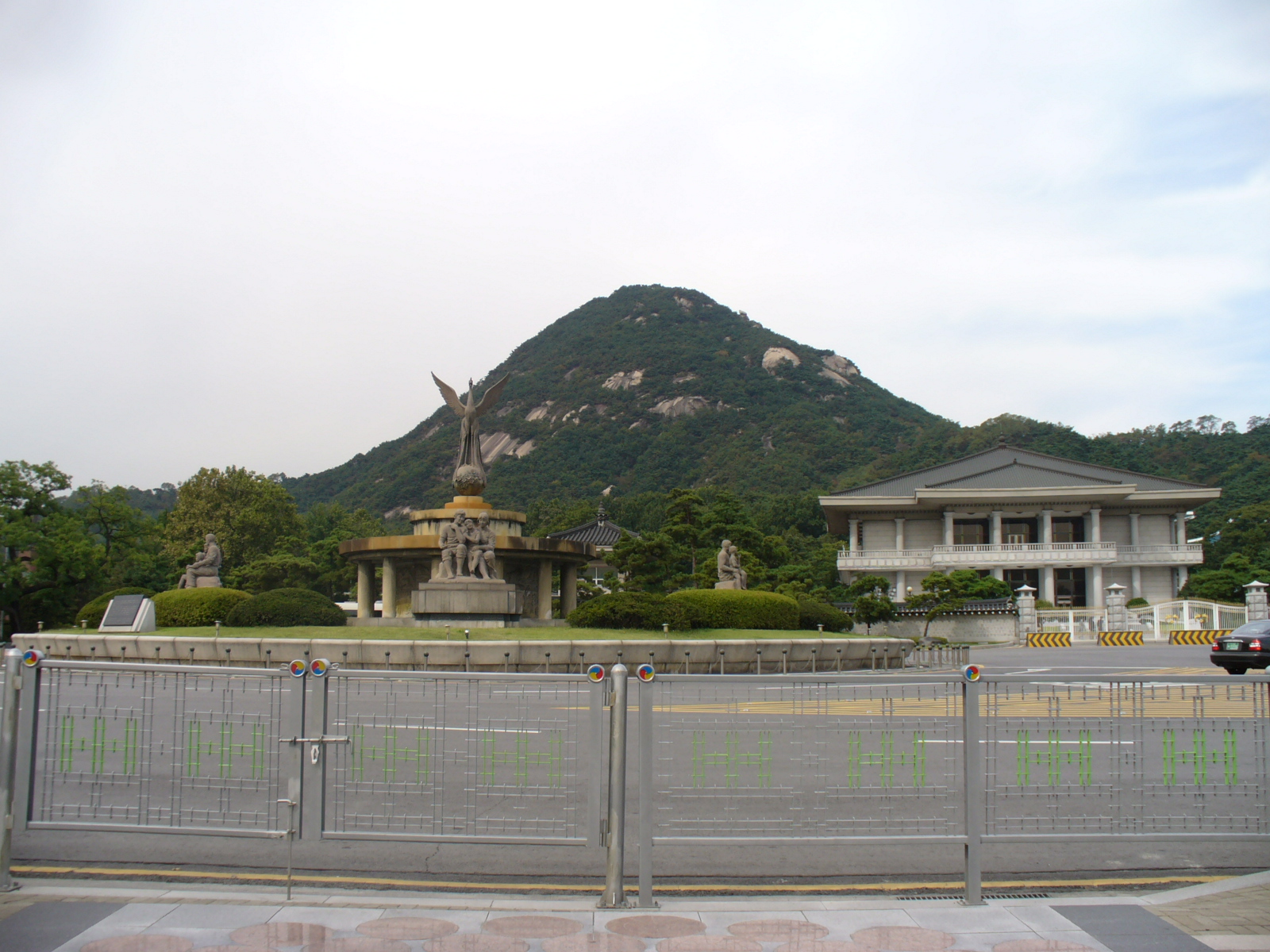
Cheong Wa Dae
The tiles are what you notice first. Approximately 150,000 of them, glazed in a distinctive blue that shifts between cerulean and slate depending on the light, covering the main building's curved Korean-style roof. Cheong Wa Dae -- literally "Blue Tile House" -- earned its English nickname the same way: the Blue House. For more than seventy years, this 62-acre compound behind Gyeongbokgung Palace served as the executive office and residence of South Korea's president, one of the most heavily guarded official residences in Asia. Its story tracks the turbulent arc of Korean democracy itself.
From Royal Garden to Power Center
The land beneath the Blue House was once the rear garden of Gyeongbokgung Palace, a retreat for Joseon monarchs dating back to the late fourteenth century. During the Japanese colonial period, the Governor-General of Korea built his official residence on the site, deliberately positioning himself behind and above the Korean palace as an assertion of authority. After Korea's liberation in 1945 and the establishment of the Republic of Korea in 1948, the first president, Syngman Rhee, took over the compound. The Japanese-built residence was eventually demolished and replaced with a new main building completed in 1991, designed by architect Kim Swoo-geun in a style that blends traditional Korean palace architecture with modern materials. The blue tiles were chosen to echo the celadon glazes of Korean ceramic tradition.
Where History Turned Violent
The Blue House became the site and target of some of South Korea's most dramatic political events. On January 21, 1968, a squad of thirty-one North Korean commandos infiltrated Seoul with orders to assassinate President Park Chung Hee inside the compound. They were intercepted just 800 meters from the main gate in a firefight that killed twenty-six of the infiltrators and several South Korean soldiers and police. The raid prompted the construction of a series of fortified checkpoints along the roads leading to Cheong Wa Dae. Park Chung Hee ultimately met his end not from the North but from his own intelligence chief, who shot him at a private dinner in 1979. Subsequent presidents faced their own crises within these walls -- military coups, democratic uprisings, corruption scandals, and impeachments all played out with the Blue House at the center.
Behind the Blue Tiles
The compound encompasses far more than its signature main building. The State Reception House, Yeongbin-gwan, hosted foreign dignitaries beneath a soaring traditional roof. The Chunchu-gwan served as the press center where presidential announcements reached the nation. Secretariat buildings, security facilities, and landscaped gardens filled out the 250,000-square-meter grounds. The natural setting, backed by the granite slopes of Bugaksan mountain, gave the compound a sense of fortress-like seclusion even though it sits barely a kilometer from the bustle of Gwanghwamun. For decades, ordinary citizens could not approach the area freely. The surrounding roads were restricted, and the mountain trails behind the compound were closed to hikers for security reasons.
Open Gates, Uncertain Future
In May 2022, newly inaugurated President Yoon Suk Yeol relocated the presidential office to the former Ministry of National Defense building in Yongsan, fulfilling a campaign pledge to make the Blue House accessible to the public. The compound opened as a park, and citizens streamed through gates that had been sealed for generations. For three years, people walked the gardens, peered into reception rooms, and hiked the mountain trails behind the residence that security had kept closed for decades. Then Yoon himself was impeached and removed in late 2024, and public debate immediately turned to whether the next president should return to the Blue House or keep the office at Yongsan. Every Korean president since 1948 has had a complicated relationship with this compound -- several left it in disgrace, under arrest, or through impeachment. The building's beauty and its curse have always been the same thing: it concentrates power in a place that feels both fortress and trap. The compound sits waiting, its blue tiles still catching the light above Gyeongbokgung, its future as uncertain as the democracy it has housed.
From the Air
Located at 37.587N, 126.975E directly behind (north of) Gyeongbokgung Palace in Seoul's Jongno District, with Bugaksan mountain rising behind it. The distinctive blue-tiled roof of the main building is visible at 2,000-3,000 ft AGL. Nearby airport: Gimpo International (RKSS), approximately 12 nm west. Note: Airspace restrictions may apply over the presidential compound area.