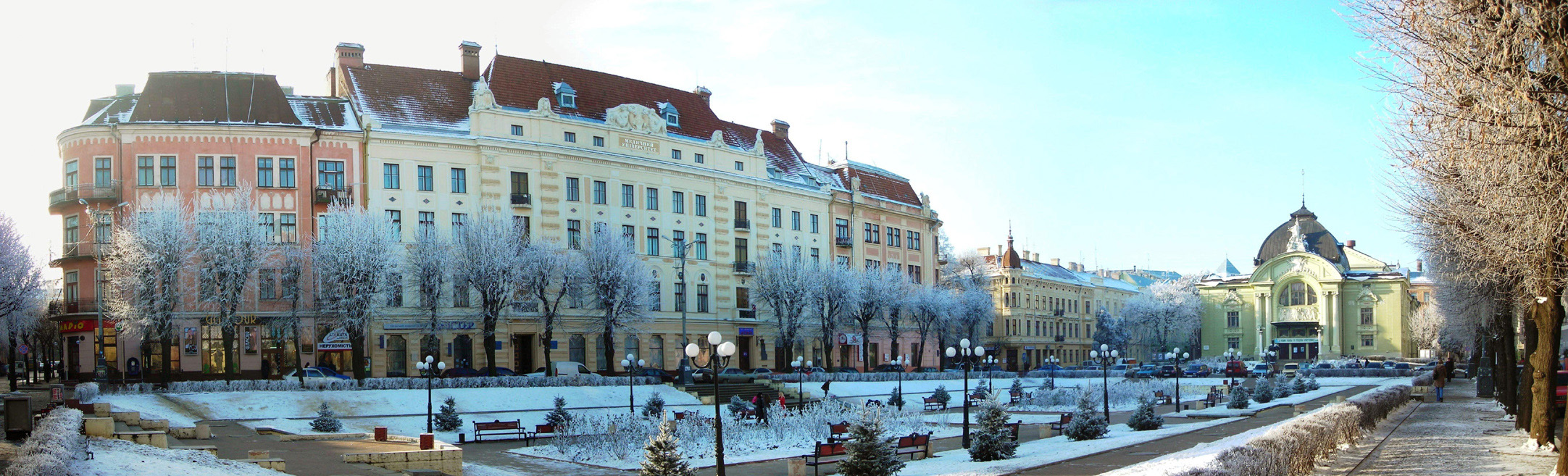
Chernivtsi
The city has had so many names that the naming itself tells its story. Chernivtsi in Ukrainian, Czernowitz in German, Cernăuți in Romanian, Chernovtsy in Russian — each name a residue of a different empire's claim. Tucked into the foothills where the Carpathian Mountains give way to the Dniester plains in Western Ukraine, this city of roughly 260,000 people has belonged to the Principality of Moldavia, the Habsburg Empire, the Kingdom of Romania, the Soviet Union, and independent Ukraine, all without moving an inch. What makes Chernivtsi remarkable is not that it survived these transitions but that it absorbed them, layering each period's architecture, language, and memory into a single walkable center.
A Fortress at the Crossroads
A fortress stood here before the 13th century, guarding a crossing point in a region contested by powers in every direction. The Mongol invasion destroyed it, but the location was too strategically valuable to abandon. The settlement passed through Polish and Moldavian hands before Austria-Hungary claimed it in 1775, making Chernivtsi the capital of the Duchy of Bukovina. Under Habsburg rule, the city entered its period of greatest development. Baroque and neoclassical buildings rose along its streets, and institutions of learning attracted scholars from across the empire. In 1875, Emperor Francis Joseph I founded a German-language university here, planting a center of higher education 740 kilometers east of Vienna. The old town that survives today is largely a product of this era — its facades still carrying the confident ornament of a provincial capital that punched above its weight.
The Vanished World of Czernowitz
By 1930, Jews made up 37% of the city's population, and Czernowitz — as the German-speaking world knew it — had become one of the great centers of Jewish intellectual life in Central Europe. German-language poets, Yiddish theater, and Hebrew scholarship all flourished here simultaneously. Then came the war. Romania, allied with the Axis powers under military dictator Ion Antonescu, confined around 50,000 Bukovinian Jews to a ghetto built within the city. Most were deported to concentration camps in Transnistria. But in the midst of this horror, Romanian city mayor Traian Popovici and sympathetic army officers managed to save roughly 20,000 Chernivtsi Jews, issuing exemption permits and bureaucratic protections at enormous personal risk. Today, the Jewish population has dwindled to about 1.2% of the city. The synagogues that once anchored entire neighborhoods have been repurposed — one now operates as a cinema. The absence is itself a kind of presence, a silence that speaks in the gaps between buildings.
Where Languages Collide
Walk through Chernivtsi and you hear Ukrainian on the streets, Russian in many shops, and occasionally Romanian near the neighborhoods where Bukovina's Romanian minority still lives — about 20% of the regional population in Northern Bukovina. A Polish minority adds yet another linguistic thread. Some elderly residents still speak German, and a handful of Jews converse in Yiddish. This is not mere diversity for its own sake; it is the living residue of centuries of overlapping sovereignty. Ukrainian is the official language and the mother tongue of most residents, rooted more deeply here in the west than in many other parts of the country. But the city's polyglot character persists, a reminder that borders move more easily than people do.
Baroque Streets and Hidden Corners
The old town is compact enough to explore on foot, its center partly pedestrianized. Baroque facades line streets that feel more Central European than Eastern — closer in spirit to Lviv or Krakow than to Kyiv. The crown jewel is the former Residence of Bukovinian and Dalmatian Metropolitans, now the main campus of Chernivtsi National University, a UNESCO World Heritage Site whose eclectic architecture blends Byzantine, Moorish, and Gothic elements into something wholly original. Beyond the center, 43 bus routes and 10 trolleybus lines connect the neighborhoods, and parks offer breathing room between the dense historical core and the Soviet-era apartment blocks on the city's edges. Nearby day trips lead to Kamianets-Podilskyi and its medieval castle, the painted monasteries of Southern Bukovina across the Romanian border, and the Carpathian highlands to the south.
From the Air
Chernivtsi sits at 48.29°N, 25.93°E in Western Ukraine, near the Romanian border in the Bukovina region. From 3,000–5,000 feet AGL, the compact old town is visible along the Prut River, with the distinctive red-roofed university complex (former Metropolitans' Residence) as the most prominent landmark. The nearest operating airport is Stefan cel Mare International Airport in Suceava, Romania (LRSV), approximately 60 km to the south across the border. The Carpathian foothills are visible to the southwest. Weather is continental with warm summers and cold winters; fog is common in river valleys during autumn and spring.