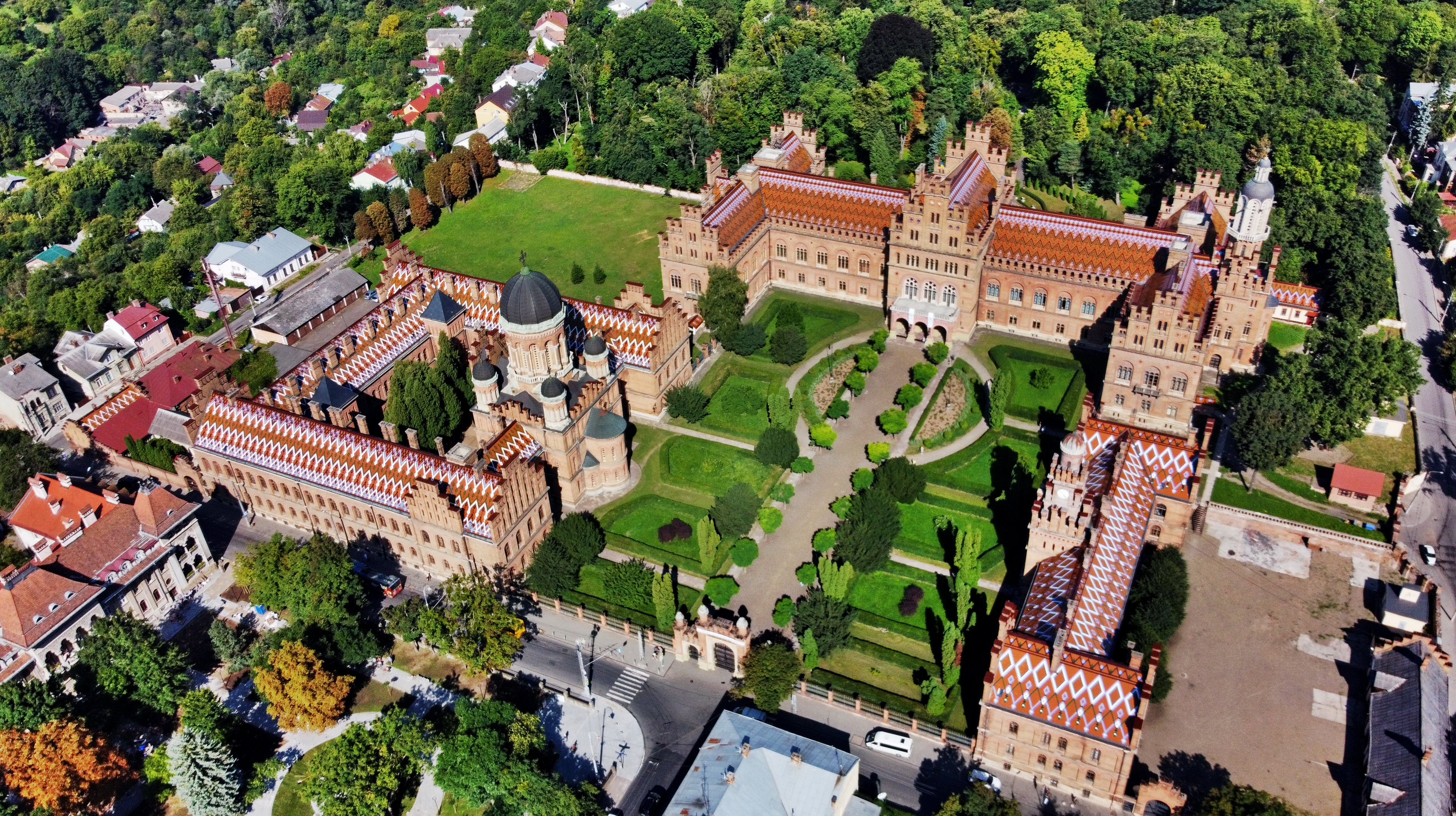
Chernivtsi University
The building looks like it belongs to a church, and in a sense it does. The main campus of Chernivtsi National University occupies the former Residence of Bukovinian and Dalmatian Metropolitans, an architectural complex so extraordinary that UNESCO inscribed it as a World Heritage Site in 2011. Byzantine domes, Moorish arches, and Gothic tracery coexist on a single campus, designed by Czech architect Josef Hlavka in the 1860s and 1870s for the Orthodox metropolitan bishops of Bukovina. That a bishop's palace became a university tells you something about the upheavals this corner of Europe has endured — and something about how institutions adapt when the ground shifts beneath them.
An Empire's Eastern Bet
When the Austrian Habsburg monarchy absorbed Bukovina in 1775, the territory was sparsely populated and far from Vienna. Emperor Joseph II settled German colonists, mainly Swabians, to anchor the new province. By the late 19th century, several German-language schools had appeared in the region, but graduates still had to travel west to attend university. After Austria lost its 1866 war against Prussia and the German Confederation dissolved, Emperor Francis Joseph I turned his attention eastward. The model was provocative: just as Germany had established the Kaiser-Wilhelms-Universitat in newly annexed Strasbourg in 1872, Austria would plant a Germanophone university 740 kilometers "beyond" Vienna. In 1875, the Franz-Josephs-Universitat Czernowitz opened with a faculty of theology, philosophy, and law, serving a multilingual population of Romanians, Ukrainians, Germans, Jews, and Poles.
Hlavka's Masterwork
Josef Hlavka, the Czech architect who designed the Metropolitans' Residence, created something that defied easy categorization. The complex blends Romanesque massing with Byzantine domes, Moorish decorative patterns, and Gothic structural elements — an architectural vocabulary as polyglot as the region it served. The ensemble covers 17 buildings with a total area of 110,800 square meters, its rooflines visible from across the city. Inside, the Marble Hall stuns with painted ceilings and ceremonial grandeur, originally built for ecclesiastical occasions but now hosting university lectures and functions. The Synodal Hall features intricate woodwork and stained glass that filter afternoon light into shifting patterns on the floor. On the grounds, the Chernivtsi Botanical Garden maintains over a thousand plant species and an arboretum tucked within the main campus. The campus's UNESCO inscription in 2011 recognizes not just the individual buildings but their coherence as an ensemble — a 19th-century vision of institutional grandeur that has outlasted the institution it was originally built for.
Six Flags, One Campus
The university's history reads like a compressed version of Central European geopolitics. Founded as an Austrian institution with German as its language of instruction, it became Romanian after World War I when Bukovina was incorporated into Greater Romania. Soviet annexation in 1940 brought Russian-language instruction and ideological reorientation. Since Ukrainian independence in 1991, the institution has operated as Yuriy Fedkovych Chernivtsi National University, named after the Ukrainian writer, poet, and folklorist who championed Ukrainian national identity in the 19th century. It received full national university status by presidential decree in September 2000, and in January 2009, the European University Association granted it full individual membership. Through each regime change, the buildings remained — the same halls, the same gardens, the same domes silhouetted against the Bukovinian sky.
Cosmopolitan Roots, Modern Reach
The university's honorary doctorate list hints at its cosmopolitan character: Leonid Kadeniuk, the first astronaut of independent Ukraine; Lina Kostenko, one of the country's most celebrated poets; Heinz Fischer, president of Austria; Ray Hnatyshyn, Canada's 24th governor general; and Roy Romanow, former premier of Saskatchewan. These connections trace the diaspora of a city whose people scattered across the globe while maintaining ties to their origins. Today the university operates institutes in biology, chemistry, physics, engineering, and computer studies alongside faculties of geography, economics, history, and modern European languages. In 2013, the first Ukrainian mystery thriller was filmed mostly on the university's grounds — proof that the campus's dramatic architecture still commands attention beyond the lecture hall.
From the Air
Chernivtsi University sits at 48.297°N, 25.924°E in Western Ukraine. From 2,000–4,000 feet AGL, the distinctive red-tiled roofs and Byzantine domes of the former Metropolitans' Residence complex are visible as the most architecturally striking structure in the city. The campus lies on the western edge of Chernivtsi's center, near the Prut River. The nearest operating airport is Stefan cel Mare International Airport in Suceava, Romania (LRSV), about 60 km south. The Carpathian foothills rise to the southwest. Continental climate with variable visibility; fog common in river valleys during transitional seasons.