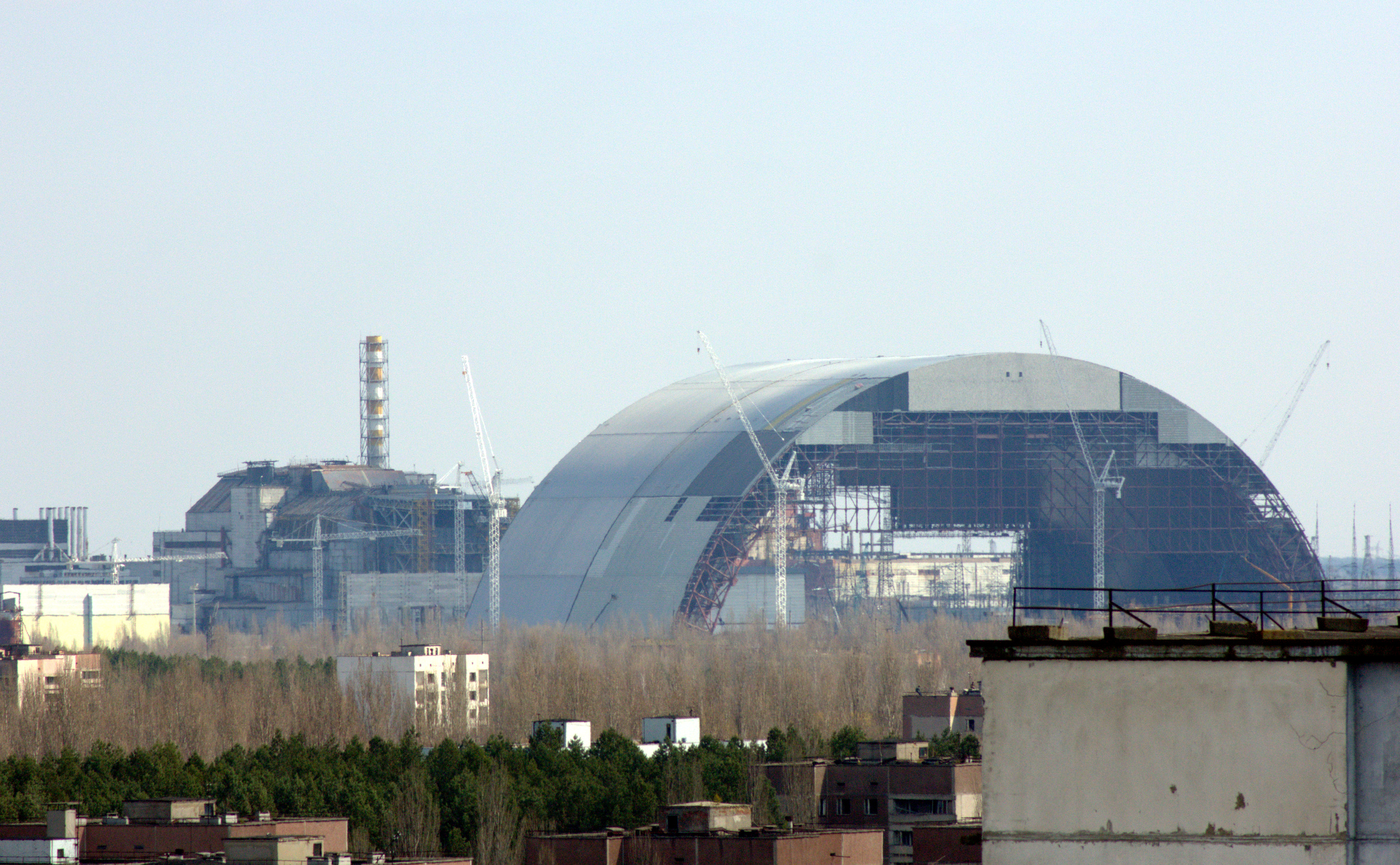
Chernobyl New Safe Confinement
It was assembled 180 meters away from where it needed to go, because building it directly over the wreckage would have killed the workers. Then, on November 14, 2016, hydraulic pistons began pushing it on Teflon pads, lasers tracking the alignment to within millimeters. Over the next 15 days, an arch the length of one and a half football fields and tall enough to swallow the Statue of Liberty crept across the cratered ground at the Chernobyl Nuclear Power Plant. When it stopped, on November 29, the New Safe Confinement covered the rotting Soviet sarcophagus that had been leaking radioactive water into the soil for thirty years.
The Numbers
The arch is 108 meters tall on the inside, 162 meters long, and spans 257 meters between its feet. It weighs roughly 36,000 tons. The structural steel is wrapped in three-layer sandwich panels, with stainless steel inside and out, and a closed atmosphere of warm, dry air circulating between the layers at low pressure to prevent the corrosion that doomed its predecessor. Dehumidifiers hold the interior below 40 percent humidity. Two overhead bridge cranes, each spanning 84 meters and rated to lift 50 tons, hang from the arches and will eventually be used to disassemble the original sarcophagus and the reactor remains beneath it. The whole project cost roughly 1.5 billion euros, financed by the Chernobyl Shelter Fund through the European Bank for Reconstruction and Development with contributions from more than 40 countries.
Why an Arch That Slides
The original Soviet shelter, built between May and November 1986 by workers who could only spend minutes at a time on the rooftop, had locked roughly 95 percent of Reactor 4's radioactive inventory inside the ruined building. It also began leaking immediately. Rain seeped through the roof, picked up contamination, and dripped into the soil. By the late 1990s, structural engineers were warning that a roof collapse could release a fresh plume of radioactive dust. The challenge was building a replacement without exposing thousands of workers to the very contamination it was meant to confine. The answer, drawn from the world of bridge launching, was to build the new structure on clean ground beside the wreckage and then slide it into place. Construction began in 2010. The French-led consortium Novarka, combining Vinci and Bouygues, did the work. Construction workers near the reactor were sometimes limited to 30 minutes on site at a time.
Designed for a Century
The arch is rated to last 100 years, long enough for crews to safely dismantle the original sarcophagus, the upper biological shield called Elena that the explosion threw nearly vertical, and the contaminated reactor remains. The current Ukrainian deadline to complete the dismantling is October 2029, though the war has scrambled every schedule on the site. Robots and remotely-operated equipment do most of the work inside. Boston Dynamics' four-legged Spot robots map radiation in zones where humans cannot enter. The foundation was designed to withstand an F3 tornado and a magnitude-6 earthquake, sitting on piles driven through a layer of contaminated soil that engineers labeled simply 'technogenic' because nothing about it resembled natural geology.
Held Open by War
On February 14, 2025, just past three years into Russia's full-scale invasion of Ukraine, a Russian Geran-2 attack drone struck the arch. It penetrated the outer cladding and damaged the inner one before fires broke out in the insulation. The innermost layer held only because the drone hit the gantry crane garage on the north side. By December 2025, the IAEA reported that the New Safe Confinement had 'lost its primary safety functions, including the confinement capability.' Repair estimates began at 25 million dollars and have grown. In October 2025, Russian airstrikes on the nearby company town of Slavutych cut power to the structure for three hours, and President Zelensky accused Russia of deliberately courting a nuclear incident. The arch is still standing, still doing most of its job, and the EBRD has pledged repair funding for 2026. But the most expensive containment structure ever built was supposed to be the last word on Chernobyl. The war made it a sentence still being written.
From the Air
Coordinates 51.389 N, 30.099 E. The arch dominates the Chernobyl Nuclear Power Plant complex, visible as a bright silver hemisphere from cruising altitude on clear days. Pripyat lies 3 km north, the cooling pond extends south to the Pripyat River, and the town of Slavutych is about 50 km east. Closest civilian airports: UKKK (Kyiv Zhuliany, ~110 km south) and UKBB (Boryspil, ~130 km southeast). Ukrainian airspace is closed to civil traffic during wartime; this region has been an active-conflict overflight zone since 2022.