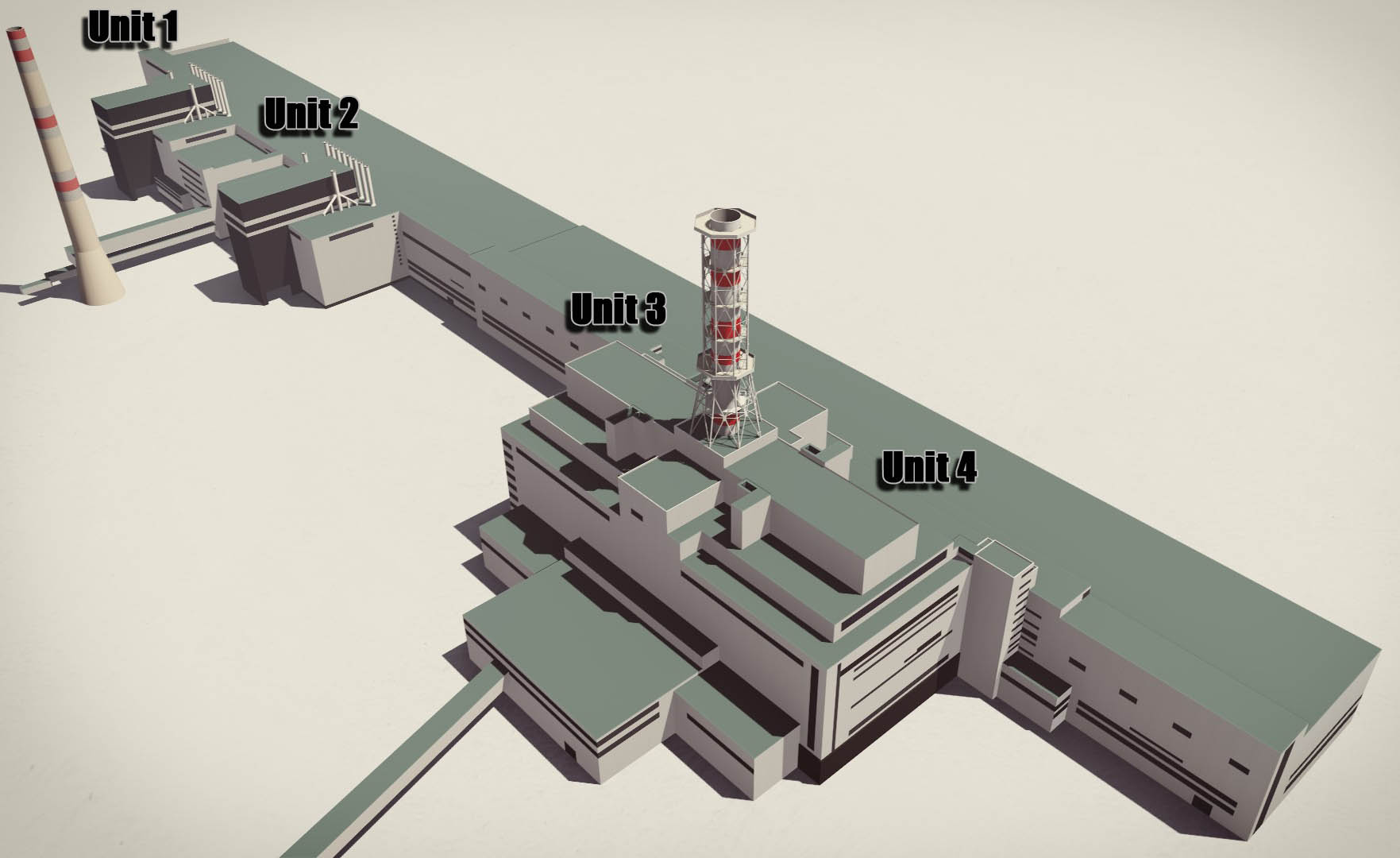
Chernobyl Nuclear Power Plant
The plant was supposed to grow into the largest nuclear power station on Earth. Twelve reactors had been planned across two sites flanking the Pripyat River, with cooling water drawn from a pond engineered for the purpose. By the spring of 1986, four were operating, two more were rising at roughly seventy percent completion, and the rest were on the drawing board. Then Reactor 4 ate itself during a safety test, and history split into before and after. What is striking, looking back, is how much of the plant kept working. Reactors 1, 2, and 3 stayed online. They generated electricity for years - in some cases more than a decade - while their wounded sibling smoldered behind a hastily-built shelter just down the corridor.
An Atom-City on the Pripyat
Construction began in 1972 about 16 kilometers northwest of the old town of Chernobyl, near the Pripyat River about 100 kilometers north of Kyiv. The plant was officially the V. I. Lenin Nuclear Power Plant, named for the founder of the Soviet Union. The four RBMK-1000 reactors that came online between 1977 and 1983 each produced 1,000 megawatts of electricity, together supplying about 10 percent of Soviet Ukraine's grid. To house workers and their families, planners built the new city of Pripyat from scratch a few kilometers away - an atomograd, or atom-city, of 50,000 people, with the youngest median age of any Soviet city. The site manager during construction, Vasilii Kizima, ran an operation that involved more than twenty specialized organizations. Many of his welders had served in tank units, valued for their physical endurance.
The Reactor Type That Failed
The RBMK design was unusual. It used graphite as a moderator and water as a coolant, an arrangement that gave the reactor a positive void coefficient at low power - meaning that under certain conditions, losing coolant could increase, rather than decrease, the chain reaction. KGB documents declassified in 2021 confirmed that as early as 1983, Soviet officials in Moscow knew the Chernobyl plant was 'one of the most dangerous nuclear powerplants in the USSR,' partly because of structural problems in the steam separator rooms. There had also been a partial core meltdown in Reactor 1 in September 1982, kept secret for years. The 1986 disaster did not come out of nowhere. It came out of a design that prioritized cheap, scalable construction and a culture that suppressed inconvenient truths.
Three Reactors Kept Running
After the explosion, the remaining three reactors were decontaminated and restarted - Reactor 1 on October 1, 1986, Reactor 2 on November 5, 1986, Reactor 3 on December 4, 1987. Together they produced 271 terawatt-hours of electricity over their post-disaster lifetimes. Reactor 2 went down in October 1991 after a turbine fire. Reactor 1 was retired in 1996 under pressure from the European Union, and Reactor 3 followed on December 15, 2000, the day the plant stopped generating electricity altogether. In exchange, the EU helped Ukraine finance two replacement reactors at Khmelnytskyi and Rivne, plus the long-delayed shelter project that became the New Safe Confinement. Decommissioning of the surviving reactors will continue, on current estimates, until 2065.
Soldiers in the Trenches
On February 24, 2022, Russian troops crossed the border from Belarus and seized the plant on the first day of the full-scale invasion. They held it for 35 days, using the Chernobyl complex as a staging ground for the failed thrust toward Kyiv. Plant workers were forced to keep running safety systems for nearly two weeks under armed guard. Russian soldiers reportedly dug trenches and fighting positions in the Red Forest, the most contaminated patch of woodland on the site, and several were later treated for acute radiation sickness; at least one died. By April 2, 2022, Russian forces had withdrawn and the Ukrainian flag was raised over the plant again. In February 2025, a Russian Geran-2 drone struck the New Safe Confinement directly, breaching its outer cladding. The plant that helped end the Soviet Union has spent its post-Soviet decades being decommissioned, slowly, while history kept showing up to interrupt the work.
From the Air
Coordinates 51.39 N, 30.10 E. The plant sits on the south bank of the Pripyat River, 16 km northwest of the town of Chernobyl and about 100 km north of Kyiv. From cruising altitude in clear weather, the silver dome of the New Safe Confinement is the most visible landmark, with the rectangular cooling pond stretching south to the river. Closest civilian airports: UKKK (Kyiv Zhuliany, ~110 km south), UKBB (Boryspil, ~130 km southeast), UMGG (Gomel, Belarus, ~110 km north). Ukrainian airspace closed to civil traffic during wartime; this is an active conflict zone.