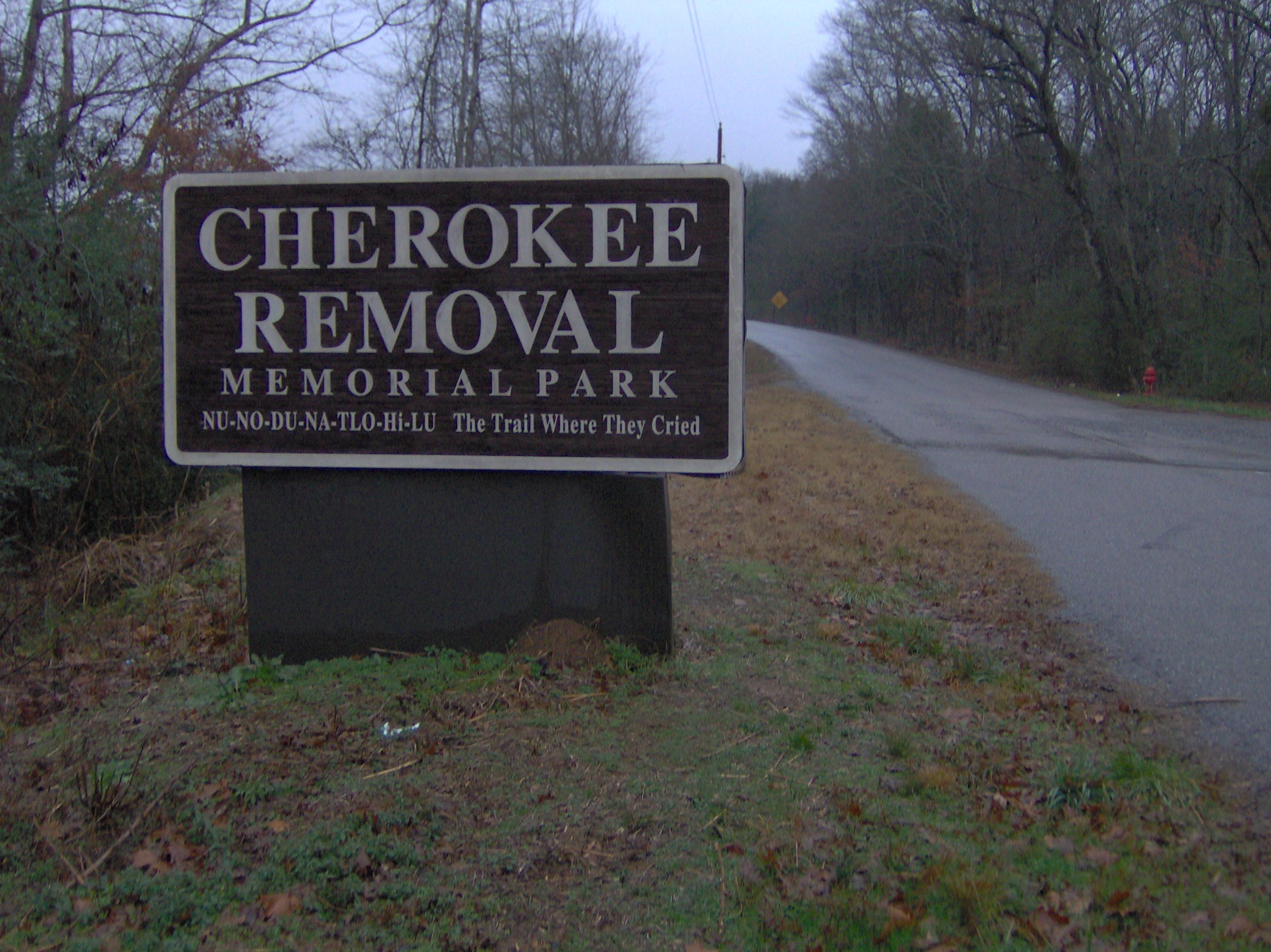
Cherokee Removal
On December 30, 1835, twenty-one Cherokee men stepped forward inside a council house at New Echota, Georgia, and signed away a nation. They represented a fraction of the Cherokee people -- perhaps five hundred out of thousands had even answered the summons. Principal Chief John Ross, the elected leader of the Cherokee Nation, refused to sign. But the Treaty of New Echota was ratified by the U.S. Senate by a single vote, and it set in motion one of the most devastating chapters in American history: the forced removal of an estimated 15,500 Cherokee and 1,500 enslaved African Americans from their homeland to Indian Territory west of the Mississippi. The Cherokee called what followed Nu na da ul tsun yi -- the place where they cried.
A Nation That Refused to Vanish
The Cherokee had done everything European-American society asked of them. They adopted a written constitution on July 26, 1827, declaring themselves a sovereign nation. They established a capital at New Echota near present-day Calhoun, Georgia. They had their own written language, created by Sequoyah. Their Principal Chief, John Ross, won office through democratic election. When the Cherokee government saw the writing on the wall, they passed a law in 1828 making it treasonous -- punishable by death -- to sign away Cherokee land without the nation's consent. But Georgia wanted what lay beneath Cherokee soil. The discovery of gold near Dahlonega in 1828 triggered a gold rush, and 1.7 million tillable acres of prime cotton land made the territory irresistible to a state drunk on King Cotton's profits. Georgia declared sovereignty over Cherokee territory and deployed armed guards to enforce it.
A Treaty Signed in Shadows
Andrew Jackson's landslide reelection in 1832 convinced some Cherokee that resistance was futile. Major Ridge, his son John Ridge, and nephew Elias Boudinot formed the Treaty Party, believing negotiation was better than waiting for white squatters and state violence to make things worse. But Chief Ross and the vast majority of the Cherokee people stood firm. In February 1836, two councils produced lists totaling 13,000 names -- written in Sequoyah's Cherokee script -- of citizens opposed to the treaty. Congress ratified it anyway. The Cherokee were given until May 1838 to leave voluntarily. Almost no one did. General John E. Wool, dispatched to oversee the process, reported that the Cherokee were 'almost universally opposed to the Treaty.' Only about 2,000 Cherokee, mostly Ridge Party members, accepted government funds and moved west on their own.
Rounding Up a People
On April 23, 1838, Ralph Waldo Emerson wrote to President Martin Van Buren, urging him not to inflict 'so vast an outrage upon the Cherokee Nation.' The letter changed nothing. General Winfield Scott established headquarters at Fort Cass in Charleston, Tennessee, and on May 26, soldiers began rounding up Cherokee in Georgia at gunpoint. Within three weeks, men, women, and children across four states were forced from their homes, often with nothing but the clothes they wore. About 1,000 Cherokee escaped into the mountains of North Carolina. The rest were herded into eleven internment camps -- Fort Cass, Ross's Landing in present-day Chattanooga, Red Clay, Rattlesnake Springs, and others. That summer, dysentery and disease swept through the camps, killing 353 people before the march even began. A petition to General Scott for a delay until cooler weather was granted, and Chief Ross, finally accepting defeat, negotiated to supervise the remaining removal himself.
The Road West
The journey unfolded in waves of suffering. The Army's initial boat detachments down the Tennessee River proved disastrous -- Captain Gustavus Drane's group of 1,072 people arrived with only 635, having lost 146 souls along the way. Drought lowered the rivers, stranding flatboats on shoals. Scott suspended the Army-run removals and turned the operation over to Chief Ross and twelve Cherokee-supervised wagon trains. Through fall and winter of 1838, roughly 11,000 Cherokee walked west. During the journey, the people sang 'Amazing Grace' -- the hymn had been translated into Cherokee by missionary Samuel Worcester -- using its verses to sustain morale against unimaginable hardship. An estimated 3,500 Cherokee and enslaved people died during the removal. Those who survived settled near Tahlequah, in what is now Oklahoma.
What Endures
The political fallout was swift and bloody. Major Ridge, John Ridge, and Elias Boudinot -- the men who had signed the treaty -- were assassinated shortly after arrival in Indian Territory. Only Stand Watie escaped his killers. But the Cherokee Nation endured. In North Carolina, about 400 Cherokee living on privately owned land along the Oconaluftee River in the Great Smoky Mountains were not subject to removal. They became the Eastern Band of Cherokee Indians, still based in Cherokee, North Carolina today. The Cherokee Nation itself eventually rebounded to become the largest American Indian group in the United States. In 1987, Congress designated the Trail of Tears National Historic Trail, stretching across nine states. The land the Cherokee were forced to leave -- the strategic corridor between the Appalachian Piedmont and the Tennessee River Valley at Chattanooga -- became the foundation for Atlanta's rise as a transportation hub. The wealth the Cherokee built there passed to other hands, but the Cherokee themselves proved impossible to erase.
From the Air
Located at 34.54°N, 84.91°W near New Echota, the Cherokee capital near present-day Calhoun, Georgia. The site sits in the Ridge and Valley region of northwest Georgia, where the Appalachian foothills meet the Piedmont. From altitude, the strategic geography becomes clear: the natural corridors between the Chattahoochee River and Chattanooga that made this land so coveted. Nearby airports include Richard B. Russell Regional Airport (KRMG) in Rome, GA, and Cornelius Moore Field (KCZL) in Calhoun. The Trail of Tears National Historic Trail stretches across nine states from here to Oklahoma. Look for the junction of ridges and valleys that defined Cherokee territory -- the same landscape that later became crucial railroad and highway routes.