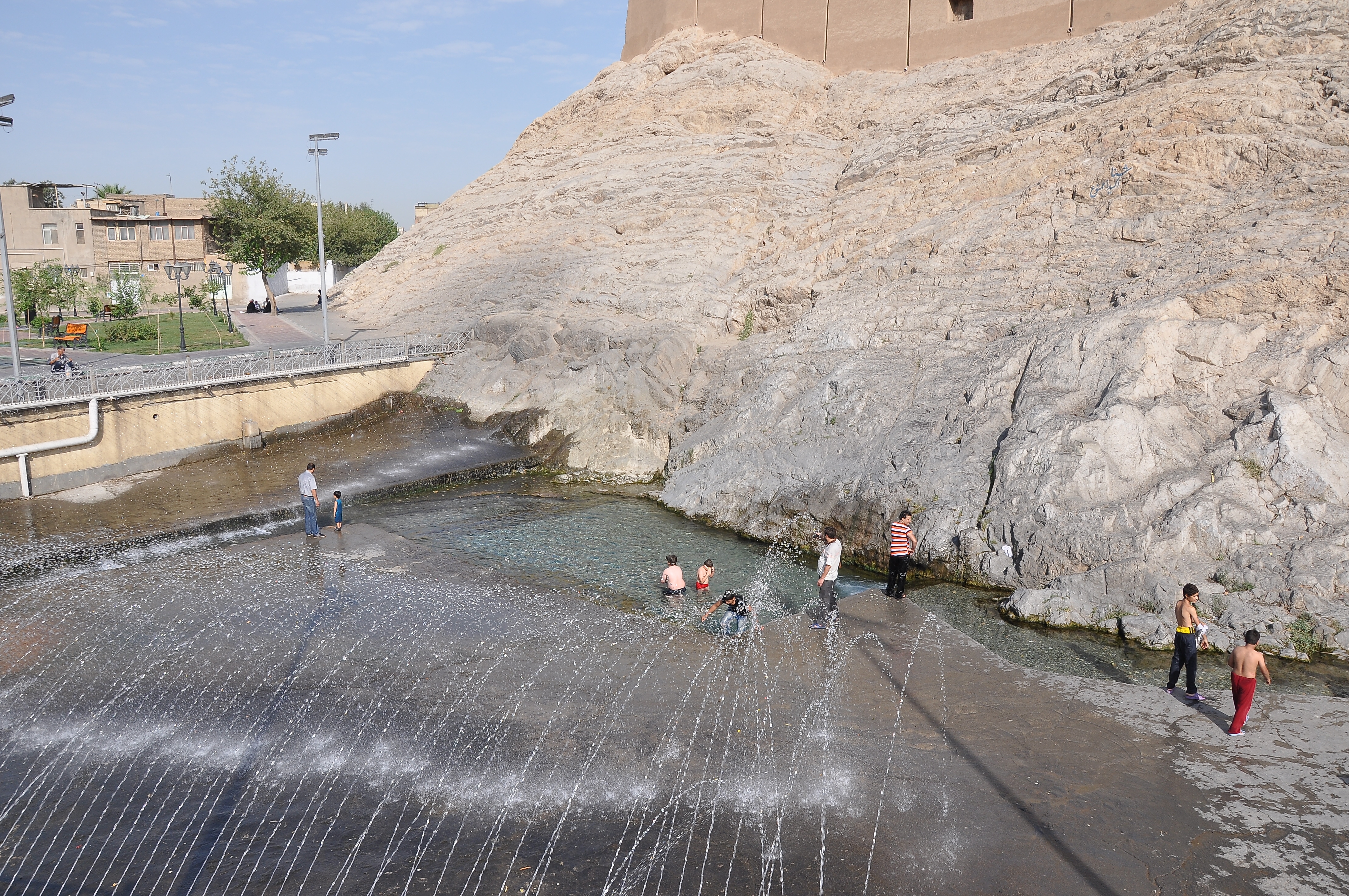
Cheshmeh-Ali (Shahr-e-Rey)
Seven thousand five hundred years ago, someone sat beside a spring at the foot of the Elburz Mountains and painted geometric patterns onto a clay bowl. That bowl survived. The spring still flows. The settlement that grew around it became the ancient city of Rayy, which eventually became a suburb of Tehran, which eventually swallowed the archaeological site whole. Cheshmeh-Ali, the "Spring of Ali," is one of those rare places where you can stand in a modern metropolis and touch the deep Neolithic past, if you know where to look among the surrounding landmarks of Ebn-e Babooyeh, the Tughrul Tower, and the ruins of Rashkan and Rey Castles.
Two Millennia in the Dirt
The ceramic sequence at Cheshmeh-Ali tells the story of two thousand years of occupation, from the Late Neolithic through the Late Chalcolithic. The site defines what archaeologists call the Cheshmeh Ali cultural complex, a Transitional Chalcolithic tradition on the Iranian Central Plateau dating between 5500 and 4800 BC. The distinctive painted pottery found here, also known as Ismailabad ware, spread across a vast swath of northern Persia, turning up as far west as Kashan near Isfahan and as far north as Qazvin. Donald E. McCown organized northern Iran's prehistoric pottery into three successive traditions: the Sialk horizon, the Cheshmeh Ali horizon, and the Hissar horizon. The name of this spring became the name of an entire phase of Iranian prehistory.
The Archaeologist Who Never Published
Erich Schmidt excavated Cheshmeh Ali in 1934 and 1936 for the University Museum in Philadelphia, with sponsorship from the Boston Museum of Fine Arts. In those years, the site lay far from Tehran's sprawl, an isolated mound beside a spring in open countryside. Schmidt uncovered the Chalcolithic layers that gave the site its archaeological fame. But when he died in Santa Barbara, California in 1964, most of his work remained unpublished. The excavation records, the pottery sequences, the stratigraphic notes sat in archives for decades. It was not until later researchers returned to the site and the archives that the full picture began to emerge, including an occupational phase even older than Schmidt had documented.
Older Than Anyone Thought
Recent re-excavation of Cheshmeh-Ali revealed something unexpected beneath the Chalcolithic layers that had made the site famous. Chaff-tempered Neolithic soft-ware ceramics turned up in deeper strata, decorated with painted geometric designs that parallel the early Sialk I material from central Iran. This pushed the site's occupation back further than the 5500 BC date associated with the classic Cheshmeh Ali ware. People were living beside this spring, shaping clay, and painting it with careful patterns during the Late Neolithic, well before the Copper Age transformations that the site had been known for. Each layer of soil peeled back another chapter, revealing that Cheshmeh-Ali was not just a Chalcolithic settlement but a place where the transition from stone-age village life to the more complex societies of the Copper Age played out in real time.
Pottery That Named an Epoch
Two examples of Cheshmeh Ali ware, dating to the sixth and fifth millennia BC, now sit in the Los Angeles County Museum of Art. One is a painted pottery vessel from around 5000 to 4500 BC. The other is a bowl with the same distinctive geometric decoration. These fragments of fired clay, shaped beside a spring in what is now suburban Tehran, represent an entire cultural horizon that stretched hundreds of kilometers across the Iranian plateau. The pottery is characterized by painted geometric patterns, precise and deliberate, applied to vessel surfaces before firing. Similar ware has been found at sites scattered from the central plateau to the northern highlands, evidence of a shared aesthetic and possibly a network of exchange that connected early farming communities across a vast and varied landscape.
The Spring in the City
Tehran grew southward and swallowed Cheshmeh-Ali. What was once a Neolithic village beside a remote spring is now a site within the dense urban fabric of Shahr-e Rey. A Qajar-era rock relief of Fath Ali Shah, carved into the cliff face above the spring, adds yet another historical layer to a place that already had thousands of years' worth. The French artist Eugene Flandin illustrated the spring and its surroundings in 1840, capturing a moment when the ancient site still sat in open landscape. Today it is listed on the Iran National Heritage List and serves as an urban park, a recreational spot where Tehranis come to enjoy the water. The spring that drew Neolithic settlers seven and a half millennia ago still draws people, though now they come to escape the city rather than to found one.
From the Air
Located at 35.61N, 51.45E, in the Shahr-e Rey district on the southern edge of Tehran. The site sits at the base of the Elburz Mountains, which rise dramatically to the north. Imam Khomeini International Airport (OIIE) is approximately 28 km to the southwest. Mehrabad International Airport (OIII) is about 12 km to the northwest. From altitude, the transition from Tehran's dense urban sprawl to the mountain foothills is clearly visible, with Shahr-e Rey marking the southern edge of the metropolitan area. The nearby Tughrul Tower, a 12th-century monument, may be visible as a landmark.