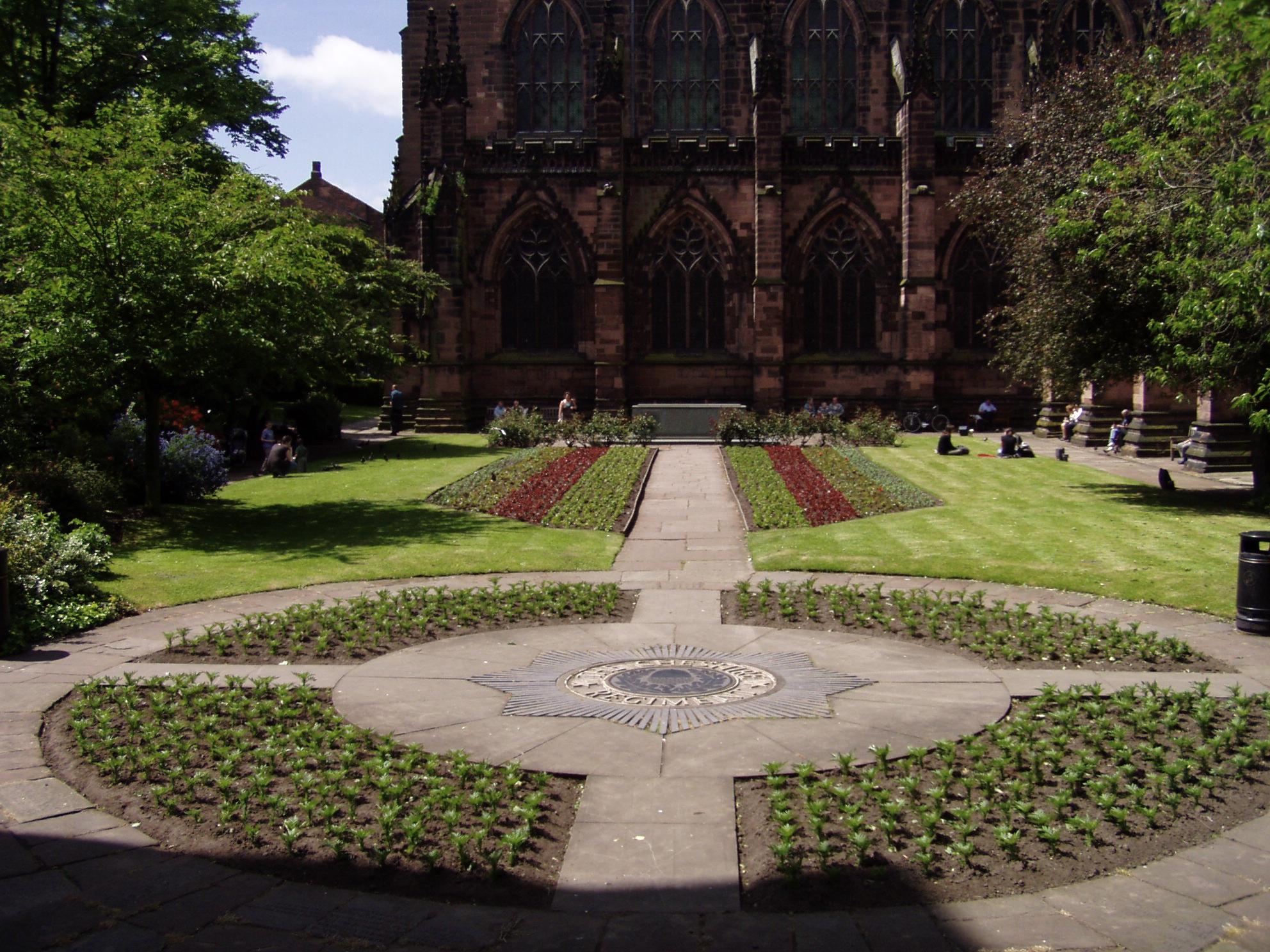
Chester Cathedral
The choir stalls at Chester Cathedral are considered the finest medieval examples in England, carved from English oak between 1380 and 1390 with a profusion of misericords, those small mercy seats beneath the folding chairs where monks could rest during long services. The carvings depict everything from biblical scenes to domestic animals, from mythical creatures to satirical portraits of medieval life. These stalls survived the dissolution of the monastery, the English Civil War, and a Victorian restoration that nearly destroyed as much as it saved. They endure because each generation found them too beautiful to discard, even when it dismantled everything else around them.
Before the Abbey
The cathedral's site may have been used for Christian worship since Roman times, when Chester was garrisoned by the Legio XX Valeria Victrix. Legend holds that a basilica here was dedicated to Saints Paul and Peter, a claim supported by the fact that in Saxon times the dedication of an early chapel was changed from St Peter to St Werburgh. In 958, King Edgar granted land to the Minster of St Werburgh, and in 1092, Hugh Lupus, Earl of Chester, founded a Benedictine abbey on the site, bringing monks from Bec Abbey in Normandy. The abbey's dedication to St Werburgh, a seventh-century Mercian princess whose bones were translated here from Hanbury in Staffordshire, gave the institution its identity for the next four and a half centuries.
Every Style in Stone
Walk through Chester Cathedral and you walk through the complete history of English medieval architecture. The building dates from between the tenth century and the early sixteenth, modified and expanded by successive generations of monks and patrons. Norman arches give way to Early English lancets, which yield to Decorated tracery and then to Perpendicular panels of glass. The north transept preserves the oldest fabric, its massive Norman pillars bearing the weight of nine hundred years. The Lady Chapel dates from the thirteenth century, while the south transept was rebuilt in the Decorated style. The cloisters, among the most complete monastic cloisters surviving in England, connect the cathedral to its former monastic buildings, which are themselves listed Grade I.
From Abbey to Cathedral
When Henry VIII dissolved the monasteries, Chester's Benedictine abbey was refounded as a cathedral in 1541, becoming the seat of the newly created Diocese of Chester. The last abbot became the first dean, a pragmatic transition that preserved the building even as it transformed its purpose. The cathedral endured the Civil War largely intact, though Parliamentary troops stabled horses in the nave. By the nineteenth century, the soft red sandstone of Chester's buildings had weathered badly, and a major restoration was undertaken by Sir George Gilbert Scott between 1868 and 1876. Scott's work was extensive and sometimes controversial, replacing eroded stone and rebuilding sections that had become structurally unsound. His intervention saved the building from collapse but inevitably altered its character.
The Living Fabric
Chester Cathedral remains an active place of worship, the mother church of a diocese that stretches across Cheshire and into parts of the Wirral and Greater Manchester. The medieval choir stalls, with their forty-eight misericords, continue to seat the cathedral choir during daily services. During the Early Middle Ages, the Celtic saint Barloc of Norbury was venerated here with a feast day on 10 September, one of many threads connecting the cathedral to traditions that predate the Norman Conquest. The monastic buildings to the north, including the refectory with its distinctive reader's pulpit and the chapter house, form a heritage precinct that preserves the daily rhythms of Benedictine life in stone and space. The cathedral falconry, established in the cloister garden, is one of the few cathedral falconries in the country, an unexpected continuity with the medieval world where monks and nobles alike kept birds of prey.
From the Air
Located at 53.191N, 2.890W in the heart of Chester's walled city. The cathedral's red sandstone tower and the adjacent monastic cloisters are visible from altitude, set within the northeast quadrant of the city walls. The River Dee curves around the south side of the city. Nearest airports include Hawarden (EGNR, 5nm west) and Liverpool John Lennon (EGGP, 20nm northwest). Chester's complete Roman and medieval wall circuit provides excellent visual orientation.