Cheyenne Mountain Complex
In 1979, a faulty computer chip inside Cheyenne Mountain nearly started a nuclear war. The warning systems reported incoming Soviet missiles, crews scrambled, and for several agonizing minutes the fate of civilization hung on whether human operators could distinguish a glitch from the apocalypse. They did. The chip was replaced, the protocols were tightened, and the mountain went back to doing what it has done since 1967: standing ready for the worst day in human history while quietly hoping it never comes. Nestled in the Front Range south of Colorado Springs, the Cheyenne Mountain Complex remains one of the most fortified military installations ever built, a city inside solid granite designed to survive what nothing on the surface could.
Blasting Into Bedrock
Excavation began on May 18, 1961, when the United States Army Corps of Engineers started drilling into Cheyenne Mountain. The Department of Defense selected the Utah Construction & Mining Company to blast tunnels through the granite, while the Burroughs Corporation built the electronics and communications systems that would process aerospace surveillance data in millionths of a second. The initial construction cost was $142.4 million. By February 6, 1967, the complex was operational, housing the NORAD Combat Operations Center, the Space Defense Center, and the National Civil Defense Warning Center. The idea was born from Cold War terror: the Cuban Missile Crisis, the Berlin Crisis, and the ever-growing Soviet nuclear arsenal demanded a command center that could absorb a direct hit and keep functioning. Cheyenne Mountain was America's answer.
A City on Springs
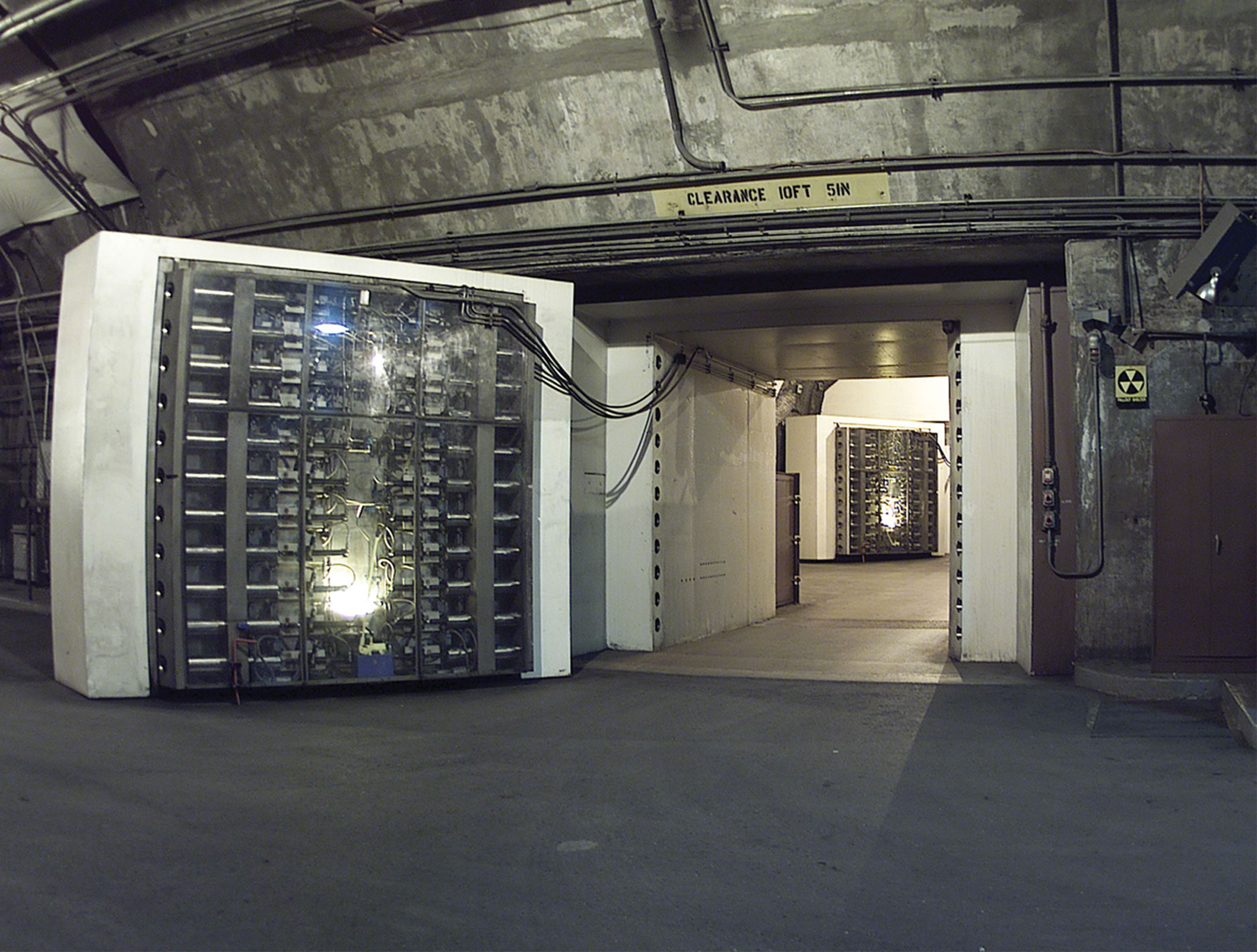
The complex spans 5.1 acres inside the mountain, containing fifteen three-story buildings that float on more than one thousand massive steel springs. These springs limit building movement to less than one inch during an earthquake or explosion, with flexible pipe connectors ensuring nothing snaps under stress. Beneath 2,000 feet of granite, the facility can withstand a blast wave and filter out chemical, biological, radiological, and nuclear contaminants through a network of blast valves. The complex generates its own power, heats and cools itself, and draws from natural mountain springs that produce more water than the base needs. A 1.5-million-gallon reservoir stands ready for firefighting, while a separate 4.5-million-gallon reservoir serves as a heat sink. It is the only underground Department of Defense facility certified to survive a high-altitude electromagnetic pulse.
Watching the Skies
For decades, Cheyenne Mountain served as the primary nerve center for North American air defense. NORAD, the Royal Canadian Air Force, the Air Weather Service, FEMA, and the U.S. Civil Defense Early Warning Center all operated from within its chambers. The Space Surveillance Center tracked every object in orbit; the Missile Warning Center monitored launches worldwide; the Intelligence Center analyzed threats in real time. On September 11, 2001, the complex locked down as the attacks unfolded. In 2008, primary operations shifted to Peterson Space Force Base in Colorado Springs, and Cheyenne Mountain became the alternate command center. But the mountain never went quiet. In 2015, a $700 million contract with Raytheon began moving systems back inside to harden them against electromagnetic pulse attacks. During the COVID-19 pandemic in early 2020, roughly 130 troops relocated operations from Peterson back into the mountain, maintaining social distancing protocols deep underground.
From Stargate to the Silver Screen
The complex has become one of the most recognizable military installations in popular culture. In the 1983 film WarGames, the mountain's command center was codenamed "Crystal Palace," where a teenage hacker nearly triggered nuclear war through a computer game. The television series Stargate SG-1 set its secret interstellar gateway program inside Cheyenne Mountain, and the real Air Force embraced the connection so warmly that a broom closet inside the actual complex was labeled "Stargate Command." Terminator 3 modeled its nuclear bunker after the mountain's entrance tunnel. Interstellar placed NASA's last command center there. The mountain's blend of secrecy, impregnability, and doomsday purpose makes it irresistible to storytellers, and the real facility has leaned into the mystique rather than fighting it.
The Mountain Endures
Known as "America's Fortress," the Cheyenne Mountain Complex has evolved through six decades of technological transformation. Its computer systems have been upgraded repeatedly, from the original Burroughs mainframes through Honeywell H6080s and UNIVAC systems to modern networks. The facility now includes hiking and biking trails, a softball field, basketball and volleyball courts, a putting green, and even a horseshoe pit outside the blast doors. Inside, there is a medical facility, a cafeteria, a market, and fitness centers. The juxtaposition is striking: recreational amenities built in the shadow of a facility designed for the end of the world. The mountain remains ready, as it has been since the first day the blast doors swung open, for whatever threat the skies might deliver.
From the Air
The Cheyenne Mountain Complex sits at approximately 38.74N, 104.85W on Cheyenne Mountain, southwest of Colorado Springs. The facility is at roughly 7,200 feet elevation on the mountain's north slope. From the air, look for the distinctive tunnel entrance on the mountainside and the parking area partway up. Colorado Springs Airport (KCOS) is approximately 10 nautical miles southeast. Maintain safe altitude over mountainous terrain; the Front Range creates significant turbulence and mountain wave conditions. Restricted airspace may apply near the complex.