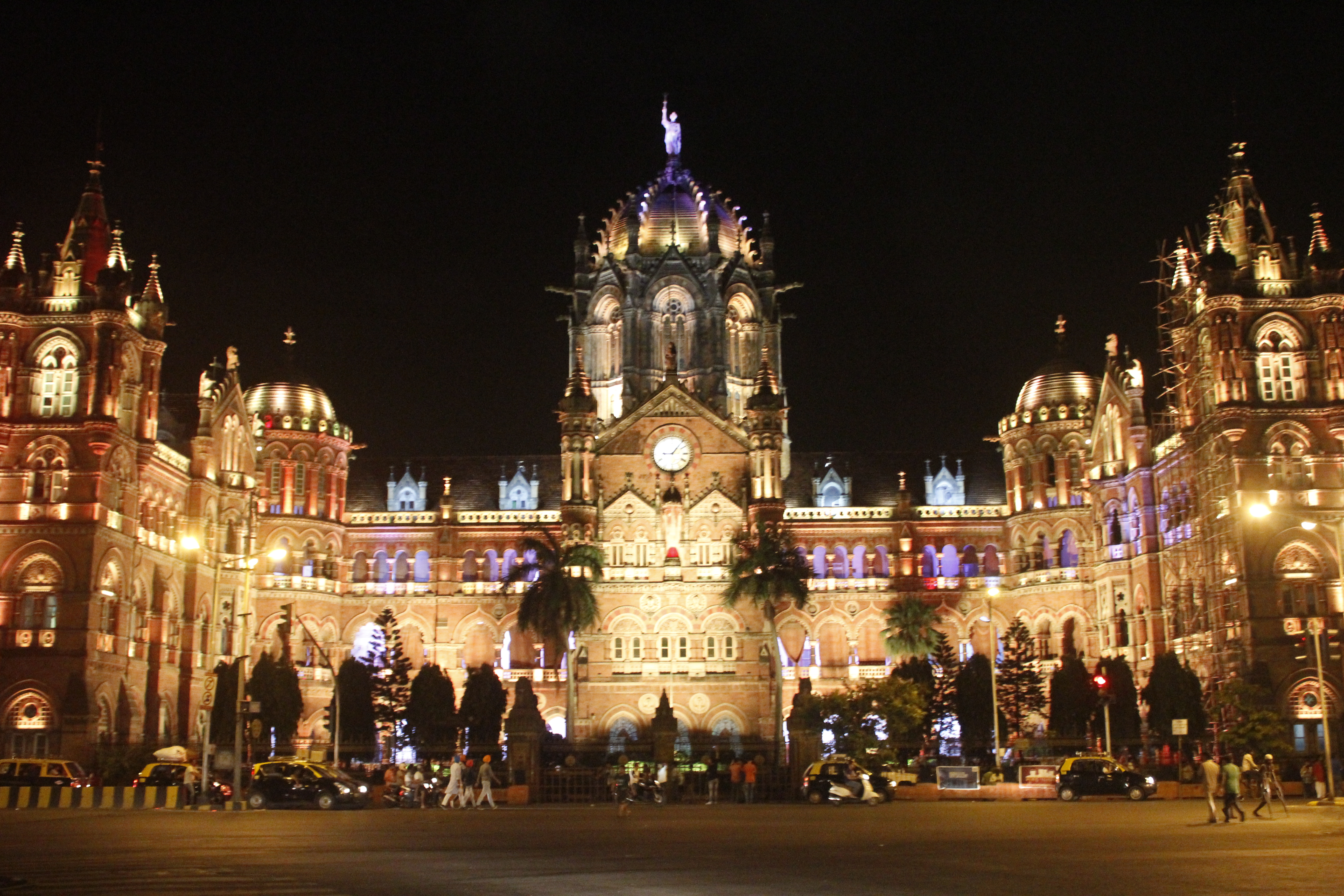
Chhatrapati Shivaji Terminus
A lion and a tiger flank the main entrance gates. The lion represents Britain; the tiger, India. Above them both, atop the central dome, a bronze woman holds a torch in one hand and a spoked wheel in the other -- an allegory of Progress, gazing out over one of the busiest railway stations on Earth. Chhatrapati Shivaji Maharaj Terminus in Mumbai, known to locals as CST or simply VT, has been the operational heart of the city since 1888. Designed in Italian Gothic style with flourishes of Indian palace architecture, it took ten years to build, served as headquarters of the Great Indian Peninsula Railway, and carries the names of two empires: the British queen who reigned when it opened, and the Maratha warrior king who founded the empire that preceded British rule.
Ten Years of Stone and Ambition
Construction began in 1878 under the direction of Frederick William Stevens, a British architect attached to the Bombay Public Works Department, working from an initial watercolor sketch by draughtsman Axel Haig. The station replaced the older Bori Bunder terminus in what was then a major port and warehouse district. Stevens designed the building in Victorian Gothic Revival style, drawing on Romanesque forms and classical Indian architectural traditions -- the pointed arches, turrets, and eccentric ground plan echo the skylines of Indian palaces as much as European cathedrals. The station took ten years to complete, making it the longest construction project of its era in Mumbai. It opened in 1888, one year after Queen Victoria's Golden Jubilee, and was named Victoria Terminus in her honor. The decorative elements -- sculpture, wood carving, ticket office grilles, and the grand staircase balustrades -- were crafted by students at the Sir Jamsetjee Jeejebhoy School of Art under the guidance of John Lockwood Kipling, father of Rudyard.
A Cathedral for Commuters
The main office building follows a C-shaped plan, symmetrical on its east-west axis, crowned by the high octagonal ribbed dome that serves as the station's focal point. Inside, the heritage wing holds a series of large rooms with high ceilings, now used as offices of Central Railways. The ground floor's Star Chamber -- still the suburban booking office -- gleams with Italian marble and polished Indian blue stone, its walls lined with glazed tiles manufactured by Maw & Co. of Britain. The main structure blends Indian sandstone and limestone, with Italian marble reserved for key decorative elements. Externally, allegorical statues of Commerce, Agriculture, Engineering, and Science gaze down from the facade, alongside busts of Indian donors such as Jamsetjee Jeejeebhoy and Jagannath Shankarseth, carved into wall niches. The dome itself was an engineering achievement -- its dovetailed ribs were built without centering, a technique considered novel at the time. Today, 18 platforms serve both suburban trains and long-distance routes, handling millions of passengers annually.
The Names It Carries
The station has been renamed three times, and each name tells a story about who holds power and how they choose to remember. Built as Victoria Terminus, it honored the British empress who never visited it. In 1996, it became Chhatrapati Shivaji Terminus, after the seventeenth-century warrior king who founded the Maratha Empire in the Deccan Plateau's Marathi-speaking regions -- a deliberate assertion of Indian identity over colonial heritage. In 2017, it was renamed again to Chhatrapati Shivaji Maharaj Terminus, adding the honorific "Maharaj" meaning "great king." Somewhere during the renaming, a marble statue of Queen Victoria that had stood in the main facade under the clock quietly vanished. Removed to Victoria Gardens in the 1950s along with other British-era statues, it was last seen lying on the grass. A Right to Information inquiry found no record of it being exported. Historians believe it was smuggled out, sold, or destroyed. The statue of Progress atop the dome -- often mistaken for Victoria -- still stands.
26 November 2008
On the evening of 26 November 2008, two gunmen entered the passenger hall of CSMT at approximately 21:30, carrying AK-47 rifles. They opened fire on commuters and threw grenades into the crowd. For over an hour, the station -- a place designed for the routine of arrival and departure -- became a site of terror. The gunmen exited via the North foot over bridge toward Cama Hospital at about 22:45. One of the attackers, Ajmal Kasab, was later captured alive, identified through CCTV footage, and convicted. The 2008 Mumbai attacks targeted multiple locations across the city, but the assault on CSMT struck at the very symbol of Mumbai's daily life. The station reopened. The trains resumed. The city's commuters returned to the platforms the next day, because Mumbai has no alternative -- this terminus is where the city begins and ends.
Light on the Gothic
Since 2022, the heritage building has been illuminated with LED lights each evening, the colors shifting thematically for national holidays like Independence Day and Republic Day. The effect transforms the Victorian Gothic facade into something alive -- the turrets and arches that Stevens designed in sandstone and limestone now glow in saffron, white, and green. The station appeared as a filming location for the "Jai Ho" sequence in Slumdog Millionaire, in Ra.One, and in The Attacks of 26/11, a film that recreated the night the station endured its darkest hour. Through all of it -- the construction, the renamings, the attack, the films -- the building has continued to do what Stevens designed it to do. Trains arrive. Trains depart. The dome's allegorical Progress holds her torch above the crowd, steady and indifferent to everything except the forward motion below.
From the Air
Chhatrapati Shivaji Maharaj Terminus is located at 18.94N, 72.84E in the southern tip of Mumbai's peninsula, Maharashtra, India. The Victorian Gothic structure is identifiable from the air by its large dome and surrounding cluster of heritage buildings in the Fort district. Best viewed at 3,000-5,000 feet AGL. Nearest airport: Chhatrapati Shivaji Maharaj International Airport (VABB), approximately 20 km north. The station sits near the eastern waterfront, close to Mumbai's harbor and the distinctive peninsula tip. Look for the railway yard extending northward from the terminus building.