Chiapa de Corzo: Where Mesoamerica First Wrote Its Name
Every January, the sky above the Grijalva River erupts. Thousands of fireworks trace arcs over the water in a spectacle the people of Chiapa de Corzo call a naval battle - a tradition that has been running, improbably, since 1599, when a local vicar named Pedro de Barrientos decided his parishioners needed a diversion. But spectacle runs deeper here than fireworks. Beneath this small city in the Chiapas highlands, fifteen kilometers east of the state capital Tuxtla Gutierrez, archaeologists have unearthed some of the earliest evidence of organized civilization anywhere in the Americas: the oldest Long Count inscription in Mesoamerica, dated to 36 BCE on Stela 2; the earliest known form of hieroglyphic writing in the region; and the oldest pyramidal tomb burial yet found in the Western Hemisphere, sealed inside a 20-meter pyramid between 700 and 500 BCE. Chiapa de Corzo has been continuously occupied since at least 1400 BCE. The surface you walk on barely hints at what lies below.
The Tomb That Rewrote the Timeline
In 2010, archaeologists working at the center of a previously excavated pyramid found what no one had expected: a burial chamber dating to between 700 and 500 BCE, making it the oldest pyramidal tomb in Mesoamerica - predating comparable tombs at Tikal and Kaminaljuyu by some 600 years. The occupant was richly adorned. Nine ceremonial axes had been placed as offerings, oriented to the cardinal directions. Over three thousand objects accompanied the body: pieces crafted from jade, river pearls, obsidian, and amber, sourced from trade networks stretching to Guatemala and the Valley of Mexico. The face was covered with a seashell mask - openings cut for the eyes and mouth - the earliest known example of a Mesoamerican funeral mask. The culture responsible is considered Olmec-influenced, though the burial departs from typical Olmec conventions. Earspools and breastplates, standard Olmec adornments, are absent. What remains is evidence that many hallmarks of Mesoamerican burial practice are far older than scholars had previously believed.
Between Olmec Shadow and Zoque Light
The people who settled this stretch of the Grijalva River valley around 1200 BCE were Mixe-Zoquean speakers, culturally related to the Olmec civilization that dominated the Gulf and Pacific coasts. By 900 BCE, the village showed strong ties to the great Olmec center of La Venta - shared pottery styles, shared obsidian and andesite sources, even a ceremonial pond echoing La Venta's designs. Whether Chiapa was a subject of La Venta or an independent partner remains one of Mesoamerican archaeology's open questions. What is clear is that Chiapa eventually diverged. During the Escalera phase (700-500 BCE), the settlement became a planned town with formal plazas and monumental buildings, yet its architecture and pottery already showed a distinct Zoque identity. By the Francesa phase (500 BCE to 100 CE), locally made pottery dominated, monumental structures grew larger, and long-distance trade networks flourished. It was during this period that the first hieroglyphic writing appeared - not Maya, not Olmec, but something born from the space between them.
Parachicos and the Healer's Cure
The town's most celebrated tradition dates to the colonial era and carries a legend. According to the story, a wealthy Spanish woman named Dona Maria de Angula arrived in Chiapa searching for a cure for her son's mysterious paralytic illness. Local doctors had failed her, as had every physician along her journey. She was directed to a curandero - a traditional healer called a namandiyugua - who instructed her to bathe the boy in the waters of a small lake called Cumbujuya. The cure worked. From this legend emerged the Parachicos dancers, one of three dance traditions performed during the Fiesta Grande de Enero each January. UNESCO recognized the Parachicos as Intangible Cultural Heritage, though the tradition faces an uncertain future. Fewer young people are learning to carve the traditional wooden masks and apply the lacquer finish that gives each one its character. The dance endures, but the craft behind it requires patience the modern world does not always reward.
A Plaza Larger Than the Zocalo
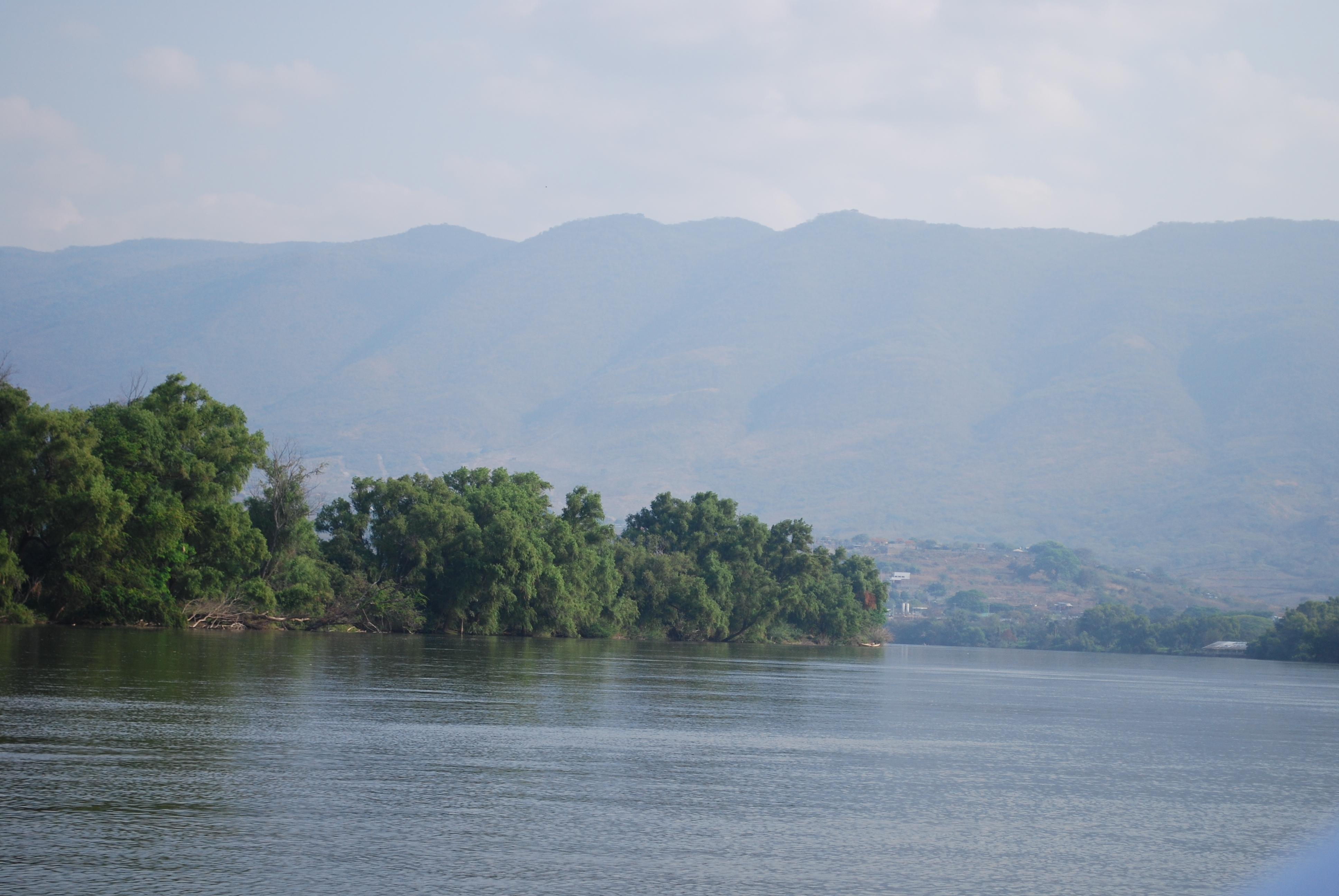
Chiapa de Corzo is laid out in classic Spanish colonial style, centered on a vast central plaza that local authorities claim exceeds the dimensions of Mexico City's Zocalo - a boast that speaks to civic pride as much as geometry. The town sits along the Grijalva River, with one of the main docks serving as the primary embarkation point for boat tours into the Sumidero Canyon just to the north. A fountain in the plaza, built of brick in the Mudejar style, measures fifty-two meters in circumference and twelve meters high, crowned with eight arches and a cylindrical tower that once doubled as a watchtower. The town's name carries its own history: originally simply Chiapa, the suffix "de Corzo" was added to honor Angel Albino Corzo, a Liberal politician of the Reform War era. The first Spanish city in Chiapas was founded here in 1528 by Diego de Mazariegos, layering colonial ambition on top of a settlement already three thousand years old.
From the Air
Located at 16.60N, 92.97W in the Grijalva River valley of the Chiapas highlands, approximately 15 km east of Tuxtla Gutierrez. The town is visible along the river, with the Sumidero Canyon opening dramatically to the north. Nearest airport: Angel Albino Corzo International Airport (MMTG/TGZ), approximately 30 km south of Tuxtla Gutierrez. The Grijalva River and Sumidero Canyon walls serve as unmistakable navigation landmarks. Best viewed at 3,000-5,000 feet AGL. The town's large central plaza and waterfront docks are identifiable from low altitude.