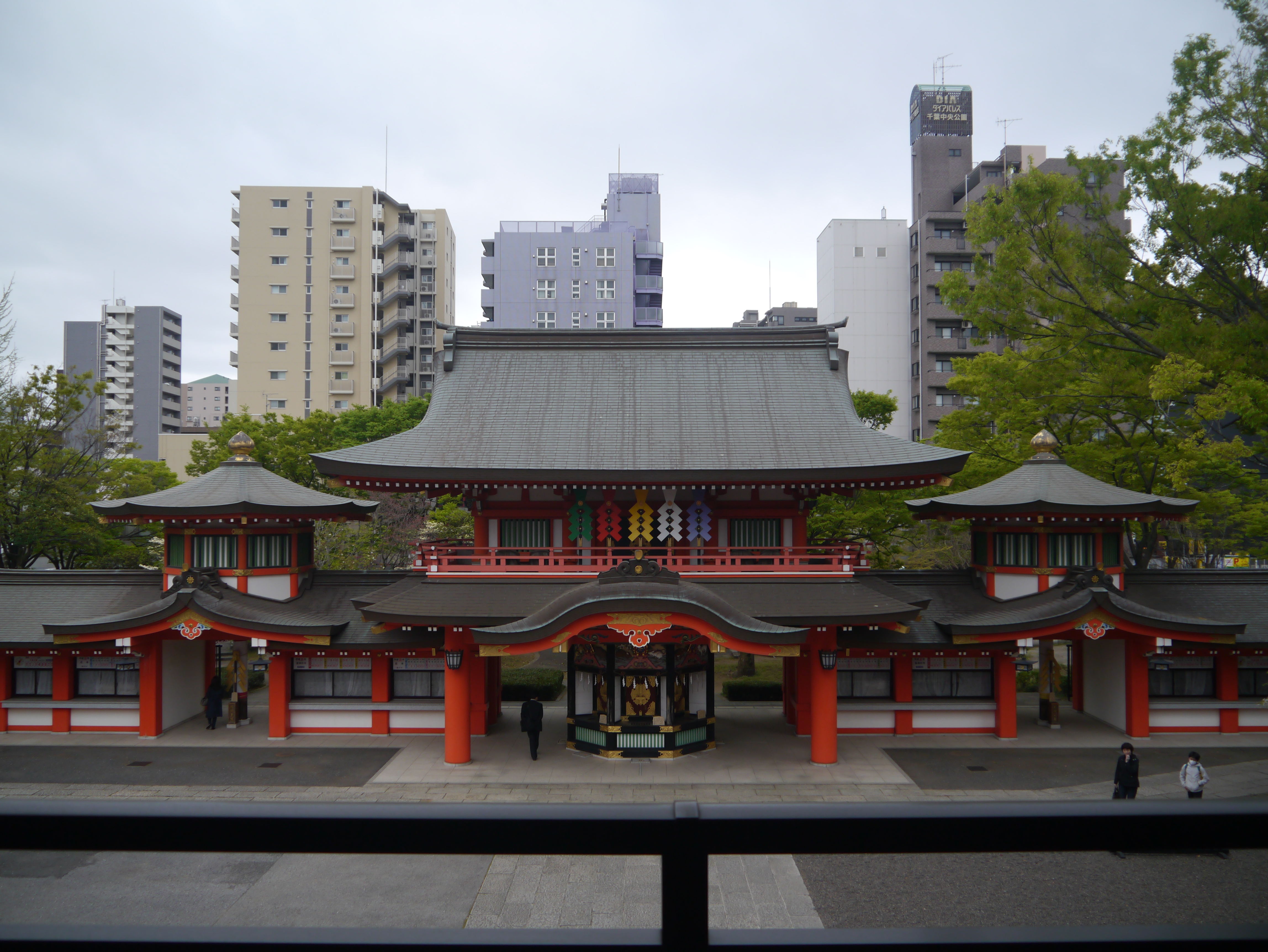
Chiba Shrine
Most Shinto shrines in Japan honor earth-bound deities -- spirits of mountains, rivers, harvests. Chiba Shrine looks to the sky. For over a millennium, this compound in the center of Chiba City has been dedicated to the worship of Myoken, the divine personification of the North Star and the Big Dipper, a celestial guardian whose cult traveled from Tang Dynasty China through the Korean kingdoms of Goguryeo and Baekje before settling permanently in eastern Japan. The shrine's formal name for its deity -- Hokushin Myoken Sonjo-O, the Venerable Star King of the North Star -- captures the cosmic ambition of the place. And behind that heavenly devotion lies a very earthly story: a warrior clan that owed its survival to a star god and repaid the debt across nine centuries of war, fire, and reinvention.
A Debt Paid in Starlight
The story begins with a battle at the Someya River in Kozuke Province, in what is now Gunma Prefecture. Taira no Yoshifumi, ancestor of the Chiba clan, was losing badly to his elder brother Kunika. Alongside Yoshifumi fought his nephew, the legendary rebel Taira no Masakado. As defeat closed in, legend says that Myoken -- the deity of a nearby temple called Sokusai-ji -- intervened and rescued both men. Yoshifumi returned to the temple in gratitude and took one of its seven Myoken statues with him. That statue became the clan's sacred heirloom, passed down through generations of warriors who venerated the star god as their patron and protector. When Yoshifumi's descendant, the monk Kakusan (a son of Taira no Tadatsune), founded the Buddhist temple Hokutosan Kongouju-ji in the year 1000 at the command of Emperor Ichijo, the Myoken image found its permanent home.
From Temple to Shrine
For most of its history, Chiba Shrine was not a shrine at all. It was a Buddhist temple where the star deity Myoken -- a figure born from the fusion of Chinese Taoist star worship and Buddhist cosmology -- held court. The compound grew in stature in 1126, when Taira no Tsuneshige moved the Chiba clan's power base from Oji Castle in Kazusa Province to the newly built Inohana Castle, about a kilometer south. The clan's Myoken image was merged into the temple complex, and the following year, 1127, the Myoken Taisai festival was held for the first time -- an annual celebration that has continued without interruption for nearly nine hundred years. Then came the Meiji government's forced separation of Buddhism and Shinto in the late 19th century. Temples dedicated to mixed-heritage deities had to choose sides. Myoken, the Buddhist star god, was re-identified as Ame-no-Minakanushi, a primordial kami from Japan's oldest mythological texts who also carried associations with the pole star. The temple became a shrine, but the devotion never wavered.
Destruction and Renewal
Chiba Shrine has been destroyed and rebuilt three times. The details of the earliest destructions are lost to the fragmentary historical record, though reconstruction of one set of ruined buildings was completed in 1914. The most devastating blow came on July 6-7, 1945, when American firebombing of Chiba leveled the shrine along with much of the city in the closing weeks of World War II. Rebuilding took nearly a decade. The current main hall was completed in 1954, rising from the same ground where warriors once received their coming-of-age ceremonies under the watchful gaze of the star god. A grand renovation in 1990 modernized the entire compound while preserving its sacred character. Today the shrine sits in the urban heart of Chuo-ku, surrounded by office buildings and rail lines, its vermillion gates and tiered rooflines a vivid counterpoint to the concrete and glass of modern Chiba.
Celestial Politics on Sacred Ground
The shrine's compound tells a story of careful diplomatic balance. Chiba Shrine actually sits on land that originally belonged to a branch of Katori Shrine, the powerful sanctuary of the warrior god Futsunushi in neighboring Katori. The branch shrine, known as Innai Katori Shrine, was already here when the Myoken temple arrived. Out of respect for Futsunushi as the "landlord" of the grounds, specific deferential customs are still observed during the week-long Myoken Taisai festival. Yamato Takeru, the legendary prince-warrior of Japanese mythology, is also venerated here as an auxiliary deity. Even the smaller Ishi Shrine within the compound holds its own story: it is dedicated to Iwanagahime, the elder sister of Konohana-Sakuyahime, the goddess of Mount Fuji. The layering of these traditions -- star worship, warrior gods, mythological princesses -- makes Chiba Shrine a microcosm of the tangled, syncretic religious history of Japan itself.
From the Air
Located at 35.6118N, 140.1238E in central Chiba City, Chuo-ku district. The shrine sits in a dense urban area east of Tokyo Bay. From altitude, identify Chiba City by its position along the bay's eastern shoreline, south of the distinctive curve of the Miyako River. Nearest major airport: Narita International (RJAA), approximately 30nm east-northeast. Tokyo Haneda (RJTT) lies approximately 25nm west across the bay. Chiba's urban grid and port facilities provide clear visual landmarks. Expect variable visibility due to maritime haze off Tokyo Bay.