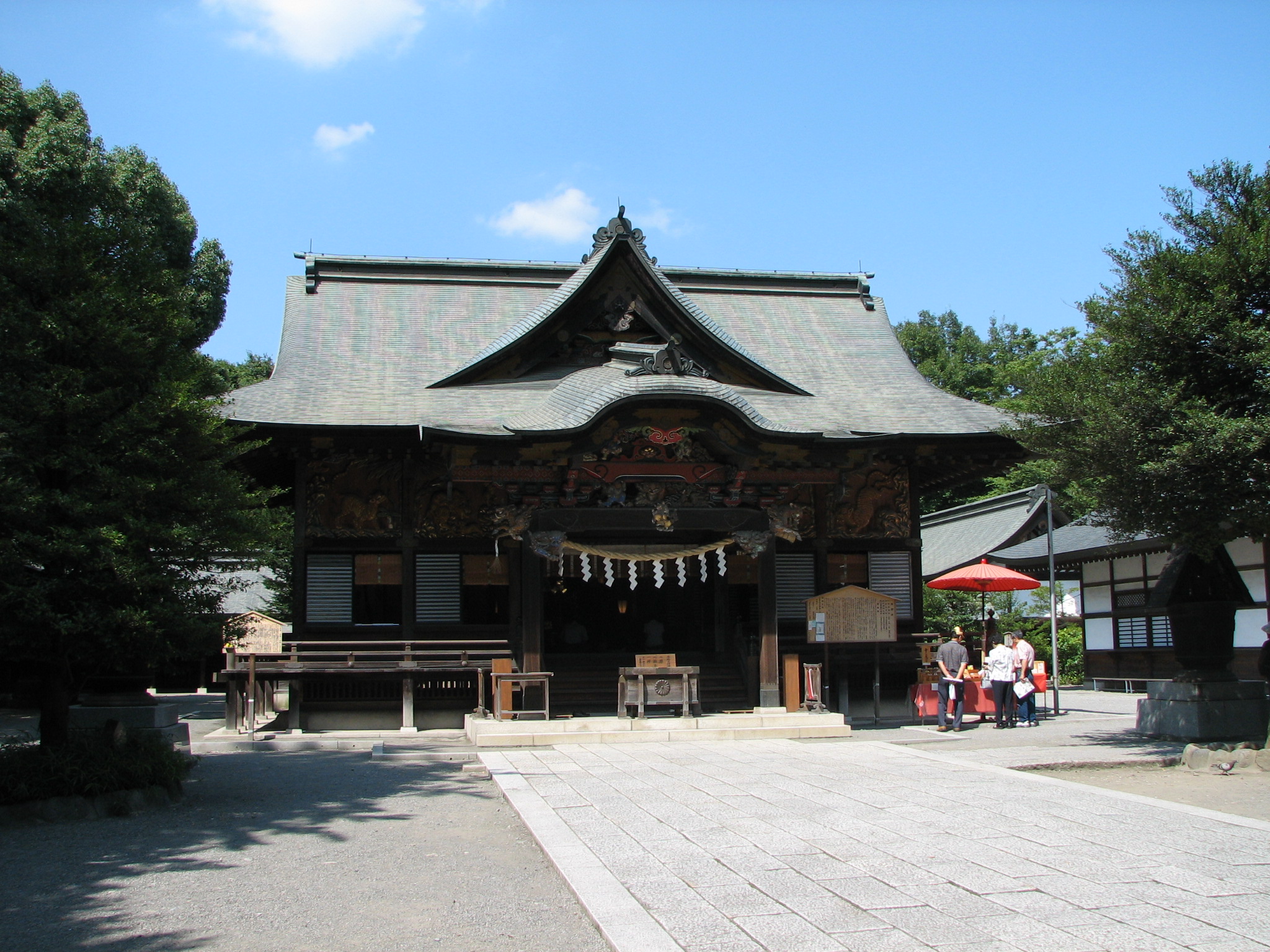
Chichibu Shrine
On the nights of December 2 and 3, six elaborately carved floats -- some weighing up to 20 tons -- are hauled through the streets of Chichibu by teams of more than 150 people each, while fireworks cascade across the winter sky for nearly two and a half hours. The Chichibu Yomatsuri, or Night Festival, ranks alongside Kyoto's Gion Festival and Hida Takayama's festival as one of Japan's three greatest float celebrations. But the shrine that hosts this spectacle has been standing in this mountain valley for far longer than any festival tradition, tracing its origins to the legendary reign of Emperor Sujin.
Where Wisdom Takes Root
According to the Sendai Kuji Hongi, an ancient chronicle of Japan's early centuries, a man named Chichibuhiko-no-mikoto -- the tenth-generation descendant of the provincial governor of Chichibu -- established this shrine during the reign of Emperor Sujin. The deity enshrined here is Yagokoro-omoikane-no-mikoto, the god of wisdom and intelligence, whose name translates roughly to 'having the wisdom and thoughtfulness of many people.' In Japanese mythology, Omoikane is the deity who devised the plan to lure the sun goddess Amaterasu out of the cave where she had hidden, plunging the world into darkness. It was Omoikane's cleverness that restored light to the world. Today, visitors come to Chichibu Shrine seeking guidance in studies, the arts, and decision-making -- practical appeals to a deity whose mythological resume involves solving the most consequential problem in the Shinto creation story.
Layers of Sacred Ground
The shrine complex is more than a single building. Within its forested grounds stand several subsidiary shrines, each with its own history and devotion: a Tenjin Shrine dedicated to the patron of scholarship, a Toshogu enshrining the deified Tokugawa Ieyasu, and a Suwa Shrine linked to the ancient Suwa Taisha tradition. During the Edo period (1603-1868), Chichibu Shrine was counted among 34 sacred sites of the old Chichibu Province, connecting it to the broader web of pilgrimage routes that crisscross this valley. In the Meiji period, when the government reorganized Shinto institutions, the shrine was classified as a third-class nationally significant shrine -- a formal recognition of its importance that placed it within Japan's modern system of ranked shrines. The characters on the torii gate were changed to read Chichibu Shrine using the older kanji 知知夫神社, a subtle assertion of deep historical roots.
Fire, Floats, and Winter Fireworks
The Chichibu Yomatsuri is the climax of the shrine's ceremonial year. Held on December 2 and 3, it draws hundreds of thousands of visitors to a city of fewer than 60,000 residents. The six festival floats, each representing a neighborhood of Chichibu, are works of art in motion -- carved in intricate detail, draped in embroidery threaded with gold, and so massive that teams of over 150 men are needed to navigate each one through the narrow streets. Inside the floats, performers stage kabuki theater as the procession moves. The fireworks display that accompanies the parade lasts nearly two and a half hours, an unusual spectacle for winter in Japan, where hanabi are traditionally a summer pleasure. In 2016, the Chichibu Yomatsuri was inscribed as a UNESCO Intangible Cultural Heritage, joining an elite group of Japanese festivals recognized for their cultural significance. The festival's history stretches back roughly 300 years.
A Calendar of Living Tradition
The Yomatsuri may be the most famous event, but the shrine's ritual calendar fills the entire year. The rice-planting festival takes place on April 4, marking the agricultural cycle that once governed life in this valley. The Kawase Festival in mid-summer, celebrated on July 19 and 20, brings its own processions and ceremonies. The Banba-machi Suwa Shrine festival, held occasionally rather than annually, features the dramatic raising of wooden pillars in a ritual that echoes the Onbashira festival of the Suwa Taisha far to the west. The Japanese government has recognized several of the shrine's traditions as important cultural assets: the sacred kagura dance, the festival music, the floats themselves, and various buildings and possessions within the shrine grounds. Chichibu Shrine is not a museum piece -- it is a place where ancient traditions are performed, maintained, and passed forward by the people who live in its shadow.
From the Air
Located at 36.00N, 139.08E in central Chichibu, Saitama Prefecture. The shrine sits in the heart of the Chichibu urban area within a distinctive mountain-ringed valley approximately 80km northwest of Tokyo. The shrine's forested grounds are visible amid the surrounding town center. During the December Yomatsuri festival (Dec 2-3), large crowds and fireworks may be visible from altitude. Nearest major airports: RJTT (Tokyo Haneda, ~100km south) and RJAA (Narita International, ~130km southeast). Recommended viewing altitude: 3,000-5,000 feet AGL to see the shrine grounds in the context of the compact Chichibu city center and surrounding mountains.