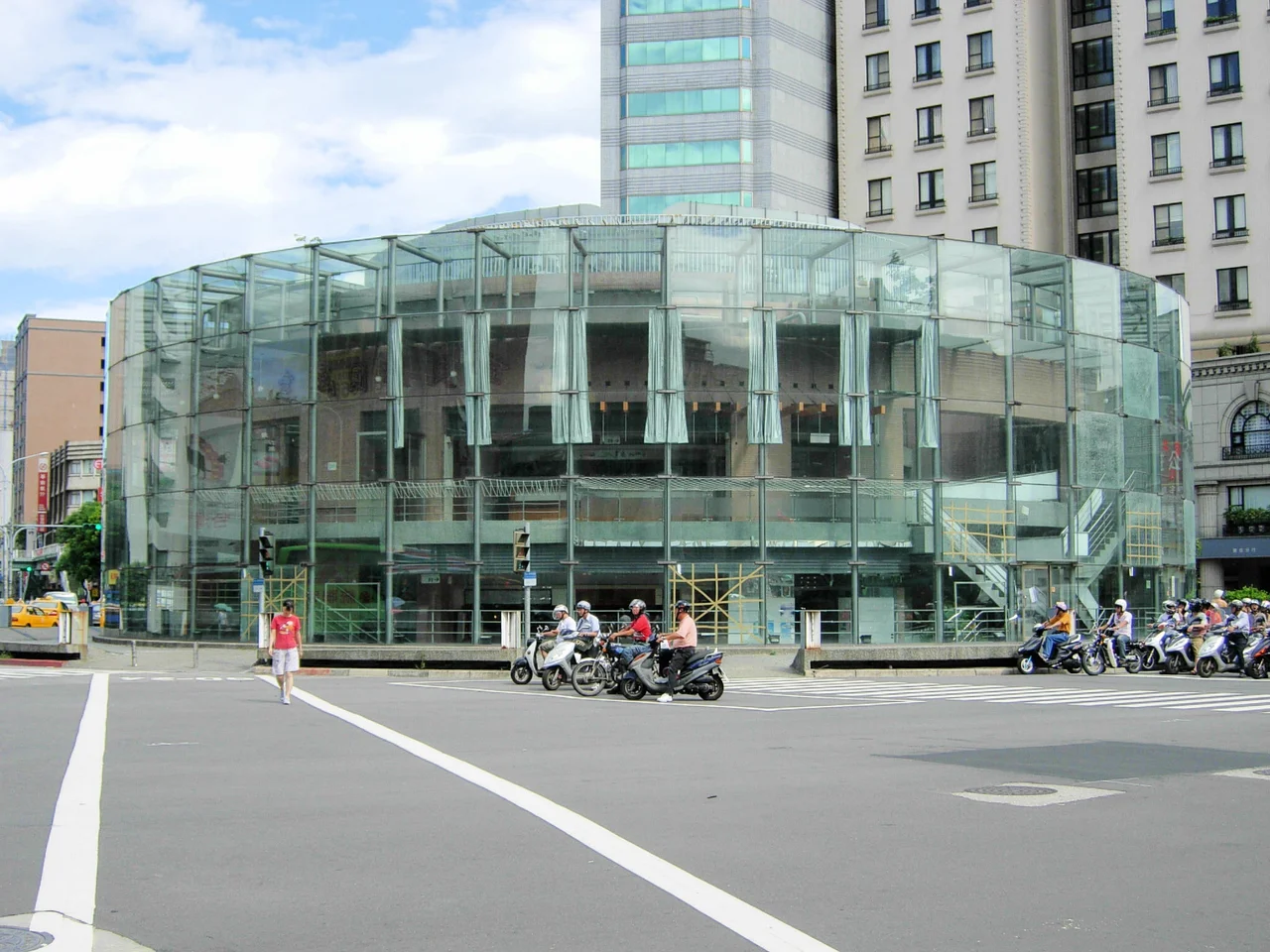

Chien-Cheng Circle
Somewhere in Taipei's Datong District, tucked between Nanjing West Road and Chongqing North Road, there is a public plaza with a fountain and a few trees. On the surface it is unremarkable. But if you talk to the older residents of the neighborhood, they will tell you about the fish pond that was here first, and the food cart operators who worked until four in the morning, and the bomb shelter dug beneath the market during the war, and the decades of legal disputes that finally silenced what had been the most popular night market in northern Taiwan. The Chien-Cheng Circle has lived many lives, and the plaza you see today is just the latest chapter.
A Fish Pond at the Crossroads
The story begins not with neon lights and sizzling skewers, but with water. During the Japanese colonial era, the intersection of two major roads formed a natural roundabout, and the Japanese administration transformed a fish pond there into a small park, planting trees along its edges. The location turned out to be irresistible to vendors. Cart by cart, stall by stall, food sellers began gathering at the edges of the park, drawn by the foot traffic of a city still finding its modern shape. The night market that grew from this modest beginning covered 1,722 square meters and became the busiest such market in northern Taiwan during the colonial period — vendors calling out well past four in the morning, the smell of grilled meat and sweet soups drifting through the subtropical night air.
War Beneath the Market
The Second World War arrived in Taipei from the sky. Allied bombing raids targeted Japanese military infrastructure across Taiwan, and the Chien-Cheng Circle was not exempt from the wartime calculus. A bomb shelter was constructed beneath the market area, and the fish pond — by then already transformed into something more civic than ornamental — was repurposed as a water reservoir, kept filled so that fire crews could draw from it during air raids. The market did not stop entirely during these years; necessity has a way of keeping commerce alive even in dangerous times. But the fish pond's last incarnation as a fire-suppression reservoir left a mark: after the war ended, it was simply drained, and vendors moved in to claim the space permanently.
The Night Market Era
Through the 1950s, 1960s, and into the decades that followed, the Chien-Cheng Circle organized itself the way Taiwanese night markets do — organically, collectively, through the accumulated decisions of dozens of small operators who had staked their livelihoods in the same place. The park space vanished under permanent restaurant structures. Families built businesses here and passed them to their children. The circle developed its own architecture, its own hierarchy, its own legends. Then the trouble began. Aging infrastructure, lease disputes, municipal politics — the familiar antagonists of urban commercial life — ground down the market over the years. By the early 2000s, a modern glass-and-steel building had been built on the site in an attempt at renewal, but the attempt did not hold. Older tenants blamed the administration of then-mayor Ma Ying-jeou for the decline. The reopening that was promised in 2011 was postponed again, strangled by unresolved lease negotiations.
Demolition and Memory
In November 2016, the glass building came down. Demolition was completed by March 2017. In July of that year, the public plaza with its green space and fountain opened in its place. Taipei City Councilwoman Chen Yu-mei, whose constituency includes Datong, created a website to keep alive the memory of the night market that had operated here for nearly a century. The stories she collected — of vendors who slept beside their carts, of late-night customers who came after the theaters closed, of the particular smell that meant you were nearing the circle before you could see it — constitute an unofficial archive of what urban economists call the informal economy, and what the people who lived it simply call home. The plaza is pleasant. The fountain is clean. The trees provide shade. And in the late evening, if the right people happen to be walking past, you might hear them describe what used to be here.
From the Air
Chien-Cheng Circle sits at 25.0539°N, 121.5144°E in Taipei's Datong District, approximately 4 nautical miles northwest of Taipei Songshan Airport (RCSS). At 2,000 feet, the grid of Taipei's old city unfolds clearly — Nanjing West Road and Chongqing North Road intersect in a recognizable pattern near the Danshui River. The circle itself is modest from the air but lies within a historically dense residential and commercial quarter. Taipei Taoyuan International Airport (RCTP) is approximately 22 nautical miles to the southwest. Approach from the river side for the clearest view of the Datong District streetscape.
Nearby Stories
- Dapu Incident 9.3 km away
- Shuanglianpi Wetland 18 km away
- Toufen 41 km away
- North Jiangsu Main Irrigation Canal 980 km away
- General Cliff Rock Paintings 1050 km away
- Sinking of MV Sewol 1061 km away
- Yellow Sea 1111 km away
- Twin Forts of Romblon 1358 km away