Chignecto Marine Transport Railway
Henry Ketchum wanted to carry ships across dry land. Not cargo from ships, not passengers -- the ships themselves, hoisted from the water onto enormous cradles and rolled seventeen miles across the Isthmus of Chignecto on twin railway tracks. The idea sounds impossible, or at least impractical, but Ketchum was a civil engineer with detailed plans, powerful backers in London, and the full support of the Canadian Parliament. By 1890 the project was three-quarters complete. Then a banking crisis in Argentina destroyed everything.
The Problem of Going Around
The Isthmus of Chignecto is the narrow bridge of land connecting Nova Scotia to the rest of North America. At its thinnest, barely twenty-four kilometers separate the Bay of Fundy on the west from the Northumberland Strait on the east. Ships traveling between Bay of Fundy ports and the Gulf of St. Lawrence had to sail 500 nautical miles around the entire Atlantic coast of Nova Scotia. People had been trying to solve this problem for centuries. As early as 1685, French intendant Jacques de Meulles reported that a portage of one league could be made across the isthmus by cutting a simple ditch. Canal proposals appeared regularly after 1822, but financing always collapsed. Ketchum's 1875 proposal was different: rather than dig a canal through the marshes with their punishing tidal ranges, he would build a railway to move the ships themselves.
An Engineering Marvel on Paper and in Earth
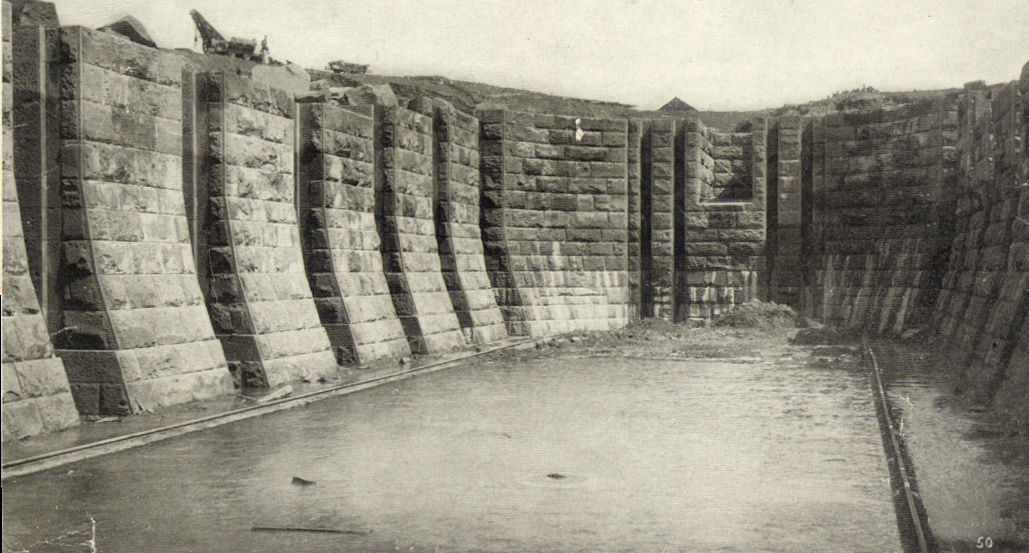
The design was extraordinary. Twin standard-gauge tracks ran in a nearly perfect straight line between Fort Lawrence on the Bay of Fundy and Tidnish Cross Roads on the Northumberland Strait. Ships weighing up to 2,000 tons would float into stone-lined basins at each terminal, settle onto a steel cradle measuring 235 feet by 60 feet, and be lifted out of the water by twenty hydraulic jacks. Two steam locomotives would then haul the cradled vessel across the isthmus in about two and a half hours. The tracks were spaced eighteen feet apart, center to center, to support the massive cradle. At Tidnish, breakwaters protected the harbor. At Fort Lawrence, where the Bay of Fundy's extreme tidal range made things more complicated, Ketchum designed a lock to manage the changing water levels.
Three-Quarters of a Dream
Incorporated in 1882 and financed by the venerable London banking house Baring Brothers, construction began in October 1888. Progress was rapid. By 1890, sixteen miles of rail bed were graded and thirteen miles of track were laid. A keystone bridge and large stone arch culvert were built at Tidnish Bridge, a community that received its name from this very infrastructure. Both terminal docks were constructed, complete with breakwaters and the hydraulic lifting mechanism. Then, in the fall of 1890, Baring Brothers faced insolvency. The bank had overextended itself financing debts in Uruguay and Argentina, triggering what became known as the Panic of 1890. By August 1891, all work on the ship railway ground to a halt. Ketchum pleaded with Ottawa for help. In 1892, Parliament refused to extend the contract.
A Grave with a View
Ketchum never gave up. He lobbied continuously for the project's revival, traveling between Ottawa and the Maritimes, writing letters, making his case to anyone who would listen. On September 8, 1896, he died unexpectedly in Amherst, Nova Scotia, his railway still unfinished. He was buried at a cemetery in Tidnish Bridge, on a hillside that overlooked the abandoned rail bed stretching toward the sea. In time, the tracks were pulled up and recycled. Some of the breakwater stones from Tidnish were carted off in 1917 to Cape Tormentine, where they were used to build ferry docks for service to Prince Edward Island. Nature reclaimed the rail bed, but slowly; aerial photographs in the twenty-first century still show the line cutting across the isthmus with the clarity of a surveyor's drawing.
The Line That Refuses to Disappear
The Chignecto Marine Transport Railway was designated a National Historic Civil Engineering Site in 1989 by the Canadian Society for Civil Engineering. In 2012, the Government of Nova Scotia purchased the right-of-way, and today the old rail bed supports walking and hiking trails. The keystone bridge at Tidnish Cross Roads still carries foot traffic over the Tidnish River on what is now called the Henry Ketchum Trail. At Tidnish Dock Provincial Park, established in 1982, a heritage plaque marks the spot where rock remnants and wood pilings emerge at low tide. Proposals to cross the isthmus have never stopped entirely. A 1930s canal commission dismissed the idea. A 1960s economic study revived it. Maritime scholar Donald Savoie has argued that the federal government should have completed such a project long ago as a promise of Confederation. The isthmus remains uncrossed, and Ketchum's ghost railway remains the closest anyone has come.
From the Air
Located at 46.00N, 64.01W on the Isthmus of Chignecto. The former rail bed is visible in aerial photos as a nearly straight line running 17 miles between Fort Lawrence (Bay of Fundy) and Tidnish Cross Roads (Northumberland Strait). Recommended viewing altitude 2,000-5,000 feet. Nearest airports: CYQM (Greater Moncton, 40 km NE), CYHZ (Halifax Stanfield, 210 km SE). The narrow isthmus, Tantramar Marshes, and both coastlines are visible from altitude. Look for the straight rail bed cutting across the landscape.