Chihaya Castle: The Mountain Fortress That Broke an Army
Kusunoki Masashige was already supposed to be dead. After the Siege of Akasaka in 1331, the warrior who had raised an army for Emperor Go-Daigo against the Kamakura shogunate faked his own death and vanished into the mountains of Kawachi Province. What he did next changed the course of Japanese history. Deep in the forested ridges extending from Mount Kongo, on the border between Kawachi and Yamato provinces, Masashige built two castles: Kami-Akasaka and Chihaya. The first fell. The second did not. For roughly three months in 1333, a garrison of perhaps a few hundred men held Chihaya Castle against a shogunate force the medieval chronicle Taiheiki claims numbered in the hundreds of thousands. The real figure was almost certainly smaller, but even conservative estimates suggest the defenders were outnumbered by a staggering margin. The siege failed. The shogunate crumbled. And the name Kusunoki Masashige became synonymous with cunning, loyalty, and the impossible defense.
A Ridge Built for Defiance
Masashige chose his ground with the eye of a guerrilla commander. Chihaya Castle sits on a narrow ridge at roughly 150 meters elevation gain, with steep cliffs dropping away on both sides into river valleys. The only approach was a climb of 500 steep, narrow stone stairs -- a route that funneled attackers into a killing ground no matter how large their numbers. Mount Kongo itself rises to 1,125 meters, the dominant peak of the Kongo-Katsuragi range on the border of modern Osaka and Nara prefectures, and the castle exploited every advantage the terrain offered. Moveable bridges could be pulled back to deny passage. Felled trees and boulders were staged above the approaches, ready to be rolled downhill onto advancing troops. Brush screens provided cover against arrows. The castle consisted of five enclosures spread along 200 meters of ridgeline, protected by dry moats, with a main enclosure measuring roughly 100 by 20 meters. It was small. It was supposed to be.
Straw Men and Falling Stones
The Taiheiki, the epic chronicle of the Genkō War, records Masashige's defensive tactics with something between admiration and disbelief. When direct assault proved suicidal on the narrow stairways, the shogunate forces tried to starve the castle out. Masashige had anticipated this: the fortress contained a well, and yamabushi -- mountain ascetics loyal to Prince Moriyoshi, who was based on the other side of Mount Kongo -- kept supply lines open through mountain paths the besiegers could not control. Masashige lined the walls with straw-stuffed dummies dressed in armor to give the impression of a larger garrison and to draw wasted volleys of arrows. When attackers advanced toward these decoys, defenders released boulders that crashed down the mountainside, and poured boiling water on those who reached the walls. The tactics were ruthless and effective. The chronicle records that on one occasion alone, fifty boulders killed 300 and wounded 500.
The Siege That Ended an Era
The siege of Chihaya ran from approximately March to late June of 1333. While the shogunate's forces were pinned down against Masashige's mountain stronghold, unable to take it by assault or starvation, the political situation across Japan was shifting decisively. Emperor Go-Daigo, who had been captured and exiled to the Oki Islands after his first failed attempt to overthrow the Kamakura regime in 1331, escaped and returned to rally support. The shogunate's inability to crush a single small castle became a symbol of weakness that emboldened pro-Imperial forces across the country. Ashikaga Takauji, one of the shogunate's own commanders, defected to the Imperial cause. By July 1333, the city of Kamakura itself had fallen. The siege of Chihaya did not win the war alone, but it held the line at the moment that mattered most -- pinning down the regime's military resources while the political ground collapsed beneath them.
Ruins on a Sacred Mountain
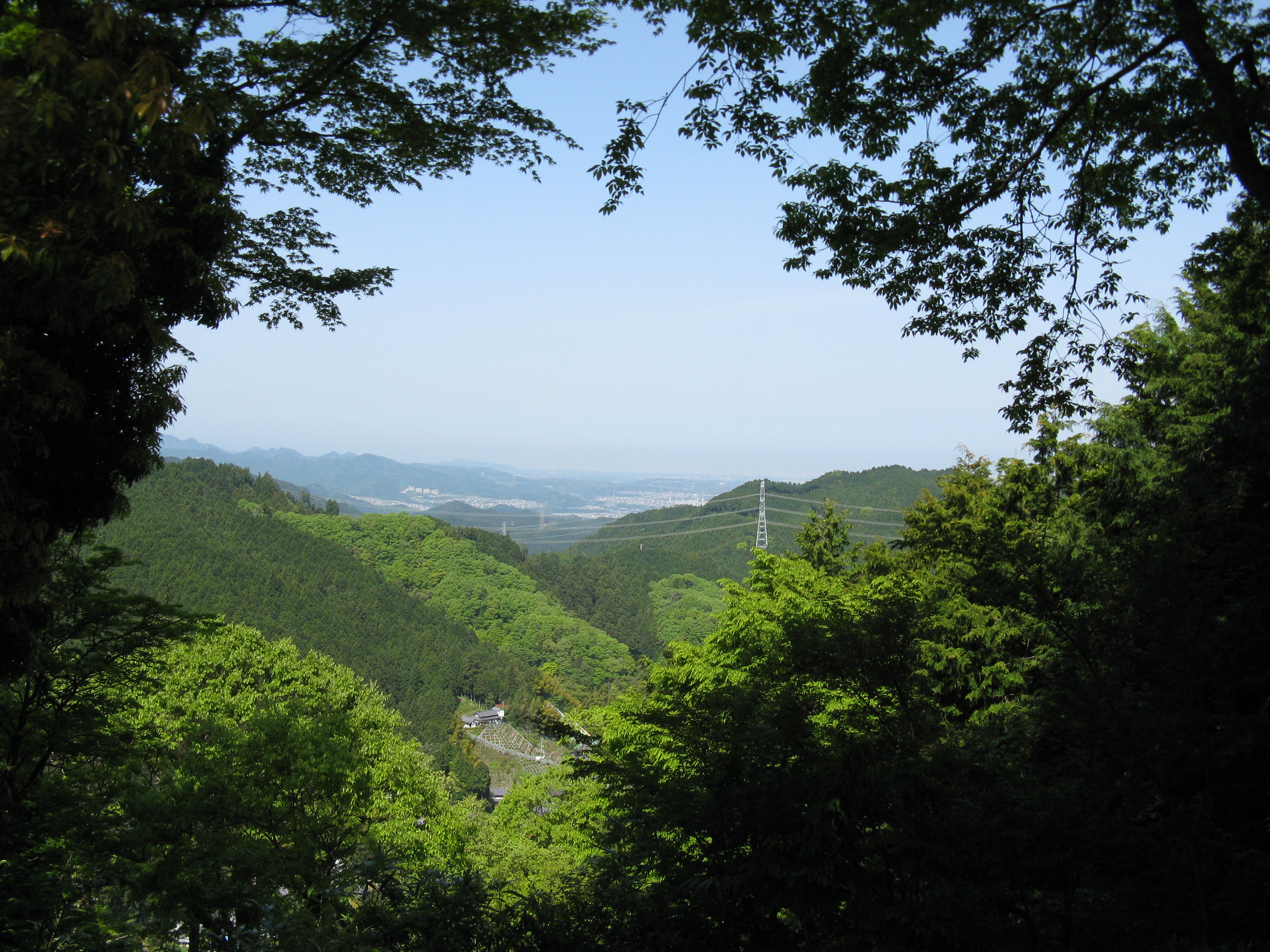
Today, Chihaya Castle exists only as ruins. The dry moats are still visible along the ridgeline, and the sites of the five enclosures -- honmaru, ni-no-maru, san-no-maru, and the outer works -- can be traced by those who climb the steep trail from the base of Mount Kongo. The ni-no-maru, the second enclosure, is now the grounds of Chihaya Shrine, dedicated to Kusunoki Masashige himself. The Japanese government designated the ruins a National Historic Site in 1934, and the Japan Castle Foundation included Chihaya on its list of Japan's Top 100 Castles in 2006. The views from the yon-no-maru, the fourth enclosure, look out over the valley that the shogunate's army once filled -- a landscape of forested ridges and river cuts that makes immediately clear why conventional siege tactics were hopeless here. Masashige understood that terrain is a weapon. Seven centuries later, the terrain still tells his story.
From the Air
Located at 34.42N, 135.65E on a ridge extending from Mount Kongo (1,125m), on the border of Osaka and Nara prefectures. The castle ruins are not visible as structures from altitude but the ridgeline position is distinctive -- a narrow spine with steep drops to river valleys on both sides, clearly defensible terrain. Mount Kongo itself is the dominant peak of the Kongo-Katsuragi range and a useful visual landmark. Best viewed at 3,000-5,000 feet AGL to appreciate the terrain that made the castle so formidable. Osaka Itami Airport (RJOO) lies approximately 25 nm north. Kansai International Airport (RJBB) is roughly 30 nm west-southwest. The mountain terrain creates turbulence; expect variable winds along ridgelines.