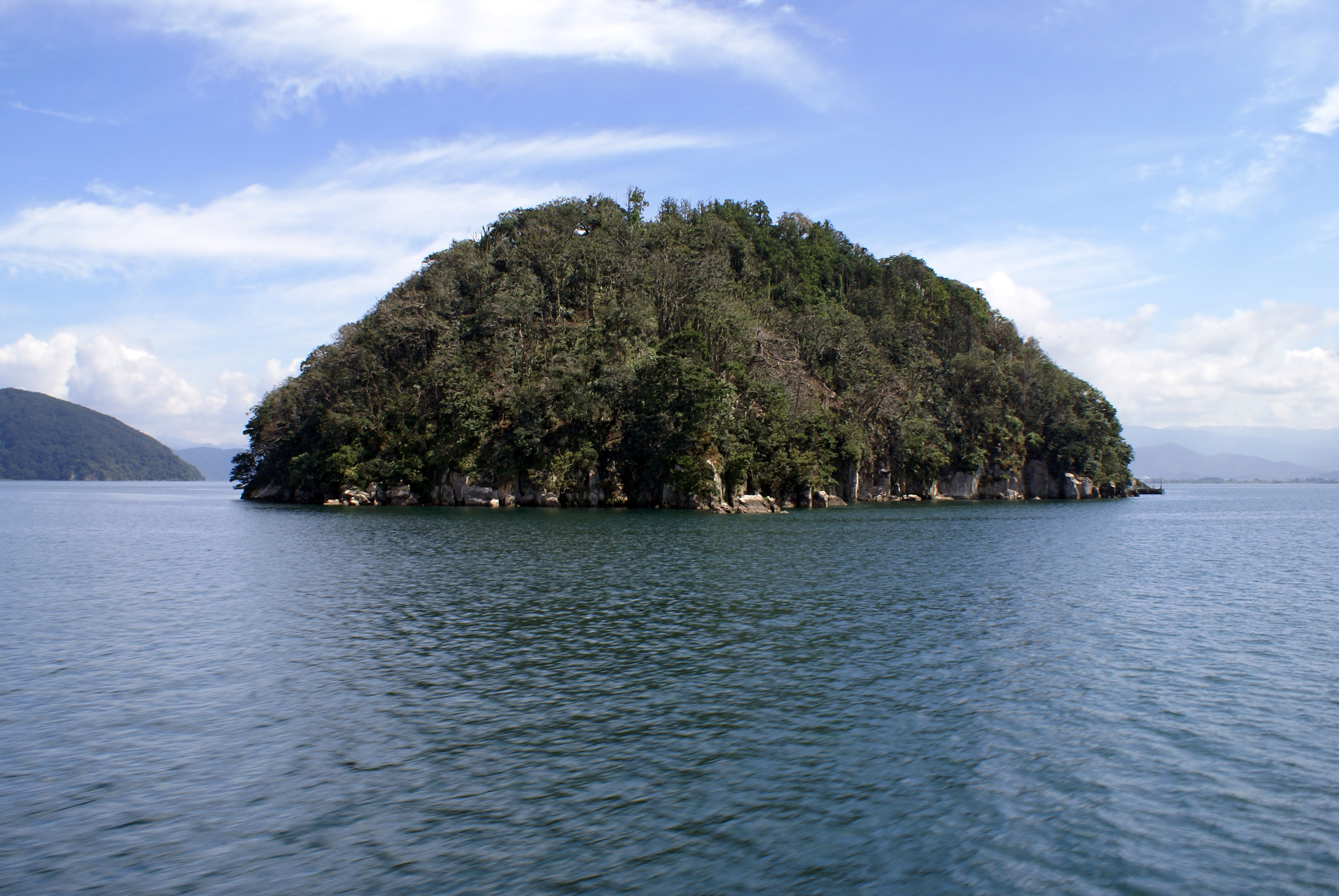
Chikubu Island: Where Gods Live After Dark
No one sleeps on Chikubu Island. The shrine keepers, the monks, the souvenir shop owners -- every human being ferries back to the mainland before dark, leaving the granite rock to its original tenants. The Japanese called it a place where gods dwell, and the nightly evacuation preserves that idea with striking literalness. Rising from the northern reaches of Lake Biwa, Japan's largest freshwater lake, Chikubushima is a granite monolith two kilometers around, ringed by sheer cliffs on every side except the single harbor at its southern tip. Below the waterline on its western face lies the deepest point in all of Lake Biwa -- 104.1 meters down. Above the surface, the island packs a Shinto shrine claiming foundation in 420 AD, a Buddhist temple from 724 AD, two National Treasures, and a designation as both a National Historic Site and Place of Scenic Beauty into an area smaller than most city parks.
Stone and Water
Chikubu Island is the second largest island in Lake Biwa, though "large" requires context -- the entire circumference is roughly two kilometers, and its highest point reaches 197 meters above the lake surface. The island is a single mass of granite, its cliffs dropping vertically into water that plunges to extraordinary depth on the western side. The harbor on the southern end is the only breach in the rock wall, and it serves as the sole point of arrival and departure for the ferries that bring visitors from Nagahama and other lakeside towns. Near the harbor cluster the temples, the shrine, and a handful of souvenir shops. Beyond them, the terrain rises steeply through forest to the summit. Until the late 1970s, that forest was a dense canopy of evergreens -- chinquapin, camphor, camellia, and holly covering the slopes in unbroken green.
The Cormorant Invasion
In 1977, great cormorants began arriving on Chikubu Island. They displaced the heron population that had previously occupied the northern portion, and their numbers grew with alarming speed. By 2007, more than 40,000 cormorants were nesting on the island. The environmental damage has been tremendous. Cormorant colonies strip trees of bark and leaves, and their guano -- acidic and nitrogen-rich -- poisons the soil beneath their roosts. The dense evergreen forest documented in vegetation surveys from 1972 to 1973 has been devastated in the northern reaches, with dead and dying trees standing skeletal against the sky. The contrast between the maintained temple grounds near the harbor and the cormorant-damaged forest further up the slopes tells a quiet story about the tension between preservation and natural forces on an island too small to absorb both.
Where Buddhism and Shinto Blur
Chikubu Island's spiritual identity refuses to be neatly categorized. The Shinto shrine of Tsukubusuma claims a founding date of 420 AD. The Buddhist temple of Hogon-ji traces its origins to 724 AD. For most of their history, the two were a single institution known as "Chikubu Benzai-ten," dedicated to the goddess Benzaiten -- a water deity adapted from the Indian goddess Sarasvati, who governs eloquence, learning, and music. This blended worship, called shinbutsu-shugo, placed Chikubushima alongside the Enoshima Shrine in the Kanto region and the Itsukushima Shrine near Hiroshima as one of Japan's Three Great Shrines of Benzaiten. Pilgrims came to the island as the 30th stop on the Saigoku Kannon Pilgrimage route. When the Meiji government forced the separation of Shinto and Buddhism in the late nineteenth century, the shrine and temple were officially split -- but on an island this small, the distinction has always felt more administrative than spiritual.
Warlords and Exiles
The island's remoteness made it useful for purposes beyond worship. During the Sengoku period, retainers of the warlord Azai Nagamasa confined his own father, Azai Hisamasa, to Chikubushima, forcing the old lord into retirement so his son could take power. The isolation that made the island sacred also made it an effective prison. Later, the Toyotomi clan left a more generous mark. Toyotomi Hideyori, son of the great unifier Toyotomi Hideyoshi, had structures relocated to the island from his father's gravesite in Kyoto's Higashiyama district. The temple's Kannon-do and the ornate Karamon gate -- both fine examples of Azuchi-Momoyama period architecture -- were transplanted to this granite speck in the lake. The Karamon gate and the honden of the shrine are now designated National Treasures of Japan.
The Island in Art
Chikubu Island's hold on the Japanese imagination extends well beyond religion. During the Edo period, it was designated one of the Eight Views of Lake Biwa -- a celebrated series of scenic landscapes in the Chinese painting tradition. The island inspired a famous Noh play called Chikubushima, in which a court official takes a fishing boat to the island and discovers that the elderly couple ferrying him are actually Benzaiten and the Dragon God of Lake Biwa in disguise. The tale became the basis for works across Japanese performing arts: a Heike Biwa narrative, two koto melodies, a joruri, a nagauta, and a tokiwazu-bushi all carry the island's name. From every angle -- geological, spiritual, ecological, artistic -- Chikubushima punches far above its weight, a two-kilometer ring of granite that has shaped Japanese culture for more than fifteen centuries.
From the Air
Located at 35.42°N, 136.14°E in the northern portion of Lake Biwa, Shiga Prefecture. The island is clearly visible from altitude as a small, forested landmass in the upper part of Japan's largest freshwater lake. Lake Biwa itself is an unmistakable feature -- the largest lake in Japan, stretching roughly 64 km north-south. Best viewed at 3,000-6,000 feet AGL. The island sits approximately 2 km south of Cape Tsuzurao on the mainland shore. Nearest airports include Chubu Centrair (RJGG) approximately 100 km southeast and Osaka Itami (RJOO) approximately 110 km southwest. The city of Nagahama lies on the eastern lakeshore nearby.