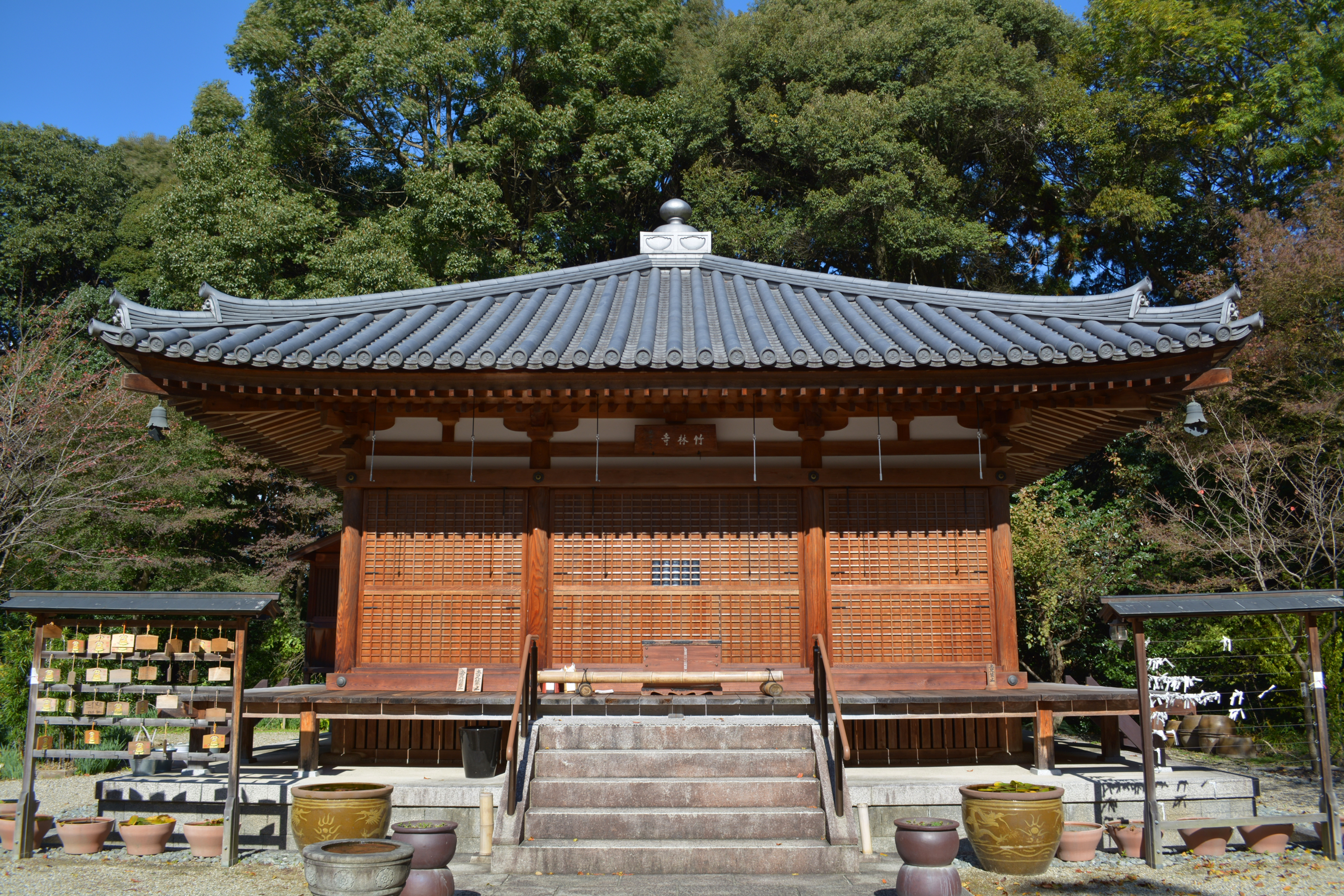
Chikurin-ji: The Bamboo Grove Temple and the Grave of a Monk Who Built Japan
Five centuries after his death, a monk named Jakumetsu dreamed of Gyoki. The dream was specific: go to Mount Ikoma, dig at the grave site, and see what remains. In 1235, Jakumetsu and his companions did exactly that, unearthing a relic jar and a copper tombstone from the hillside burial. The tombstone confirmed what temple records had long claimed -- that Gyoki, the great monk of the Nara period who built bridges, organized flood control, and played a central role in constructing the Great Buddha of Todai-ji, had been cremated and buried here on the eastern slopes of Mount Ikoma. The temple that guards this grave is Chikurin-ji, the Bamboo Grove Temple, named after its sacred counterpart on Mount Wutai in China. It has been destroyed, abandoned, and rebuilt across thirteen centuries. What endures is the connection to a man whose life bridged the gap between spiritual devotion and public service.
The Monk Who Built Bridges
Gyoki was born around 668 and spent his life in a remarkable intersection of religious practice and civil engineering. Active throughout the Nara period, he organized bridge construction, irrigation projects, and flood control systems across central Japan. His most celebrated achievement was his role in building the Great Buddha -- the Daibutsu -- at Todai-ji in Nara, one of the largest bronze statues in the world. His reputation for selfless public works grew so vast that he came to be regarded as an incarnation of Manjusri, the bodhisattva of wisdom. According to the Gyoki Nenpu, written in 1175, Gyoki moved to a hermitage called Ikuma Senbo on Mount Ikoma in 707, when he was about forty years old. A separate account, the Chikurinji Ayakuroku written by the Todai-ji scholar Gyonen in 1305, places his arrival on the mountain in 704. Whether these references describe the same place is uncertain, but the presence of Gyoki's grave at Chikurin-ji ties the temple directly to the monk's final years.
Buried, Lost, Found Again
The temple appears to have fallen into disrepair remarkably quickly. The Shoku Nihongi, an official court history, records an entry from November 20, 773 -- only about twenty years after Gyoki's death in 749 -- noting that six of the forty-odd temples where Gyoki trained had deteriorated and needed rice field donations for their support. Ikuma-in, believed to be an early name for Chikurin-ji, was listed among them. The site lay largely forgotten until Jakumetsu's excavation in 1235 brought the relics back to light. The copper tombstone confirmed the cremation site and was reburied. Centuries later, at the end of the Edo period, a small fragment of that same copper tombstone was excavated again and passed into private hands. On November 11, 1933, Japan designated it an Important Cultural Property under the name 'Fragment of Gyoki's Copper Relic Vase.' It now resides in the Nara National Museum.
Revival, Destruction, and Return
In the medieval period, the great Ritsu sect reformers Eison and his disciple Ninsho rebuilt Chikurin-ji, restoring it as a place of worship on the mountain. The revival held for centuries. Then came the Meiji Restoration. Beginning in 1868, the new government's haibutsu kishaku movement -- a wave of anti-Buddhist sentiment tied to the promotion of State Shinto -- swept through Japan, and Chikurin-ji was abandoned. A wooden seated statue of Gyoki, once enshrined at the temple, was moved to Toshodai-ji for safekeeping; that statue is now classified as a National Important Cultural Property. The temple grounds on Mount Ikoma sat empty for more than a century. It was not until 1997 that Chikurin-ji was finally rebuilt, restoring the site as an active temple of the Ritsu sect with its honzon, a statue of Monju Bosatsu -- Manjusri, the very figure Gyoki was believed to embody.
A Quiet Mountain, A Long Memory
Today, Chikurin-ji sits 1.2 kilometers southwest of Ichibu Station on the Kintetsu Ikoma Line, in the Arisato neighborhood of Ikoma, Nara Prefecture. It is a small, quiet place, easy to miss. The mountain setting offers none of the grandeur of Todai-ji or the scale of Toshodai-ji. But what it holds is singular: the grave of a monk who was revered as an incarnation of wisdom, whose public works shaped the infrastructure of eighth-century Japan, and whose relic jar was sought out by dream-guided monks five hundred years after his death. The temple's name links it across continents to Mount Wutai in China, one of the most sacred Buddhist sites in the world. Chikurin-ji may be modest in size, but its roots reach deep -- into the bedrock of Japanese Buddhism, and into the life of a man who believed that building a bridge was as holy as reciting a sutra.
From the Air
Located at 34.67°N, 135.70°E on the eastern slopes of Mount Ikoma, which forms the natural boundary between Nara and Osaka Prefectures. From altitude, Mount Ikoma (642 meters) is the prominent ridgeline running north-south between the two plains. The temple sits in forested terrain east of the mountain's summit. Osaka Itami Airport (RJOO) is approximately 25 km to the west-northwest. Kansai International Airport (RJBB) is roughly 55 km to the southwest. Nara city center and the Todai-ji complex are approximately 10 km to the east-southeast. Best viewed at 3,000-4,000 feet AGL to appreciate the mountain setting.