Children's Fairyland
Here is a rule you will encounter nowhere else in American amusement parks: adults cannot enter without a child, and children cannot enter without an adult. The policy tells you everything about Children's Fairyland, a ten-acre storybook world on the shores of Lake Merritt in Oakland that has operated on the radical premise, since 1950, that wonder is best experienced together. This tiny park - no roller coasters, no corporate mascots, no sprawling parking lots - became one of the most consequential amusement parks in American history, not for what it contained but for what it inspired.
The Park That Caught Disney's Eye
In 1950, Walt Disney was touring amusement parks across the country, collecting ideas for a project he had not yet named. Among the parks he visited was the newly opened Children's Fairyland, with its storybook-themed play sets, gentle rides, and live animals scattered across the lakeside grounds. Something about the place stuck. When Disneyland opened five years later in Anaheim, Disney hired Fairyland's first director, Dorothy Manes, to serve as youth director - a position she held from opening day in 1955 until 1972. The connection between the modest Oakland park and the Anaheim empire is not a stretch of revisionist history; it is a documented thread in the story of American themed entertainment. Fairyland was among the earliest parks in the country to organize itself around narrative themes rather than simply assembling thrill rides.
Where Puppets Made Careers
The Open Storybook Puppet Theater, which opened in 1956, holds an unlikely distinction: it is the oldest continuously operating puppet theater in the United States. The list of people who passed through its curtains reads like a hidden history of American puppetry and entertainment. A teenager named Frank Oznowicz apprenticed there, manipulating hand and rod puppets on the small stage. He later shortened his name to Frank Oz, went on to perform Miss Piggy, Fozzie Bear, and Yoda, and directed films including Little Shop of Horrors and Dirty Rotten Scoundrels. Muppet performer Alice Dinnean also got her start at the Fairyland theater. Lewis Mahlmann directed the puppet program from 1967 to 2005, authored four books on puppetry, and twice served as president of the Puppeteers of America.
Art Woven Into the Landscape
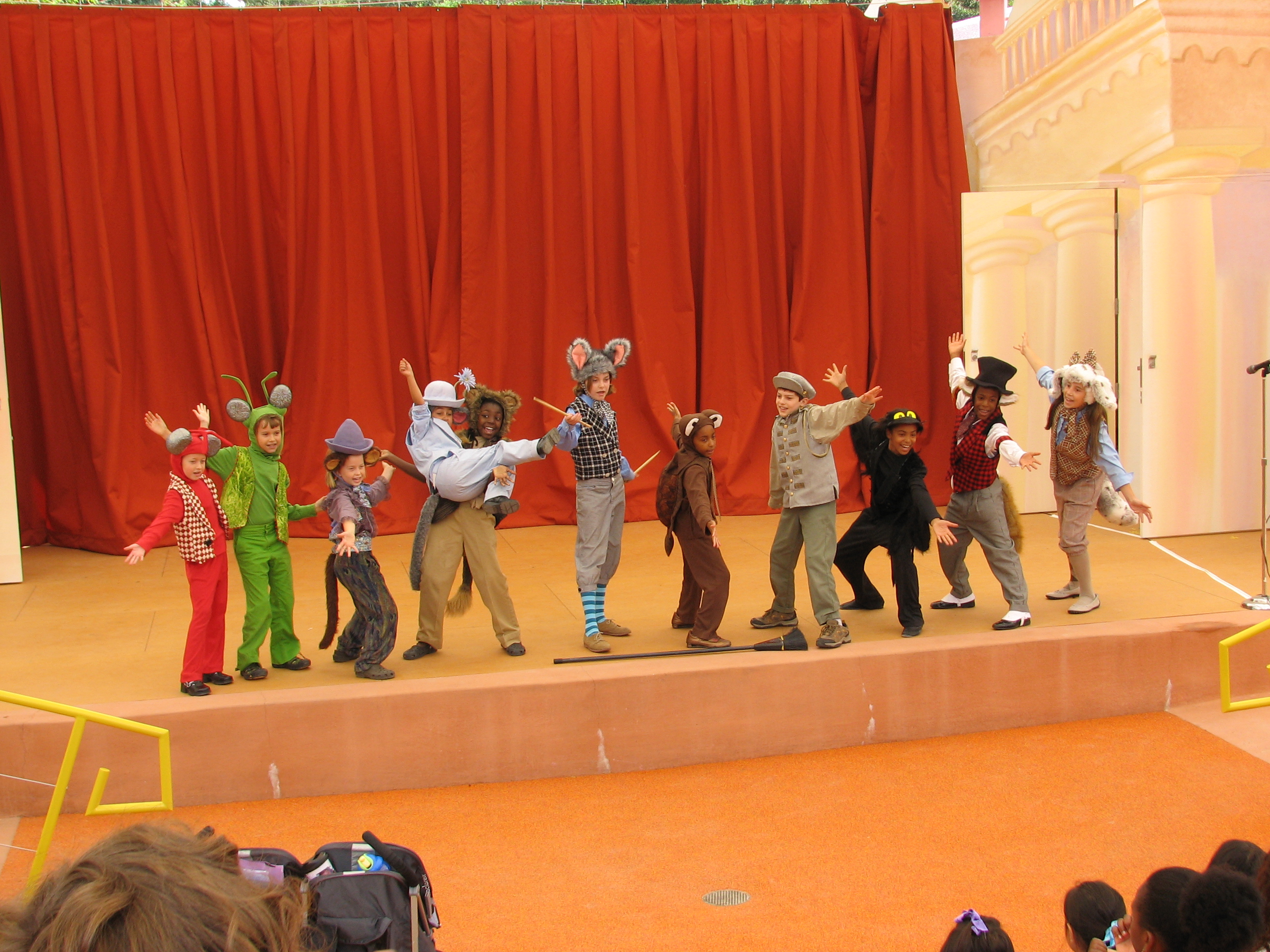
Fairyland has always drawn serious artists to its whimsical mission. The sculptor Ruth Asawa, celebrated for her intricate wire sculptures displayed in museums worldwide, contributed work to the park. Murals, sculptures, and hand-crafted exhibits fill the ten acres, each designed to pull children into stories rather than simply entertain them. The park's rides reflect this philosophy: a spiderweb-shaped Ferris wheel, a carousel, and the Jolly Trolly train - all scaled to a child's sense of proportion. In 2008, Fairyland opened Aesop's Playhouse, a Greek theater-style outdoor amphitheater seating 215 people, funded by Oakland city bond measure DD. The theater hosts plays performed by local children ages eight to ten, continuing a tradition that stretches back decades on the park's earlier Emerald City Stage.
Surviving on Stories and Stubbornness
Fairyland's longevity is itself a small miracle. In a state where theme parks compete with billion-dollar budgets and immersive digital experiences, this nonprofit park has survived by staying exactly what it has always been. In 1994, with help from the Lake Merritt Breakfast Club, Fairyland obtained 501(c)(3) nonprofit status, allowing it to apply for grants, receive bond funds, and solicit donations. The puppet theater received a near-complete renovation in 2006 for its fiftieth anniversary, with a new facade and workshop. The park remains deliberate about its audience: families with young children, not thrill-seekers or Instagram tourists. Its admission policy - the mutual escort rule - is not a quirk but a statement of purpose.
Ten Acres of Quiet Influence
During the 1950s, Fairyland's model inspired numerous towns across America to create their own small themed parks. The idea that a park could tell stories, could immerse visitors in narrative rather than just sell them speed and vertigo, was genuinely new. Most of those imitators are long gone. Disneyland became a global empire. But Fairyland endures on its original ten acres beside Lake Merritt, still putting on puppet shows, still casting local children in plays about Brer Rabbit and Aesop's Fables and The Cat in the Hat. The park where Frank Oz learned to make puppets talk has never needed to be bigger than it is. Its influence was always larger than its footprint.
From the Air
Children's Fairyland sits at 37.809N, 122.260W on the north shore of Lake Merritt in Oakland. From the air, Lake Merritt is the most identifiable landmark - a distinctive tidal lagoon surrounded by urban parkland in the heart of Oakland. Fairyland occupies a green strip along the lake's northern edge. The park is too small to distinguish individually from altitude, but the lake itself is unmistakable. Nearest airports: Oakland International (KOAK) approximately 6 nm south, and Buchanan Field (KCCR) approximately 17 nm northeast. Metropolitan Oakland International provides ILS approaches that pass near the lake on certain arrivals.