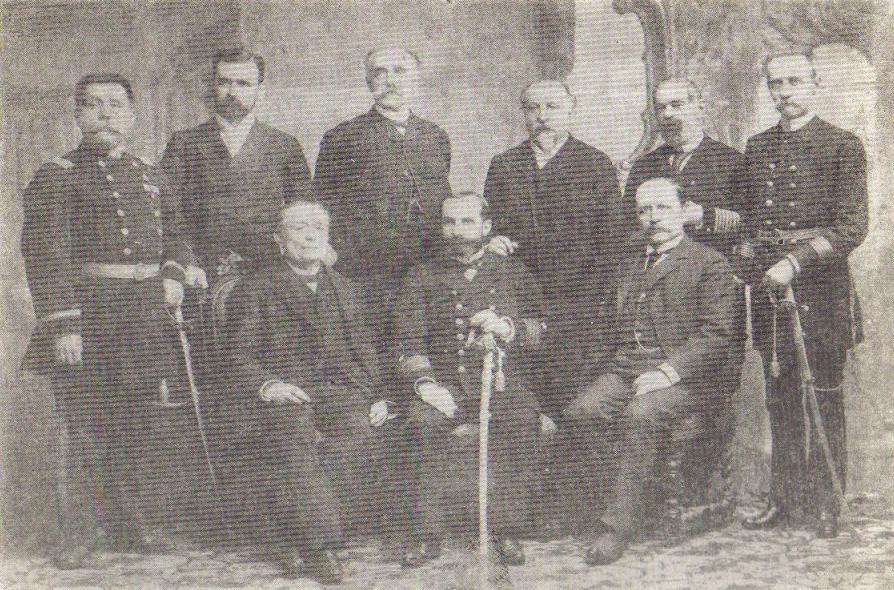
Chilean Civil War of 1891
On the morning of September 18, 1891, Jose Manuel Balmaceda shot himself in the Argentine legation in Santiago. It was the exact day his presidential term expired. He left behind letters explaining that he did not believe his enemies would give him a fair trial -- and a country that had just endured its bloodiest internal conflict, a civil war that killed more than 10,000 people in eight months. The war had been fought over a question that sounds almost procedural: who controls the budget? But behind that question lay the nitrate wealth of the Atacama Desert, the ambitions of a modernizing president, and a Congress determined to assert its authority over both.
A President Without a Majority
The crisis grew from a collision between Chilean political custom and presidential will. Under the conventions of the time, a minister could not remain in office without the support of a congressional majority. President Balmaceda, unable to appoint a cabinet that satisfied both Congress and his own vision for governing, decided that the constitution granted him the right to choose his ministers regardless. Congress waited for its moment. It came in 1890, when Balmaceda made clear his intention to install his close friend Claudio Vicuna as his successor. Congress refused to approve the budget. Balmaceda compromised, then reneged. On January 1, 1891, he declared the previous year's budget would simply carry forward -- an act the opposition viewed as unconstitutional. Within days, the vice-president of the Senate and the president of the Chamber of Deputies signed an Act of Deposition, and Captain Jorge Montt was appointed Commander of the Navy.
A Fleet Without an Army
The Chilean Navy sided with Congress; the Army stayed loyal to the president. The result was a peculiar division of power: the Congressionalists had ships but no soldiers, the Balmacedists had soldiers but no ships. On January 7, 1891, the armored frigate Blanco Encalada, carrying congressional leaders aboard, sailed north from Valparaiso to Tarapaca -- to the nitrate region whose revenues had fueled the crisis in the first place. From Iquique, the Congressional Junta began building an army from scratch, recruiting sympathizers and importing arms from Europe via a circuitous route through Tierra del Fuego and the Strait of Magellan. An ex-Prussian officer, Emil Korner, was appointed chief of staff and drilled the raw recruits into fighting shape. Balmaceda, meanwhile, raised a presidential army of 40,000 and waited.
Iquique at the Center
The nitrate port became the Congressional headquarters. After early setbacks at Pisagua in January, Congressional forces captured Iquique on February 16 and won the decisive battle of Pozo Almonte on March 7, securing the entire Norte Grande from the Peruvian border to the Balmacedist outposts at Coquimbo. The Balmacedists struck back at sea: on the night of April 23, the torpedo gunboat Almirante Lynch steamed into Caldera Bay and sank the Blanco Encalada with a torpedo, killing 300 crew members and severely weakening the Congressional squadron. But it was not enough. By July, arms from Europe had reached Iquique, and Colonel Estanislao del Canto commanded 9,000 equipped troops ready for the campaign that would decide the war.
The March on Valparaiso
In mid-August 1891, the Congressional army embarked at Iquique and sailed south -- not to Coquimbo, as both sides expected, but directly to Valparaiso. The expedition landed at Quintero on August 10, just 20 kilometers north of the port city. The Battle of Concon on August 21 was the first test: Congressional infantry forced the Aconcagua River crossing and stormed the heights, inflicting 1,600 casualties on the Balmacedists. Nearly all 1,500 prisoners enrolled in the rebel army. Del Canto and Korner then executed a bold flank march inland, abandoning their supply lines to appear southeast of Valparaiso. At La Placilla on August 28, the decisive battle destroyed the presidential army. General Orozimbo Barbosa and 941 of his men were killed; 2,402 were wounded. Valparaiso fell that evening, Santiago three days later.
The Parliamentary Era Begins
Balmaceda handed power to General Manuel Baquedano on August 29 and retreated to the Argentine legation, where he remained until his suicide twenty days later. The war's aftermath reshaped Chilean governance for a generation. The defeat of presidential power ushered in the so-called Parliamentary Era, lasting from 1891 to 1925, in which the legislature dominated the executive -- though without the checks and balances of a true parliamentary system. The position of president survived as head of state, but with diminished authority. The total cost exceeded ten million pounds sterling. The dead numbered more than ten thousand. And the nitrate wealth that had precipitated the conflict continued to flow -- for another two decades, until synthetic nitrogen made it worthless and left ghost towns scattered across the desert where an army had been built and a nation torn apart.
From the Air
The war's key locations span northern Chile. The Congressional Junta was headquartered in Iquique (SCDA, 20.27S, 69.80W). The Blanco Encalada was sunk at Caldera Bay (27.07S, 70.82W). The decisive battles occurred near Valparaiso: Concon at the Aconcagua River mouth and La Placilla southeast of the port. The geohash coordinates place this article near the Humberstone saltpeter works, the heart of the nitrate region whose revenues drove the conflict. From the air, the desert landscape between Iquique and Pisagua (where early battles took place) is clearly visible along the coast.