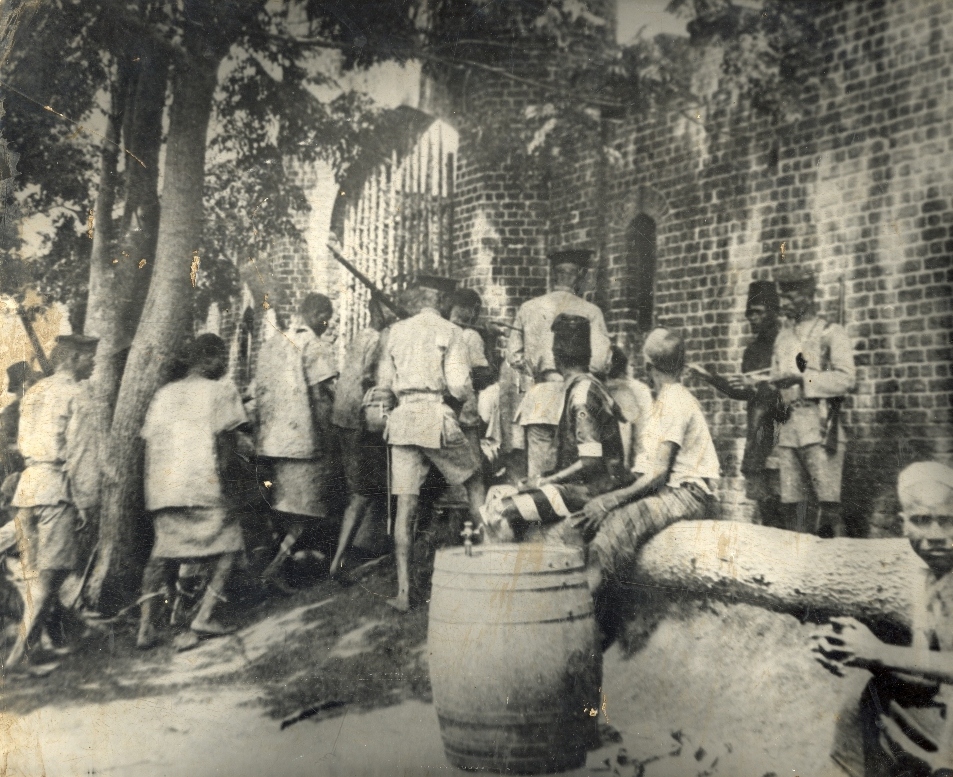
Chilembwe Uprising
On the evening of 23 January 1915, a Baptist minister named John Chilembwe stood before his congregation in the village of Mbombwe and told them that none of them should expect to survive what came next. The uprising he was about to launch against British colonial rule in Nyasaland would not succeed militarily -- he knew that. But Chilembwe believed that the act itself, the refusal to submit quietly, would force the world to notice what was happening to his people. Within two weeks he would be dead. Within half a century, his face would appear on the currency of an independent Malawi.
A Minister's Reckoning
Chilembwe was born around 1871 near what is now Chiradzulu in southern Malawi. Educated first at a Church of Scotland mission, he caught the attention of Joseph Booth, a radical Baptist missionary whose egalitarian preaching alarmed both the colonial government and the established churches. Under Booth's patronage, Chilembwe travelled to the United States in 1897 and studied at the Virginia Theological Seminary in Lynchburg, where he encountered the legacies of John Brown and Booker T. Washington. He returned to Nyasaland in 1900 with an American education, American Baptist backing, and a vision of African self-determination that would put him on a collision course with the colonial system. He founded the Providence Industrial Mission near Mbombwe, building churches and schools, and for over a decade worked within the system -- petitioning, writing letters, trying to change things through patience and persuasion. By 1914, patience had run out.
The Spark and the Powder
The grievances were not abstract. White settlers in the Shire Highlands had acquired vast tracts of land from local chiefs, often for token payments in beads or guns. On these plantations, African workers were beaten, underpaid, and trapped by the thangata system of forced labour. The A. L. Bruce Estates at Magomero, spanning some 5,000 acres, had a particular reputation for brutality -- its managers closed local schools, beat their workers, and in November 1913 burned down one of Chilembwe's own churches. Then came the First World War. The colonial government began conscripting African men to fight in a European conflict that had nothing to do with them, sending them to die in the East Africa campaign. Chilembwe wrote a letter to the Nyasaland Times asking why Africans should shed blood for an empire that treated them as less than human. The paper published it. The government suppressed further copies. For Chilembwe, words had failed.
Three Days in January
The rebellion unfolded in less than seventy-two hours. On the night of 23 January, one group of rebels attacked the Bruce plantation at Magomero, killing the manager William Jervis Livingstone and two other white settlers. They captured Livingstone's wife and the other women and children but did not harm them -- Chilembwe had given strict orders that women and children were not to be touched. A simultaneous raid on a weapons store in Blantyre captured only five rifles before being repulsed. The rebels cut telephone lines between Zomba and Blantyre, buying themselves a few hours. By morning, the colonial authorities had mobilized the Nyasaland Volunteer Reserve and redeployed the King's African Rifles from the north. On 25 January, Chilembwe's forces held a defensive position along the Mbombwe river and repelled a KAR assault, killing two soldiers. It was the rebels' only military success. The next day, government troops found Mbombwe abandoned and dynamited Chilembwe's church.
Flight and Aftermath
Chilembwe fled toward Portuguese Mozambique, a border he had crossed many times on hunting trips. He never made it. On 3 February, a police patrol shot him dead near the frontier. David Kaduya, the former King's African Rifles soldier who had led the rebels in the field, was captured and publicly executed at Magomero. About forty rebels were executed in the uprising's aftermath, and some three hundred were imprisoned. The colonial government demolished the Providence Industrial Mission and tried to erase Chilembwe's memory. They failed at that, too. The rebellion prompted official inquiries and modest reforms, including restrictions on thangata labour, though the fundamental structure of colonial exploitation remained intact. What changed was something less tangible but more durable: the knowledge, passed through families and communities, that someone had stood up.
The Face on the Banknote
In the decades that followed, Chilembwe's story grew. The Nyasaland African Congress of the 1940s and 1950s adopted him as a symbolic figurehead, declaring 15 January as Chilembwe Day -- a move that scandalized colonial officials. Historians George Shepperson and Thomas Price published their exhaustive study, Independent African, in 1958; the colonial government promptly banned it, which only increased its readership among Nyasaland's educated class. When Hastings Kamuzu Banda led Malawi to independence in 1964, the new government elevated Chilembwe to the status of national hero. His image now appears on Malawi's banknotes. A public holiday, John Chilembwe Day, is observed every January. The Providence Industrial Mission was rebuilt. In Mbombwe, where a minister once told his followers they would not survive the night, a monument now stands to the idea that resistance, even when doomed, can reshape the future.
From the Air
Located at 15.76°S, 35.19°E in the Shire Highlands of southern Malawi, near the village of Mbombwe in Chiradzulu District. The area lies approximately 20 km northeast of Blantyre. Nearest major airport is Chileka International Airport (FWCL) in Blantyre. The terrain is hilly highland at approximately 1,000 m elevation. Chiradzulu Mountain is visible to the north as a prominent landmark. Clear skies typical in the dry season (May-October).