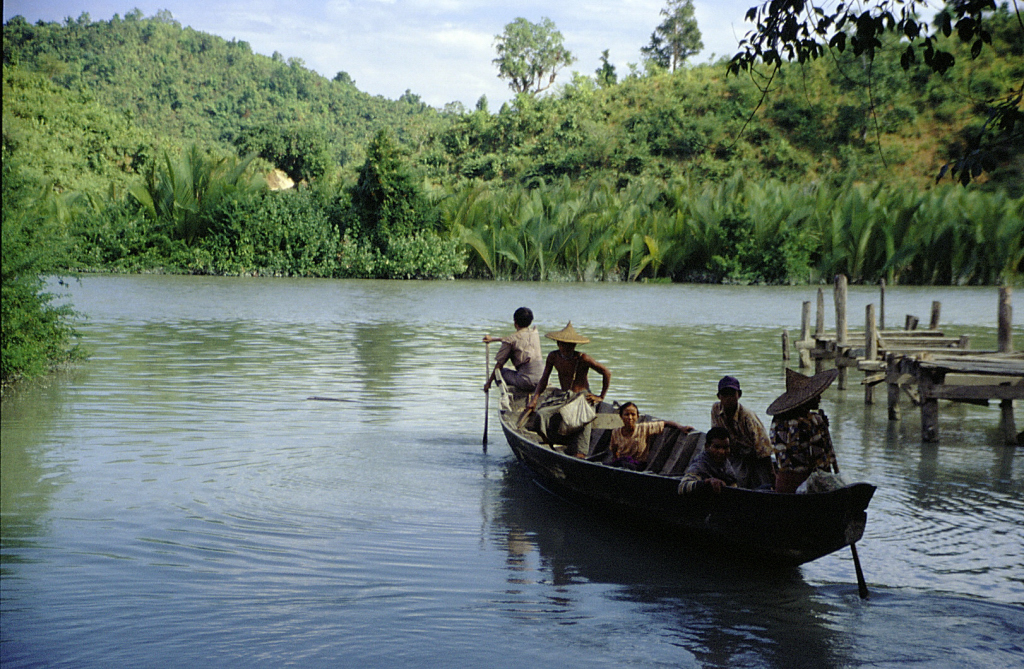
Chin State
Somewhere in western Myanmar, the roads stop making sense. They twist upward through fog-wrapped ridges, narrowing to single lanes that cling to hillsides at 6,000 feet. This is Chin State, a 36,072-square-kilometer wedge of mountains along the Indian and Bangladeshi borders, home to roughly half a million people scattered across terrain so vertical that neighboring villages can see each other's cookfires but need a full day's walk to visit. It is Myanmar's poorest state, its least connected, and one of its most culturally distinct.
Where the Hills Have Names
The Chin Hills are not one range but a tangle of ridges and valleys running north to south, spurs of the greater Arakan Mountains that separate Myanmar's central plains from the Indian subcontinent. Mount Victoria, known locally as Nat Ma Taung, rises to 10,070 feet and stands as the state's highest point. The capital, Hakha, perches on a plateau at 6,125 feet above sea level, making it one of Myanmar's coldest cities. Temperatures can drop near freezing in winter, an improbable chill in a country most travelers associate with tropical heat. The Chin people, of Tibeto-Burman origin, are believed to have migrated into these highlands by the fourteenth century. The government recognizes 53 distinct Chin sub-groups, each with its own dialect, customs, and clan identity. For centuries, the mountains kept them largely autonomous, and that geographic isolation has shaped everything from their farming practices to their faith.
Ink That Tells a Story
For at least a thousand years, Chin women bore intricate tattoos across their faces. The designs varied by sub-group: semi-circles on the cheeks representing the moon, lines on the nose and chin symbolizing sun rays, dots standing for stars. Tattoo artists used thorns from cane plants as needles and mixed pine bark soot with leaf pigments for ink. Girls between twelve and fourteen endured the process as a rite of passage into adulthood. The origins of the practice remain debated. Some oral histories claim the tattoos were meant to make women less attractive to Burmese kings who raided the hills for brides. Others say the patterns served as tribal identifiers in case of capture. The elder women who carry them today speak of beauty, courage, and belonging. Myanmar's military regime banned facial tattooing in the 1960s, and the last known traditional session took place over two decades ago. Today, most tattooed women are over seventy. The tradition is vanishing with the generation that wears it.
The Hymns in the Hills
Chin State is the only state in Myanmar where Christians form a majority, at 85.4 percent according to the 2014 census. The transformation began in the late nineteenth century when Swedish-American Baptist missionaries arrived in the hills. They found communities practicing animism, with rich traditions of spirit worship tied to the mountains and forests. Within a few generations, Christianity took deep root. Churches now anchor nearly every Chin village, and institutions like the Chin Christian College in Hakha Township and Zomi Theological College in Falam serve as both educational and cultural centers. Buddhists make up about 13 percent of the population, with small communities of Muslims and followers of Pau Cin Hau, a uniquely Chin religious tradition that developed its own script. The religious landscape makes Chin State an anomaly in overwhelmingly Buddhist Myanmar, a place where Sunday hymns echo off mountain walls instead of monastery bells.
A Poverty Written in Geography
Chin State's poverty is not abstract. With a poverty rate that has been measured as high as 73 percent, it consistently ranks as Myanmar's poorest region. The mountains that preserved Chin cultural identity also limited economic development. Most families practice rotational slash-and-burn agriculture, growing rice, maize, and millet on steep hillsides, often producing just enough to eat. Roads are few and frequently impassable during the monsoon. Hakha itself remains small and undeveloped despite being the state capital since 1974. There were only 25 high schools in the entire state as of 2003. Young people leave for Yangon, Mandalay, or abroad in search of opportunity, and Chin diaspora communities have formed as far afield as Norway, Denmark, Germany, and the United States. Those who remain tend crops on terraced hillsides, weave textiles with patterns specific to their clan, and play the nose flute, an instrument that has become a quiet symbol of Chin identity.
Resilience Above the Clouds
Since the military coup of February 2021, Chin State has become one of the centers of grassroots resistance in Myanmar. The same remoteness that kept the Chin isolated for centuries now complicates military control over the region's steep terrain and scattered settlements. The Chin National Front, which has operated in various forms for decades, gained renewed significance as civil servants went on strike and young people formed local defense forces. Entire towns, including Thantlang, suffered burning and bombardment. The conflict has deepened an already severe humanitarian crisis in a state with minimal infrastructure to begin with. Yet the Chin have a long history of self-governance and mutual aid across clan lines, qualities forged by centuries of survival in some of Southeast Asia's most unforgiving geography. The mountains remain both their burden and their fortress.
From the Air
Located at 22.00N, 93.50E in western Myanmar along the Indian border. The terrain is extremely mountainous with peaks exceeding 10,000 feet, including Mount Victoria (Nat Ma Taung) at 10,017 feet. Hakha, the capital, sits at 6,125 feet elevation. Nearest airports include Kalay (VYKL) to the northeast and Sittwe (VYSW) to the south in Rakhine State. Expect turbulent conditions over the ridgelines and frequent cloud cover, especially during monsoon season (May-October). The lack of flat terrain makes this region visually striking from altitude, with ridgeline after ridgeline extending to the horizon.