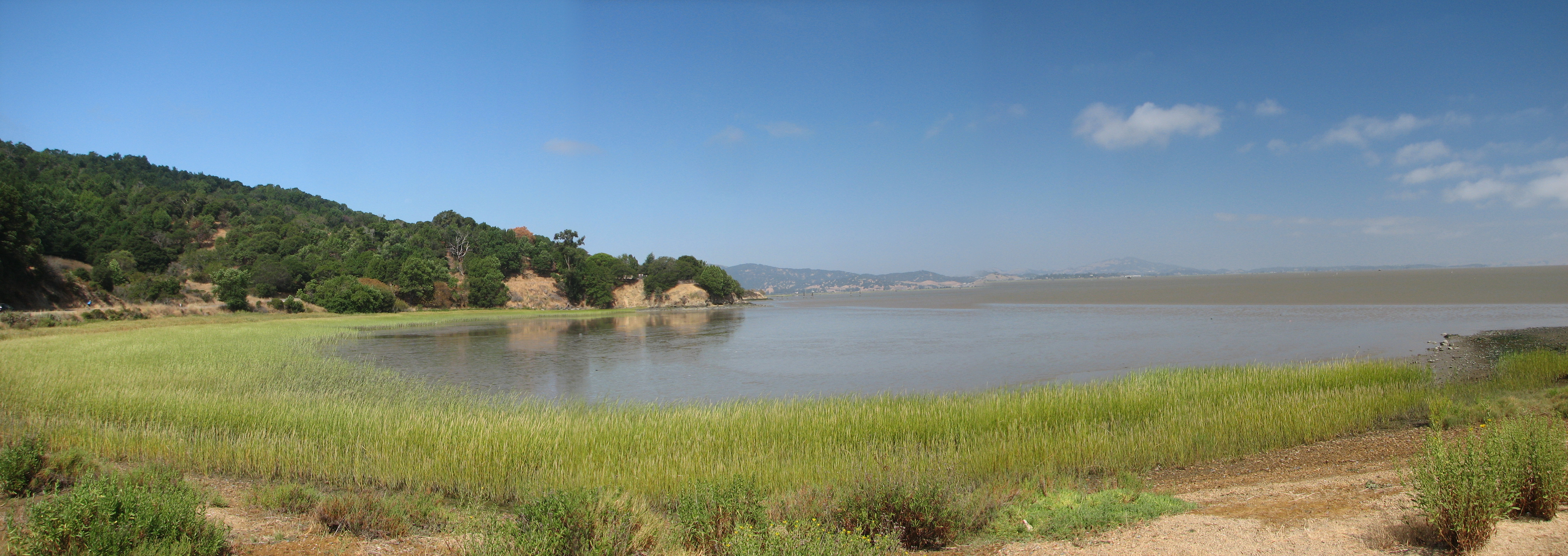
The Last Shrimper of China Camp
Frank Quan died in August 2016, at age 90, in the same village where his grandfather had first cast nets into San Pablo Bay more than a century earlier. He was the last resident of China Camp, the last of a shrimping community that once numbered 500, and the last living connection to a chapter of Chinese American history that nearly vanished under discriminatory laws, urban development, and the slow retreat of the shrimp themselves. Today, the weathered pier, the wooden buildings, and the hills rising from the salt marsh are preserved as China Camp State Park -- 1,514 acres of Marin County coastline where Coast Miwok shell middens, an Irish settler's land grant, and a Cantonese fishing village layer atop one another like sediment. It is a park that tells its story in the things that remain.
Before the Nets
Long before Chinese immigrants arrived, the Coast Miwok people lived along this stretch of San Pablo Bay, hunting, harvesting acorns from the surrounding oaks, and gathering shellfish from the shallows. The shell middens they left behind -- compacted layers of discarded shells accumulating over centuries -- are among the archaeological features that earned 75 acres of the park a listing on the National Register of Historic Places in 1979. After the Spanish arrived in 1775 and founded Mission San Rafael Arcangel nearby, the Miwok population was devastated within a century. In 1844, the Spanish granted much of this land to Timothy Murphy, an Irish settler who became alcalde -- mayor -- of San Rafael. After the American takeover of California in 1846, Murphy lost most of his holdings. The land passed to John and George McNear, Sonoma County businessmen who ran a dairy ranch, a quarry, and a brickyard on the site. Those businesses employed Chinese immigrants, and a community began to take root.
Five Hundred Strong
By the 1880s, approximately 500 people lived at China Camp, most of them originally from Canton. They built a self-sufficient village with three general stores, a marine supply shop, and a barber. The settlement was one of about 26 Chinese shrimp-fishing villages along the California coast, many established by families who had left San Francisco to escape the racial prejudice and violence directed at Chinese communities in the city. In the late 1800s, China Camp's fishermen caught millions of pounds of shrimp per year, exporting much of the harvest to China and Hawaii. Then came the laws. Early 1900s legislation outlawed shrimp exports, closed the fishery during peak season, and banned the bag nets that were the primary method of catching shrimp. The village emptied. When the 1906 San Francisco earthquake and fire drove refugees from Chinatown to China Camp, the population briefly swelled to 10,000 -- but that surge was temporary. As the legal restrictions tightened, only one family stayed: the Quans.
The Quan Family's Century
In 1914, the invention of the trawl net gave the Quans a way to resume commercial shrimping, and they rebuilt their enterprise, processing up to 5,000 pounds of shrimp per day. They also ran a general store, a boat rental, and a cafe that served both villagers and visitors drawn to the area for recreation. By the 1960s, water pollution and diversion had devastated the shrimp population of San Pablo Bay, and Frank Quan -- grandson of the family patriarch -- was selling most of his catch as bait rather than food. When Gulf Oil proposed developing the surrounding land into high-rise condominiums in the early 1970s, local residents and conservation groups fought back. In 1976, the land was sold for approximately $2.3 million to the California State Parks Foundation, which transferred it to the state. Developer Chinn Ho donated the 36-acre village site as a memorial to Chinese American history. The park plan included a provision that Frank Quan could continue living in the village for as long as he wished. He did, for another 40 years.
Saved Twice
The park nearly closed in 2011, when California slated 70 state parks for shutdown amid a $22 million budget cut. Frank Quan, then 85, warned that China Camp was the last of the 26 coastal Chinese fishing villages with enough original structures left to preserve. The community rallied. The Marin State Parks Association and Friends of China Camp raised funds and negotiated to keep the park open. Their case gained unexpected ammunition when the Sacramento Bee revealed that the state parks department had been hiding a $54 million budget surplus -- a scandal that forced the resignation of the parks director and the firing of her assistant. An agreement was reached, revised in 2013, under which Friends of China Camp would operate the park with no state funding. That arrangement continues today. Each August, the park celebrates Chinese-American Heritage Day with lion dances, tai chi demonstrations, and a visit from the replica Chinese junk Grace Quan. Hollywood has found its way here too: John Wayne filmed Blood Alley at the village in 1955, and the park served as a location for the HBO film Hemingway & Gellhorn in 2012.
From the Air
China Camp State Park sits on the eastern shore of the San Rafael peninsula at approximately 38.00N, 122.49W, along the western edge of San Pablo Bay. From 2,000-4,000 feet AGL, the park's forested hills, salt marshes, and the small pier of the historic village are visible against the broad expanse of the bay. The nearest airport is Gnoss Field (KDVO) in Novato, about 8 nautical miles to the north. San Francisco International (KSFO) lies roughly 25 nautical miles to the southeast. The Richmond-San Rafael Bridge is a prominent landmark to the south, and Point San Pedro juts into the bay just east of the park.