China Millennium Monument
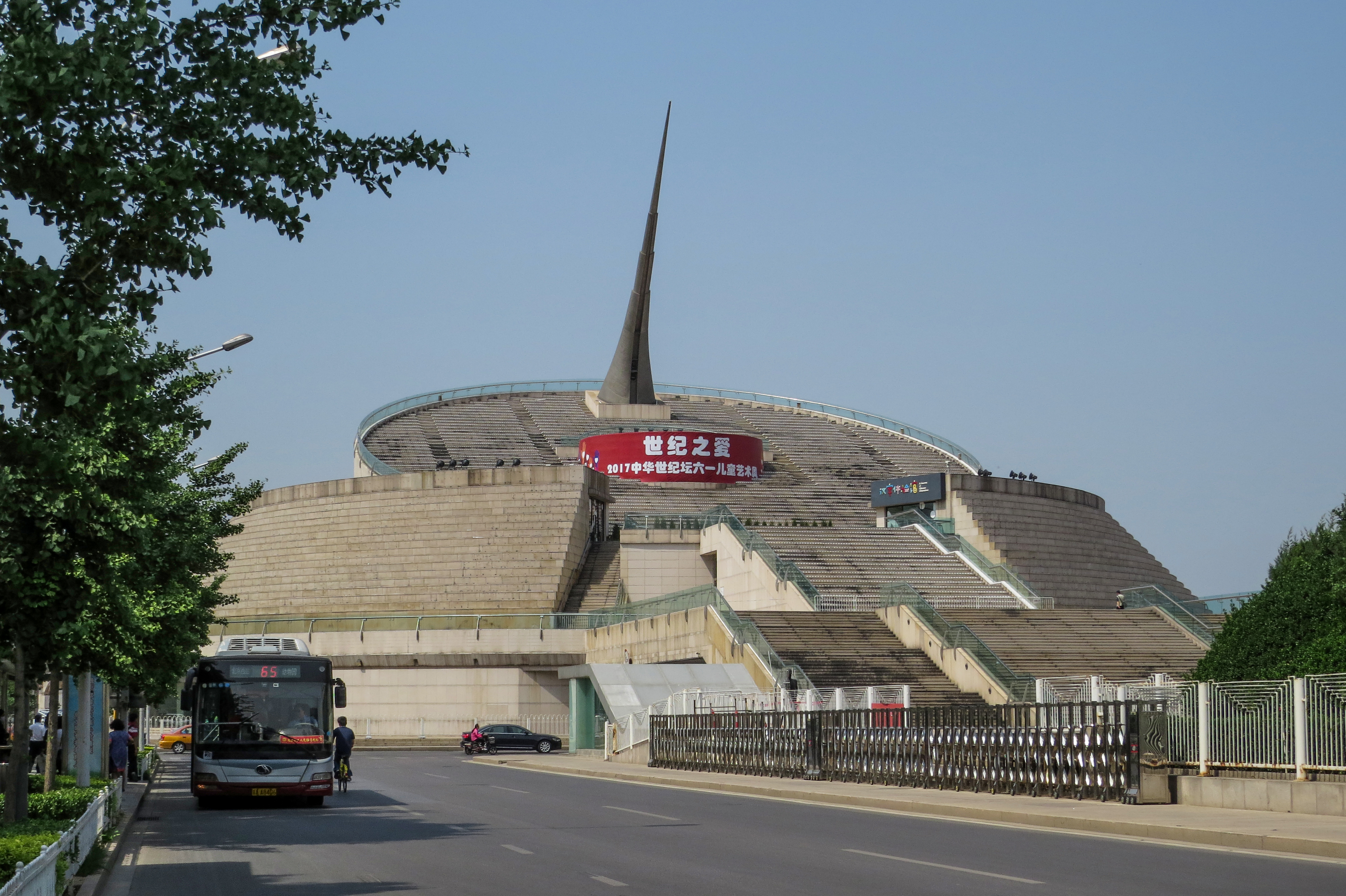
Walk the bronze thoroughfare at Beijing's China Millennium Monument and you walk through 300,000 years of history inscribed on metal plates beneath your feet. The timeline starts in deep prehistory, shifts to year-by-year entries beginning in 3,000 BCE, and by 1901 adds Chinese zodiac animals and longer narrative descriptions. It is 270 meters long and three meters wide -- an entire civilization compressed into a single paved path. The monument it leads to is equally ambitious: a structure that combines the forms of a Chinese altar and a sundial, completed in 1999 as the country's principal venue for millennium celebrations.
An Altar to Time
The monument's central structure, the Century Altar, divides into two symbolic halves. Below, a truncated conic base represents earth. Above, a sundial-shaped rotunda represents heaven -- and it can actually rotate around a vertical axis. An inclined metal spire called the "Time and Space Probing Pin" rises above a central circular platform, where a gilded pillar decorated with traditional imagery stands surrounded by eight cylindric columns. The monument faces south, aligned with Feng Shui principles, and is accessed through a monumental stairway. On the upper level, a 140-meter circular corridor features 40 bronze statues of figures from Chinese culture and science, from political adviser Guan Zhong in the 7th century BCE to nuclear scientist Deng Jiaxian, who died in 1986. Fifty-six sculpted stone slabs represent China's officially recognized ethnic groups.
Five Millennia in Stone Relief
The Great Century Hall's circular wall rises five meters high, adorned with what has been called the largest stone relief sculpture in China. Titled "Ode to the Chinese Millennia," the frieze is divided into four sweeping sections: the pre-Qin period from 3000 to 221 BCE, the Han through Tang dynasties from 221 BCE to 907 CE, the Song through Qing dynasties from 960 to 1911, and modern history from 1912 to 1999. The carved narrative features historical figures from Qin Shi Huang to Deng Xiaoping. The northern plaza features a circular gilded medallion bearing a map of China, fringed by sculpted dragons. Scholars have noted that the monument's selection of historical events frames a teleological narrative -- history presented as inevitably leading toward the present.
From Political Monument to Art Museum
The monument was closely associated with Jiang Zemin, who championed its construction from 1994. A 2000 propaganda poster by artist Liu Xiqi placed Jiang alongside Mao Zedong and Deng Xiaoping, each flanked by their signature architectural achievements: Tiananmen Gate for Mao, the Hong Kong skyline for Deng, and the Millennium Monument for Jiang. In July 2001, the monument served as the main venue for celebrating Beijing's selection to host the 2008 Summer Olympics. But since Jiang's official retirement, the site has drifted toward a quieter role. Since 2006, it has housed the Beijing World Art Museum, hosting exhibitions that range from Contemporary American Realism and paintings by Xu Beihong to works by Raphael and Egyptian mummies. The monument that once declared a political moment now serves as a gallery open to the world.
From the Air
Located at 39.91N, 116.32E in western Beijing, between the Military Museum of the Chinese People's Revolution and Yuyuantan Park. The monument's distinctive circular structure and sundial form are visible from altitude along Beijing's western axis. Nearest major airport is Beijing Capital International Airport (ZBAA/PEK), approximately 30 km northeast. Beijing Daxing International Airport (ZBAD/PKX) lies about 47 km south. The nearby Central Radio & TV Tower provides a useful visual reference. Best viewed at 3,000-5,000 ft.