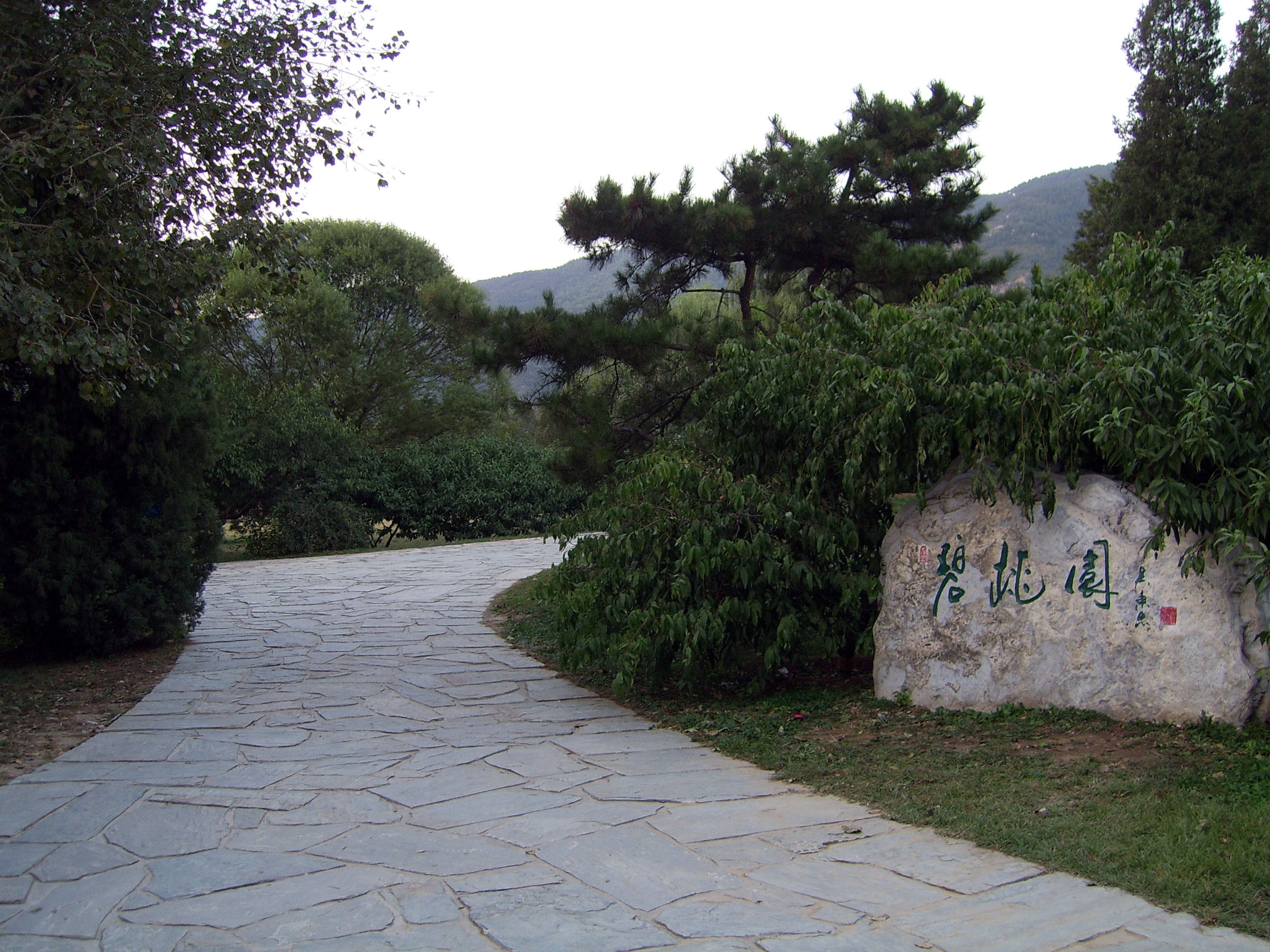
China National Botanical Garden
Somewhere in a Beijing greenhouse, an orchid thrives without roots. It clings to nothing, drawing water and nutrients from the air through fine hairs -- a plant so improbable it sounds invented. It is one of more than 300 orchid varieties cultivated at the China National Botanical Garden, a sprawling 600-hectare landscape tucked between the Fragrant Hills and Jade Spring Hill in Beijing's Western Hills. Chartered in 2022, the garden is actually two institutions merged into one: a scientific research campus and a public horticultural showcase, united by the conviction that plants deserve the same national attention as any museum or monument.
Two Gardens, One Mission
The garden's split identity is by design. The South Garden, built on the existing Institute of Botany of the Chinese Academy of Sciences, focuses on scientific research -- biodiversity conservation, plant resource development, and the kind of core botanical science that rarely makes headlines but underpins everything from agriculture to medicine. The North Garden, based on the former Beijing Botanical Garden, faces the public: ex situ plant collections, popular science exhibitions, displays of rare and endangered species, and training in gardening and horticultural technologies. Botanist Ma Jinshuang has served as chief scientist since 2020, overseeing a collection of 6,000 species -- 2,000 kinds of trees and shrubs, 1,620 varieties of tropical and subtropical plants, 500 species of flowers, and 1,900 kinds of fruit trees and water plants.
Greenhouse Worlds
The hothouse exhibition is the heart of the garden's public experience, and it unfolds room by room like a journey across climates. The first room is filled with evergreens and palms. The second gives way to tropical aquatic plants -- water lilies and flowering taros floating in warm, humid air. The third room shifts to commercial botany, displaying rubber plants, cocoa and coffee trees, and the sugar-producing sweet-leaved chrysanthemum introduced to China from abroad. Additional rooms showcase medicinal plants, aromatic species, and succulents. Beyond the greenhouses, a national plant specimen hall covers 11,000 square meters, with specimen houses, classification laboratories, research rooms, and a lecture hall arranged around a courtyard linked by arches and trellises.
The Tree That Time Forgot
Among the garden's rare species, the metasequoia carries the most dramatic backstory. Scientists believed the tree had gone extinct during the Paleogene Period, roughly 66 million years ago. Then, in the 1940s, a Chinese scientist discovered living specimens in the border region of Hubei and Sichuan provinces -- a botanical revelation that stunned researchers worldwide. Specimens now grow in the garden alongside other unlikely neighbors: Nepenthes pitcher plants that digest insects, golden butterfly orchids with lustrous yellow flowers, American redwoods, Japanese flowering cherries, and the bodhi tree, the species under which the Buddha is said to have attained enlightenment.
Peonies and Revolution
The Peony Garden, open to the public since 1981, covers 100,000 square meters divided into three sections, with the Peony Grove spanning 35,000 square meters as the centerpiece. Peonies hold deep significance in Chinese culture -- for centuries they symbolized wealth, honor, and the beauty of the imperial court. Nearby, a memorial to the December 9th Movement of 1935 adds an unexpected political dimension, commemorating student protests against Japanese imperialism. The garden does not shy from these layers of meaning. Plants here are never just plants; they carry centuries of symbolism, scientific controversy, and political memory along with their blossoms.
From the Air
Located at 40.00N, 116.21E at the foot of Beijing's Western Hills in Haidian District, between Fragrant Hills Park to the west and Jade Spring Hill to the east. The garden's 600-hectare green expanse is visible from altitude as a large wooded area set against the hillsides northwest of central Beijing. Accessible via the Xijiao line metro. Nearest major airport is Beijing Capital International Airport (ZBAA/PEK), approximately 40 km east. Best viewed at 3,000-5,000 ft where the garden's layout and surrounding hills are visible.