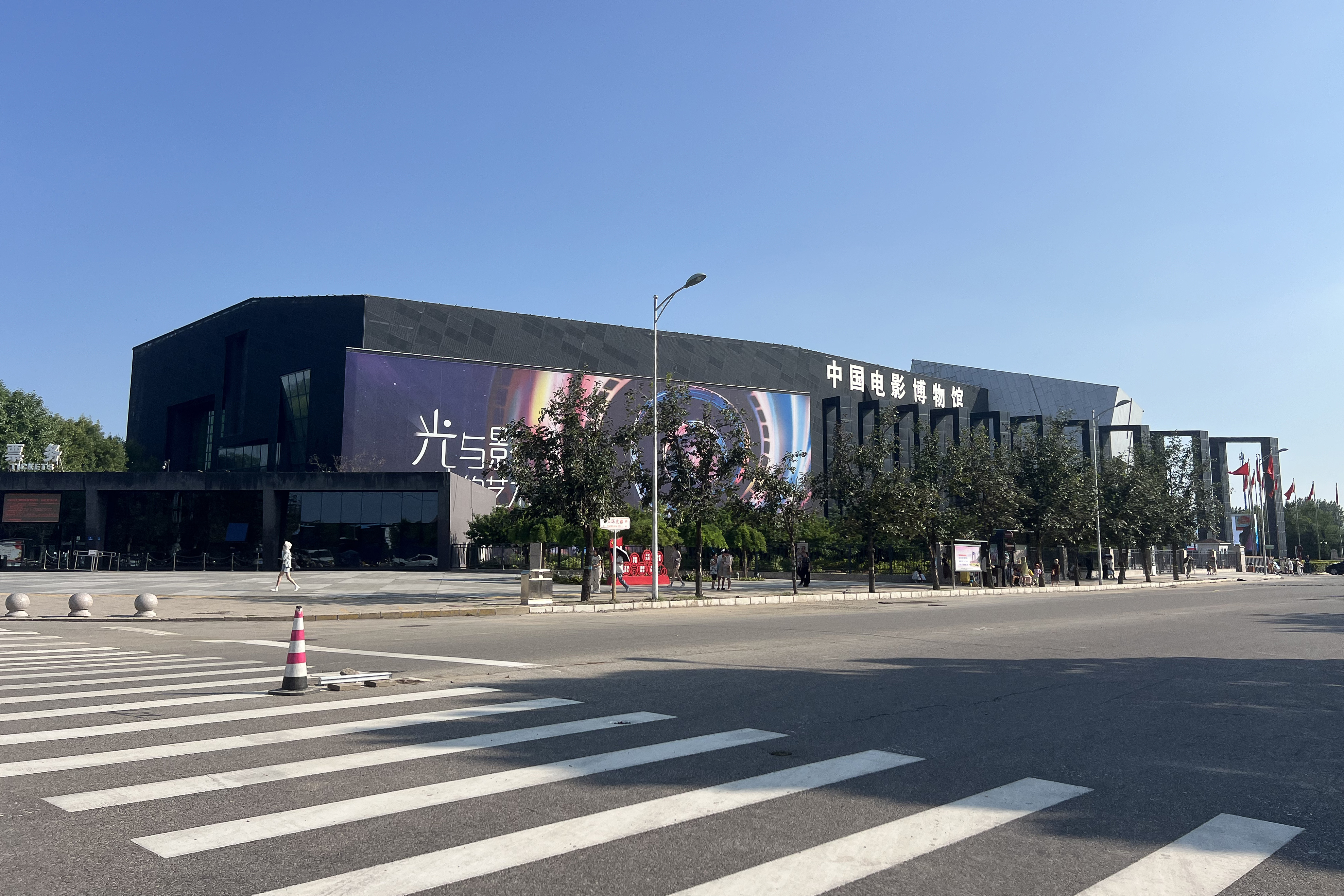
China National Film Museum
Chinese cinema begins, by most accounts, with a Beijing opera performance filmed in 1905. One hundred years later, in 2005, the China National Film Museum opened in the Chaoyang District of northeast Beijing to tell that story and everything that followed. Covering 65 acres with 38,000 square meters of architectural space, it is the largest professional film museum in the world -- a scale that reflects both the ambition of the Chinese film industry and the government's determination to celebrate it.
Twenty Halls of Moving Pictures
The museum's 20 permanent exhibition halls walk visitors through the full arc of Chinese filmmaking. The journey begins with the earliest experiments in motion pictures during the late Qing dynasty and moves through the turbulent decades of war, revolution, and political campaigns that shaped what Chinese audiences could see on screen. The Communist era brought state-controlled studios and propagandist epics; the reform era of the 1980s unleashed the Fifth Generation directors -- Zhang Yimou, Chen Kaige -- whose work stunned international film festivals. The exhibitions do not shy from the complexity of this history, tracing how cinema in China has always been entangled with politics, censorship, and the question of what stories a nation tells about itself.
Beyond the Exhibition Halls
The museum is not merely archival. Its facilities include an IMAX theater, a digital projection theater, and three traditional 35mm projection rooms, making it a working cinema as well as a repository of history. Multifunctional halls host temporary exhibitions, film technology expos, and industry conferences. The fourth floor contains a dedicated expo area where advances in filmmaking technology are displayed, from early camera mechanisms to modern digital effects equipment. The building itself, with its sweeping facade, is designed to evoke the drama of cinema -- a structure that announces its subject before visitors walk through the door.
A Century of Stories on Screen
What makes the China National Film Museum compelling is the breadth of the story it tells. Chinese cinema has produced some of the most visually stunning films ever made, from the wuxia martial arts fantasies of King Hu to the austere dramas of Jia Zhangke. It has also been subject to some of the most extensive state censorship in film history. The museum navigates this terrain by focusing on the art and technology of filmmaking, the craft behind the camera as much as the politics in front of it. For visitors arriving from abroad, the sheer volume of Chinese film history on display is a revelation. For Chinese visitors, many of the films showcased here are woven into the fabric of childhood memory and national identity.
Northeast Beijing's Cultural Anchor
The museum's location in northeast Beijing, roughly 15 kilometers from the city center, places it outside the usual tourist orbit of the Forbidden City and Temple of Heaven. This remoteness is part of its character. Visitors who make the trip tend to be genuinely interested in film rather than checking off a sightseeing list. The surrounding area has developed considerably since 2005, and the museum now sits within a district that includes other cultural and commercial venues. Its 65-acre footprint ensures it remains the dominant presence in its immediate neighborhood -- a building that matches the outsized ambitions of the industry it celebrates.
From the Air
Located at 40.00°N, 116.52°E in the Chaoyang District of northeast Beijing. The museum's large footprint may be visible from lower altitudes in the suburban area northeast of central Beijing. Nearest major airport is Beijing Capital International (ZBAA/PEK), approximately 12 km to the east.