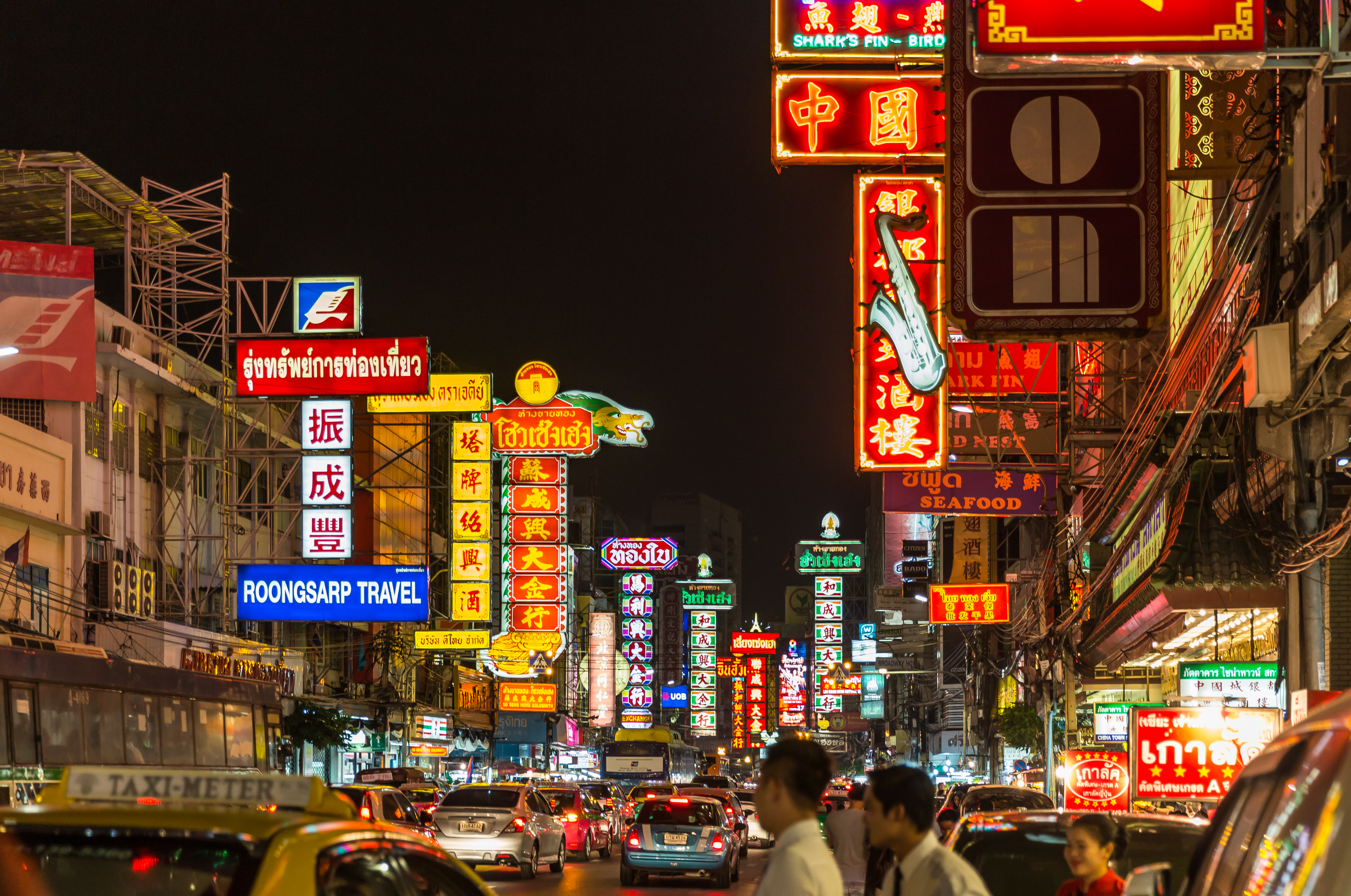
Chinatown, Bangkok
A king needed their land, so he moved them to a swamp. That is the origin story of Bangkok's Chinatown -- not a tale of voluntary migration or merchant ambition, but a royal relocation order issued in 1782. When General Chao Phraya Chakri overthrew King Taksin and founded the Rattanakosin Kingdom as Rama I, he wanted the east bank of the Chao Phraya River for his new palace. The Teochew Chinese community already living there had to go. Rama I directed them to Sampheng, a marshy, nearly inaccessible stretch of riverbank downstream from the new capital. From that unpromising beginning, one of the world's largest Chinatowns emerged.
A Debt Repaid with Displacement
The Teochew had arrived in Bangkok under favorable circumstances. When King Taksin established the Thonburi Kingdom after the fall of Ayutthaya in 1767, he turned to Teochew merchants -- with whom he shared ethnic ties -- to supply his new capital with rice and provisions. In return, Taksin granted them prime land on the east bank of the Chao Phraya, opposite his palace. The community prospered, eclipsing the previously influential Hokkien Chinese, whose settlement was further south at Kudi Chin on the west bank. But Taksin's overthrow changed the equation. Rama I had ties to the Hokkien rather than the Teochew, and the Teochew had backed the losing side. Their relocation to Sampheng was strategic as much as practical -- moving potential rivals away from the seat of power. The area they received, between Wat Sam Pluem and Wat Sampheng, was connected to the fortified city by a single narrow road that would become Sampheng Lane.
From Swamp to Commercial Engine
What began as exile became advantage. The Teochew drained the marshes, built shophouses, and turned Sampheng Lane into a trading corridor. By the late 19th century, Chinatown had grown into Bangkok's commercial hub. The Chinese became the city's dominant ethnic group -- merchants, laborers, and middlemen whose networks connected Siam to the broader Southeast Asian economy. Yaowarat Road, cut through the neighborhood in the early 1900s, became the main artery and eventually lent its name to the entire district. At its peak, Chinatown hummed with gold shops, textile warehouses, and import-export businesses that made it the financial heart of Bangkok. The neighborhood's boundaries roughly matched Samphanthawong District, stretching from Song Wat and Talat Noi along the river to Charoen Chai and Khlong Thom along Charoen Krung Road -- itself Bangkok's first paved road, built in 1862.
The Flavors That Remain
The 20th century brought gradual decline. Businesses and wealthy residents moved to newer parts of the expanding city, and Chinatown's commercial dominance faded. But culture proved more durable than commerce. The neighborhood became a culinary destination whose reputation now draws visitors from across the world -- street stalls and shophouse restaurants serving Teochew-influenced dishes that have become inseparable from Bangkok's food identity. Charoen Chai, tucked into Soi Charoen Krung 23, survives as Thailand's largest and oldest marketplace for Chinese joss paper, ceremonial items for the Moon Festival, and traditional Chinese wedding goods. At Odeon Circle, the Chinatown Gate built in 1999 marks the formal entrance. Sampheng Lane itself endures as a narrow pedestrian alley lined with shophouses -- a market that has operated continuously since the community's resettlement nearly 250 years ago.
Underground Change
Chinatown's future arrived underground in the 2010s with the construction of the Blue Line extension of Bangkok's MRT. Wat Mangkorn station now serves the neighborhood, connecting the area to the city's modern transit grid for the first time. The station brought accessibility but also anxiety. Long-standing communities worry about displacement as development follows rail lines, and conservation advocates have pressed for protections for the neighborhood's historic shophouses and streetscapes. The tension is fitting for a place that has always balanced between preservation and transformation. The Teochew who were moved here in 1782 gradually assimilated into Thai society -- intermarrying, adopting Thai names, blending cuisines and customs -- yet Chinatown retains a distinct identity. Temples burn incense, gold shops glitter on Yaowarat Road, and the narrow lanes still smell of roasting duck and steamed dumplings. The community that made something from a swamp is not finished adapting.
From the Air
Located at 13.7417N, 100.5083E in the Samphanthawong District of Bangkok, along the east bank of the Chao Phraya River. From the air, the dense, low-rise neighborhood contrasts with surrounding modern development. Yaowarat Road is visible as a curving main street. Best viewed at 2,000-3,000 feet. Nearest airport: Don Mueang (VTBD) approximately 16 nm north. Suvarnabhumi (VTBS) approximately 17 nm east-southeast.