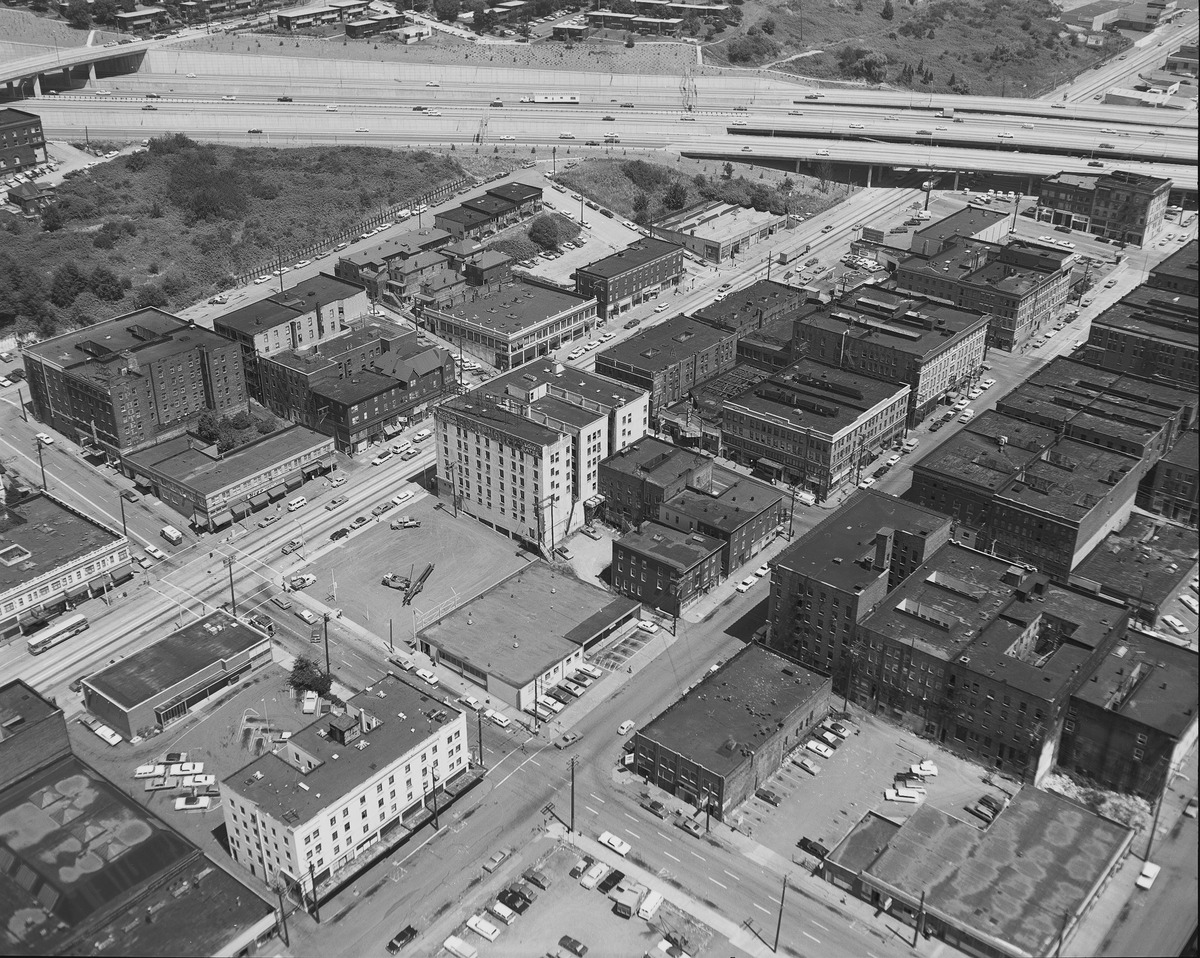
Chinatown-International District, Seattle
Even the neighborhood's name is an argument. When Seattle's mayor proclaimed this corner of the city "International Center" in 1951, businesswoman Ruby Chow fired back that the label masked Chinese American history. Seven decades later, the debate still simmers. That tension -- between honoring individual heritage and celebrating collective identity -- runs through every block of Seattle's Chinatown-International District, a neighborhood where four Asian American communities built their lives after being pushed, again and again, to the margins of the city.
Pushed to the Edge
By 1873, roughly 100 Chinese residents lived among Seattle's total population of 2,000. Their first quarters clustered near Yesler's Mill on the waterfront, where businesses had opened as early as the late 1860s. But permanence was never guaranteed. Anti-Chinese sentiment drove the community from its original settlement near Pioneer Square in the late 19th century. The Great Seattle Fire of 1889 scattered them again. Each time, the community rebuilt farther inland -- along Washington Street, then Second Avenue South. When the Jackson Regrade of 1907 leveled the hills and filled the tidal flats near King Street Station, the Chinese were pushed once more as downtown property values climbed, and a new Chinatown took root along King Street. Chinese Americans formed the Kong Yick Investment Company, pooling resources to construct the East and West Kong Yick Buildings -- anchors that still stand today.
Nihonmachi, Manilatown, and the Jazz Clubs
Two blocks north of King Street, Japanese Americans built Nihonmachi -- Japantown -- along Main Street. By the mid-1920s, it stretched from 4th Avenue to 7th Avenue, with clusters of businesses lining Jackson, King, and Weller streets. Filipino Americans arrived in the early 1920s, drawn by work in salmon canneries and agriculture. Among them was author Carlos Bulosan, who would chronicle their struggles in his 1946 novel America Is in the Heart. By the 1930s, a Manilatown had formed near the corner of Maynard and King. Then came World War II. The internment of Japanese Americans hollowed out Nihonmachi. African Americans moving to Seattle during the Great Migration filled the vacant homes and businesses along Jackson Street, establishing jazz clubs that gave the corridor a new soundtrack. When Japanese Americans returned after the war, many scattered to the suburbs. Maneki, one of the oldest Japanese restaurants in the country, reopened in a storage space after its original building was looted during the internment years.
The Fall of Saigon and the Boat-Shaped Restaurant
The neighborhood's next chapter arrived in 1975 with the fall of Saigon. Vietnamese and Southeast Asian immigrants established Little Saigon east of Interstate 5, which had already been carved through the district in the 1960s. Many of these new arrivals were of Chinese descent, adding another layer to the neighborhood's complex identity. Pho came to Seattle in 1982 when Pho Bac opened in a building shaped like a boat -- a form that became the restaurant's signature. Viet-Wah, Little Saigon's first grocery store, opened in 1981, followed by Lam's Seafood Market in 1991 and Hau Hau Market in 1995. Meanwhile, the Kingdome's construction in the 1970s had boxed the neighborhood in from the south, prompting an impromptu demonstration at the stadium's groundbreaking on November 2, 1972 -- an early act of a community learning to fight for its own space.
Dragon Lampposts and Bilingual Signs
Walk the neighborhood today and its layers reveal themselves. The Historic Chinatown Gate, a 45-foot steel and plaster paifang unveiled in 2008, marks the west end of South King Street. Dragon sculptures by artists Meng Huang and Heather Presler have perched on lampposts along Jackson Street since 2002. Since 2013, bilingual street signs announce intersections in English and the neighborhood's heritage languages -- traditional Chinese in Chinatown, Japanese in Japantown, Vietnamese in Little Saigon. The Wing Luke Museum, housed in the historic East Kong Yick Building since 2008, tells the story of Asian Pacific American experience. The Panama Hotel, declared a National Treasure in 2015, still holds belongings left by Japanese American families sent to internment camps decades ago. Each fall, a night market fills Hing Hay Park, and Lunar New Year celebrations light up the streets in winter.
An Endangered Place
In 2023, the Chinatown-International District became the first Washington state neighborhood named to the National Trust for Historic Preservation's list of America's 11 Most Endangered Historic Places. The designation reflected years of compounding pressures: rents that outgrew incomes by 45 percent between 2000 and 2014, more than 19 businesses shuttering in a single year, and the closure of Viet-Wah supermarket on September 30, 2022 -- a loss felt across the community. A 2021 economic study rated the area at high risk for displacement, with roughly 1,145 new housing units built in just four years. The neighborhood that survived fire, forced removal, internment, freeway construction, and stadium development now faces a quieter but no less existential threat. Its survival, as always, depends on the same stubbornness that rebuilt it after every blow.
From the Air
Located at 47.601°N, 122.325°W in the southern edge of downtown Seattle. The neighborhood sits between Pioneer Square to the northwest and the stadiums (T-Mobile Park and Lumen Field) to the south. The Historic Chinatown Gate and the distinctive rooflines of the district are visible from low altitude. Nearby airports: KBFI (Boeing Field, 2 nm south), KSEA (Seattle-Tacoma International, 10 nm south). The International District/Chinatown light rail station connects to the broader transit network. Best viewed at 2,000-3,000 ft AGL approaching from the west over Elliott Bay.