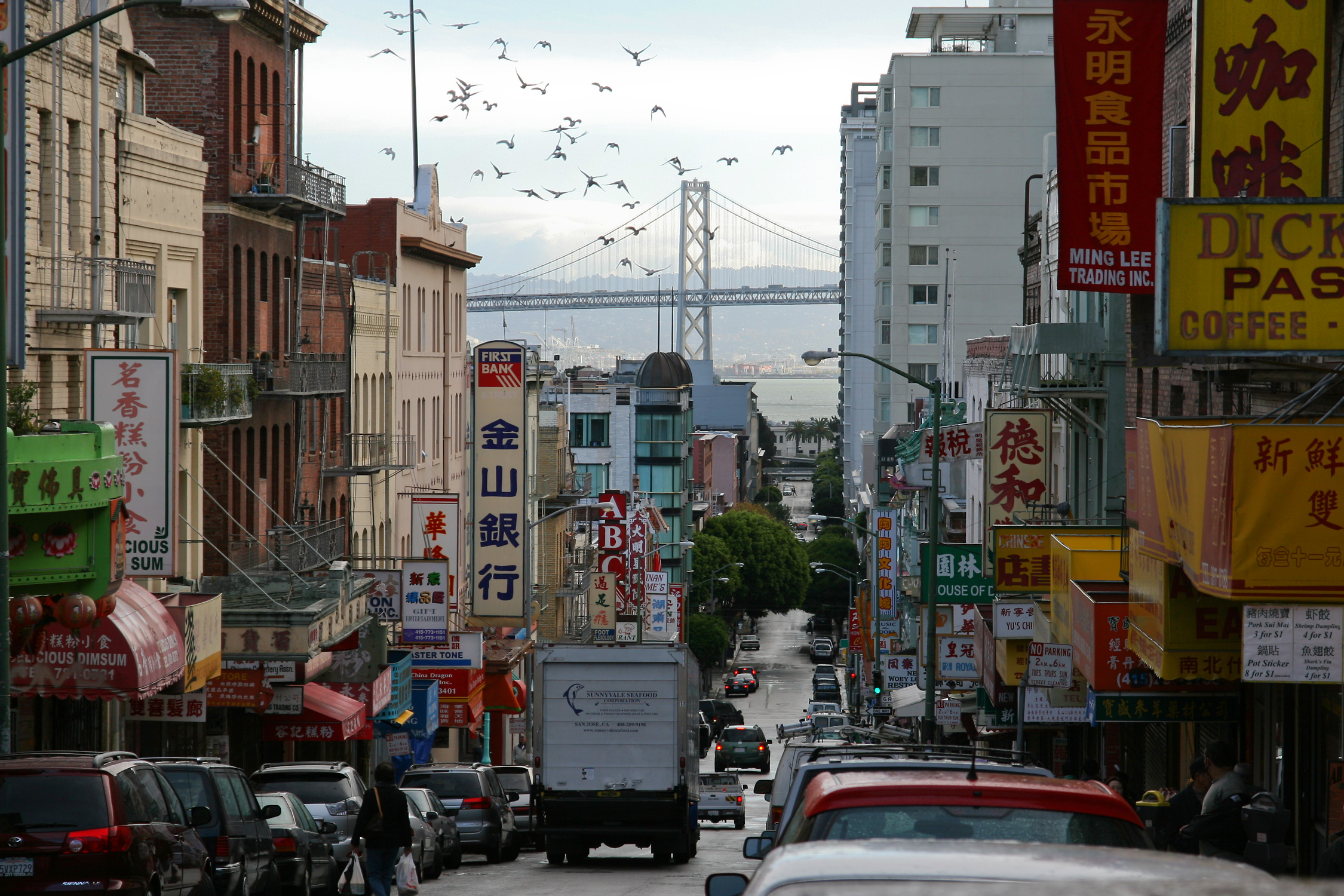
Chinatown, San Francisco
The Dragon Gate on Grant Avenue is the entrance to the oldest Chinatown in North America. Established in the 1840s during the California Gold Rush, San Francisco's Chinatown grew from a small encampment of Chinese immigrants into the most densely populated neighborhood west of Manhattan. It survived anti-Chinese violence, the Chinese Exclusion Act, the 1906 earthquake and fire, and repeated attempts by city leaders to relocate it. Today it covers 24 blocks and serves as home, marketplace, and cultural anchor for a community that has endured more than a century and a half of American hostility with remarkable tenacity.
Gold Mountain's Price
Chinese immigrants began arriving in San Francisco during the Gold Rush of 1849, drawn by the same promise that brought hundreds of thousands of others to California. They called it Gam Saan -- Gold Mountain. What they found was hostility. Anti-Chinese sentiment, rooted in economic competition and racial prejudice, manifested in riots, discriminatory legislation, and the Chinese Exclusion Act of 1882, which barred Chinese immigration for over sixty years. The community that coalesced around Grant Avenue and Stockton Street was both a refuge and a prison -- the one neighborhood where Chinese Americans could live, work, and build institutions without being driven out.
Rebuilt From Ashes
The 1906 earthquake and fire destroyed Chinatown entirely. City officials saw an opportunity to relocate the Chinese community to the city's outskirts, freeing up valuable real estate near the Financial District. The community fought back. Chinese American leaders rebuilt Chinatown in the Western architectural style that exists today -- pagoda-topped buildings and decorative facades that made the neighborhood visually distinctive and tourist-friendly, a deliberate strategy to make Chinatown too valuable as a cultural attraction to demolish. The strategy worked. When City Hall burned along with the Hall of Records, thousands of Chinese immigrants claimed citizenship through records that could no longer be verified, creating an unexpected pathway through the Chinese Exclusion Act.
Living Chinatown
Modern Chinatown remains one of the most densely populated neighborhoods in San Francisco, home to a large population of elderly Chinese Americans, recent immigrants, and working-class families. The neighborhood supports a complex ecosystem of restaurants, herbalists, produce markets, temples, family associations, and community organizations. Tourism is a major economic driver but also a source of tension, as visitors seeking an 'authentic' experience sometimes reduce a living community to a backdrop for photographs. The real Chinatown is not the tourist shops on Grant Avenue but the produce stalls on Stockton Street, the dim sum restaurants packed with families on Sunday mornings, and the residential hotels where elderly residents live on fixed incomes in one of the most expensive cities in the world.
From the Air
Chinatown is at 37.79N, -122.41W in downtown San Francisco, identifiable from the air by its density and proximity to the Financial District's towers. The neighborhood occupies the hillside between Nob Hill and the Financial District. Nearest airports: KSFO 12nm south, KOAK 8nm east.