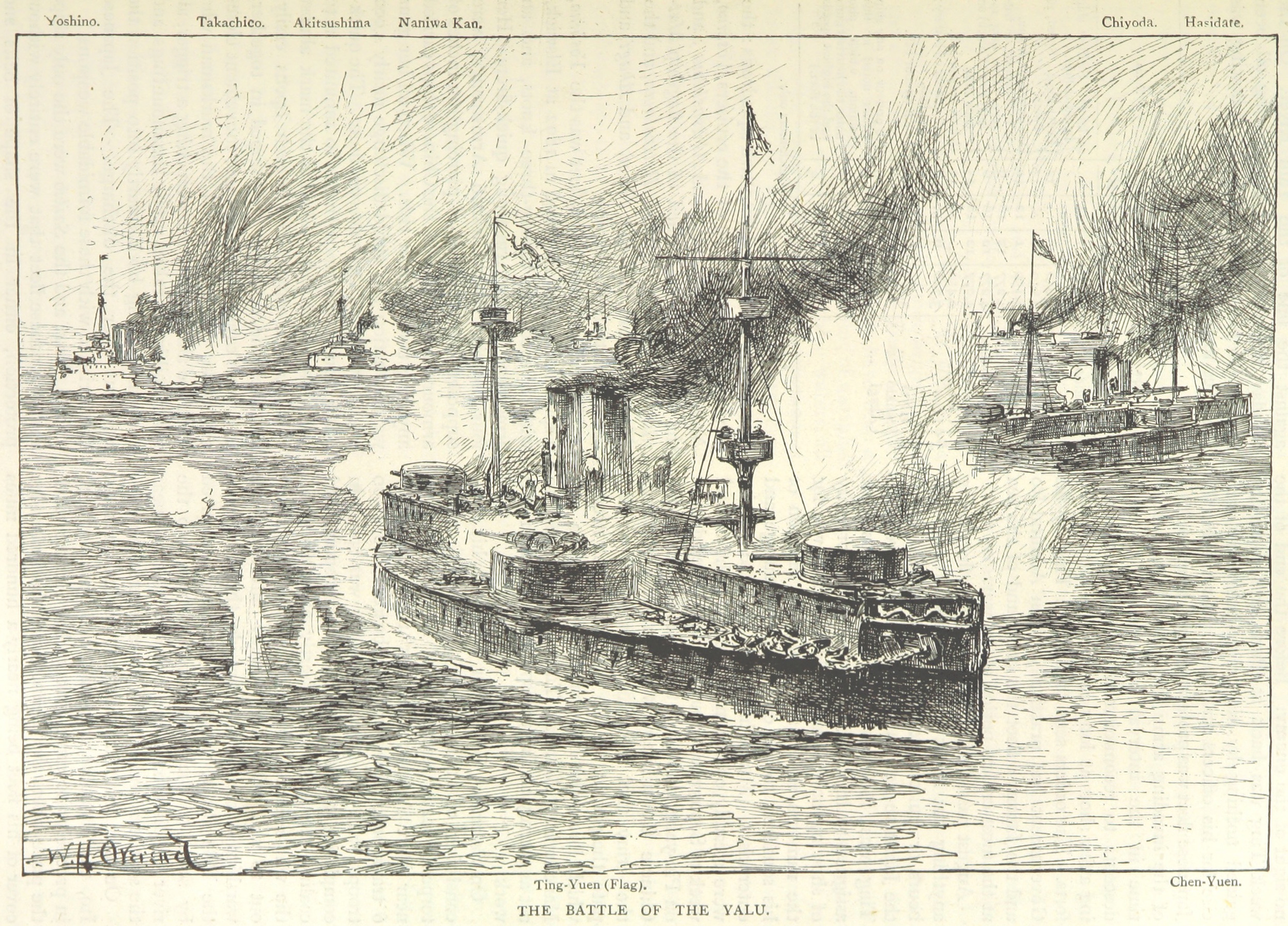
Chinese Ironclad Dingyuan
Her name meant 'Everlasting Peace,' but Dingyuan was built for war. When she arrived in Chinese waters in 1885, this German-built ironclad was the most powerful warship in East Asia -- 7,670 tons of compound armor and Krupp steel, carrying four massive guns in twin turrets that no ship in the region could match. Her very presence was supposed to guarantee that peace. Instead, she became the centerpiece of a naval arms race with Japan that ended in catastrophe.
German Iron, Chinese Ambitions
Dingyuan was laid down at the AG Vulcan shipyard in Stettin in March 1881, ordered by Viceroy Li Hongzhang as the cornerstone of a fleet that would protect China from the Western powers whose steam-powered navies had humiliated the Qing dynasty in two Opium Wars. Her 14-inch compound armor belt made her nearly impervious to the guns of her era. She carried a crew of 350 and could make 15.7 knots. But Germany, maintaining neutrality during the Sino-French War of 1884-1885, refused to deliver her until the conflict ended. When Dingyuan and her sister Zhenyuan finally sailed for China in July 1885 under German crews and the German flag, they represented the most advanced warships China had ever possessed.
The Nagasaki Incident
Li Hongzhang intended his ironclads as instruments of intimidation, sending them on conspicuous visits to Japanese ports at a time when Japan's fleet was small and underdeveloped. In August 1886, the gambit backfired spectacularly. While Dingyuan, Zhenyuan, and four cruisers were visiting Nagasaki, Chinese crewmen brawled with locals in an altercation that left eight Chinese sailors and two Japanese police dead, with over seventy people injured on both sides. The Japanese press cast it as Chinese bullying, and the incident fueled calls for naval expansion that would, within a decade, produce a fleet capable of destroying the very ships that had provoked it. Japan ordered three new protected cruisers in direct response and barred the Chinese ironclads from returning for repairs -- a critical blow, since China lacked dry docks large enough to service them.
A Fleet Starved of Funds
By the time the First Sino-Japanese War erupted in August 1894, Dingyuan's advantages had eroded. The funds Li Hongzhang had planned for modernizing the fleet -- adding quick-firing guns that could match the Japanese navy's new rapid-fire weapons -- had been diverted to finance the 60th birthday celebration of the Dowager Empress Cixi. Discipline aboard the fleet was poor, and the Japanese had broken Chinese diplomatic codes as early as 1888, giving them access to Beijing's internal communications. Preparing for battle, Dingyuan's crew stripped the gun shields from her turrets after learning at the Battle of Pungdo that the thin plates created lethal splinters when hit. They placed bags of coal around the gun positions as improvised armor and repainted the ship light gray for camouflage.
The Bridge Collapses
At the Battle of the Yalu River on 17 September 1894, Dingyuan fired the first shots of the engagement. The concussion from her own massive guns destroyed her bridge, trapping Admiral Ding Ruchang and his staff and robbing the entire Beiyang Fleet of central command at the battle's opening moment. What followed was a melee in which the Japanese Combined Fleet, faster and armed with quick-firing guns, systematically destroyed much of the Chinese fleet. But Dingyuan and Zhenyuan proved nearly invincible -- their heavy citadel armor shrugged off Japanese shells, and though fires broke out repeatedly, their crews suppressed them under heavy fire. By 17:30, when the Japanese withdrew, only the two ironclads and four smaller vessels remained afloat. The battered survivors limped to Port Arthur.
Scuttled at Weihaiwei
The end came at Weihaiwei in February 1895. Japanese torpedo boats broke into the harbor on the night of 4-5 February and struck Dingyuan with a torpedo on the port side. The crew could not contain the flooding -- leaking watertight doors defeated their damage control efforts -- and they beached the ship to prevent her from sinking. For the next five days, the grounded ironclad served as a stationary artillery battery, her guns still firing at advancing Japanese forces. But when the Japanese captured the coastal fortifications on 9 February and turned captured guns on the trapped fleet, Admiral Ding ordered Dingyuan scuttled and then surrendered. The decision drove many officers to suicide, including Dingyuan's captain, Liu Buchan. A mine detonated amidships tore the ship apart. Today, a full-scale replica of Dingyuan sits at Weihai as a museum ship, and in 2019 underwater archaeologists located the original wreck, recovering over 150 artifacts from a vessel whose name promised everlasting peace.
From the Air
Located at 37.50N, 122.18E in Weihai Bay, Shandong Peninsula, China. The 1:1 replica museum ship is moored at the Weihai waterfront and visible from low altitude. Liugong Island, the Beiyang Fleet's headquarters, sits at the bay's mouth. Nearest airport: Weihai Dashuibo Airport (ZSWH), approximately 30 km southwest. Best viewed at 2,000-4,000 ft approaching from the sea.