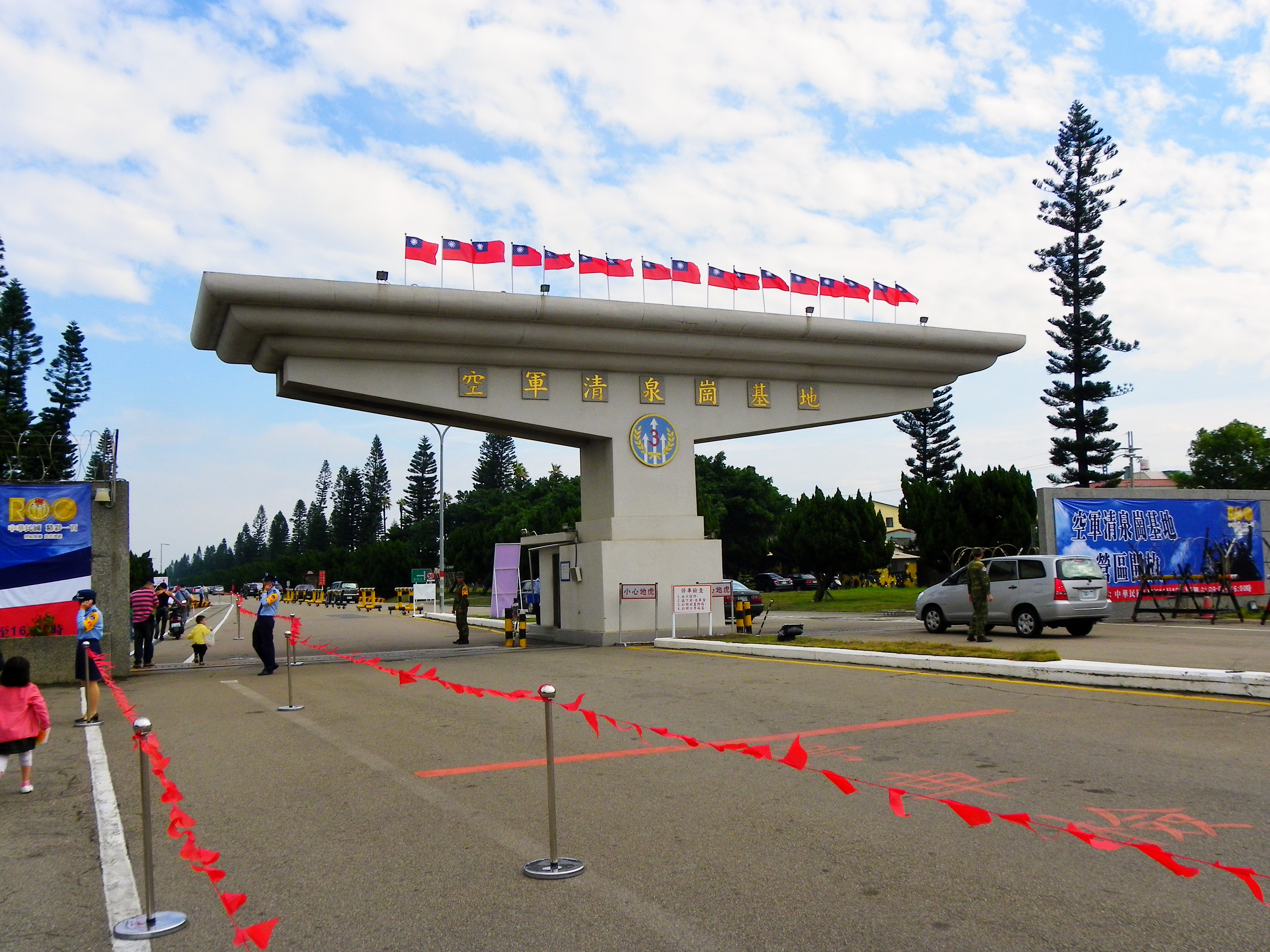
Ching Chuan Kang Air Base
China built a copy of it. That fact alone tells you everything about Ching Chuan Kang Air Base's strategic importance. In May 1999, satellite imagery revealed that the People's Liberation Army had constructed a full-scale replica of CCK near Dingxin airport in Gansu province, presumably to train units assigned to strike this Taiwanese facility in the event of war. The original sits in Taichung, Taiwan's third-largest city, where its 12,000-foot runway doubles as the city's international airport. For decades, CCK has been one of the most consequential air bases in the western Pacific - a place where Cold War tensions, cross-strait rivalry, and the evolution of air power all converge on a single strip of concrete.
From Kōkan to Cold War Fortress
The Japanese built the first airfield here in 1936, near the village of Kōkan, during their colonial rule of Taiwan. It was a modest facility in a modest location. But when the Chinese Civil War ended and the defeated Republic of China government retreated to Taiwan in 1949, the island's airbases became existential assets. Construction of a modern air base began in 1954, given the highest priority as tensions between Taiwan and mainland China escalated. On 20 March 1966, the base was renamed Ching Chuan Kang in memory of ROC Army General Qiu Qingquan, a hero of the anti-Japanese war who died in the final battles of the civil war. From that point forward, the base was known throughout the theater by its initials: CCK.
The American Years
USAF use of CCK began during the 1958 Quemoy Crisis, when twelve F-104 Starfighters from the 83rd Fighter-Interceptor Squadron deployed to the base. The crisis passed, but the American presence grew. By the mid-1960s, CCK had become the largest American air installation on Taiwan, with between 6,000 and 8,000 US troops stationed there. Tactical Air Command rotated fighter squadrons through on a near-continuous basis - F-100 Super Sabres from Okinawa, F-102 Delta Daggers from the Philippines, F-105 Thunderchiefs bound for Vietnam. The 314th Troop Carrier Wing arrived in 1966 with C-130 Hercules transports, turning CCK into a vital logistics hub for combat airlift throughout Southeast Asia. Bob Hope performed his Christmas show there in December 1969, entertaining thousands of American servicemen far from home.
Indigenous Fighters on the Ramp
Taiwan obtained its first American F-104 Starfighters in 1960 and eventually received over 200 of the sleek interceptors. The 3rd Tactical Fighter Wing at CCK flew them for three decades before withdrawing the type in the early 1990s. Their replacement tells a story of growing Taiwanese self-reliance. The AIDC F-CK-1 Ching-kuo, Taiwan's first domestically designed fighter, now equips three squadrons of the 3rd Wing at CCK. Named after the late President Chiang Ching-kuo, the twin-engine jet was developed when the United States refused to sell Taiwan more advanced fighters, forcing the island's aerospace industry to build its own. Today, CCK's ramp also hosts AH-1W Cobra attack helicopters from the Army's 602nd Brigade and MIM-104 Patriot missile batteries - a layered defense against the threat that lies just 180 kilometers across the strait.
The Airport Next Door
CCK shares its runway with Taichung International Airport, a dual-use arrangement that places commercial airliners alongside armed fighters. Passengers rolling their suitcases through the terminal are separated by chain-link fence and concrete barriers from hardened aircraft shelters designed to survive missile strikes. The base's 12,000-foot runway can accommodate anything that flies, from small regional turboprops to the heaviest military transports. This juxtaposition of civilian and military aviation is common in Taiwan, where the island's small size means nearly every airport has a strategic dimension. At CCK, that dimension is particularly acute: the base sits roughly at Taiwan's geographic center, making it a natural command-and-control hub for any defense of the island.
Rehearsals for a War Not Yet Fought
The replica at Dingxin was a warning, but also a compliment. You do not spend the resources to build a scale model of a target you do not take seriously. CCK's combination of fighter jets, Patriot missile batteries, airborne troops, and strategic location makes it one of the highest-value military targets in the Taiwan Strait. The base's defenses have been repeatedly upgraded in response to the growing capabilities of the PLA, which has conducted multiple rounds of military exercises simulating strikes against Taiwan's critical infrastructure. For the pilots of the 3rd Tactical Fighter Wing, the daily routine of training flights and readiness drills carries a weight that few other air forces experience - the knowledge that the threat is not theoretical but geographic, visible on a clear day from altitude, just across the water.
From the Air
Located at 24.26N, 120.62E in Taichung, central Taiwan. The base shares its 12,000-foot runway (RWY 36/18) with Taichung International Airport (ICAO: RCMQ). Elevation approximately 663 feet. Expect military traffic patterns alongside commercial operations. Nearby airports include Taipei Songshan (RCSS) 130km north and Kaohsiung International (RCKH) 200km south. The base sits in the Taichung Basin with mountains of the Central Range rising sharply to the east. Recommended viewing altitude 5,000-8,000 feet for base overview; note restricted airspace.