Ching Nan Shrine: The Temple Japan Burned Before Surrender
On August 15, 1945, Japanese soldiers in Malang received word of their emperor's surrender. Before Indonesian civilians could reach the site, the soldiers dismantled a Shinto shrine they had built two years earlier and set it on fire. The Ching Nan Jinja -- its name meaning "to dominate the southern region" -- had been the southernmost Shinto shrine in Asia, a monument to imperial ambition crafted from exceptional Javanese teak and dedicated to Amaterasu Omikami, the Sun Goddess. Within hours, it was ash. The soldiers destroyed their own sacred building rather than risk its desecration by the people they had occupied. Today, the only physical trace is a place name: locals still call the area "Jinja," a Japanese word embedded in Indonesian geography like a splinter that was never fully removed.
Built Without Permission
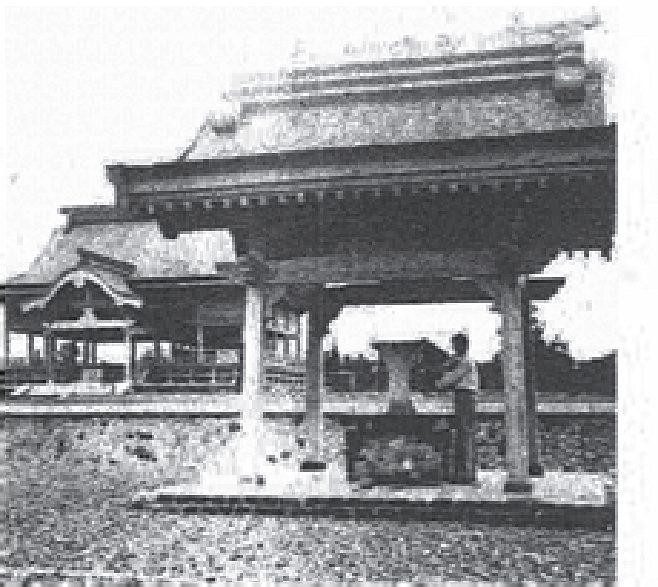
The shrine's origins carried a note of insubordination. When local Japanese military commanders in Malang proposed building a Shinto shrine in 1943, the Military Administration Headquarters in Jakarta refused to approve it. The local command built it anyway. The decision reflected both the religious fervor of officers stationed far from home and the practical reality that central authority frayed at the edges of empire. What they built was no makeshift altar. Analysis of archival photographs held by the Nationaal Archief in the Netherlands reveals a torii gate estimated at over eight meters tall and seven and a half meters wide. The worship hall, or haiden, stretched roughly nineteen meters across, its roof ridge reaching fourteen to fifteen meters above the ground. The structure was crafted from old-growth teak, a wood that Japanese builders recognized as comparable to the finest hinoki cypress used in shrines back home.
A Crossroads of Occupiers
For a shrine built to honor a specifically Japanese deity, Ching Nan Jinja attracted a remarkably cosmopolitan crowd. Ceremonies and parades drew not only Japanese regiments but participants from Malang's Chinese, Arab, German, and Indonesian communities. Dragon dances, traditional costumes, and cultural performances turned the shrine grounds into something more complex than a purely religious site -- it became a stage where the occupied and the occupier performed their uneasy coexistence. The complexity deepened when German diplomats visited. The Nieuwe Courant newspaper reported that envoy Eugen Ott from Tokyo and consul-general Ernst Ramm from Mukden were positioned in a separate corner, distanced from Japanese officials despite their nations' wartime alliance. Even among allies, hierarchies were observed and distances maintained.
Piecing Together a Ghost
Locating the exact site of Ching Nan Jinja has become a puzzle for historians and local researchers. The shrine left no foundation, no stone remnants -- teak burns completely. Researchers like Tjahjana Indra Kusuma have worked from archival photographs, period newspapers, and old town plans to narrow the location. The Nieuwe Courant placed it beside a cemetery. An archival photo from the Nationaal Archief shows the shrine on an incline near a cemetery with cypress trees in the background. Those cypresses, planted by the colonial-era Malang municipal government along Daendels Boulevard, now survive only around the Untung Suropati Heroes Cemetery. The convergence of evidence points to grounds now occupied by a university campus, adjacent to the cemetery -- an area that older residents still know by its Japanese name.
What Burning Erases and What It Preserves
The soldiers who burned Ching Nan Jinja likely believed they were erasing it entirely. In one sense they succeeded: no physical artifact of the shrine survives. No komainu guardian statues, no timber, no torii posts. But destruction creates its own kind of record. The burning confirmed what the shrine meant -- not just to its builders but to the occupied population it was meant to impress. A structure worth destroying in defeat was a structure that carried meaning beyond wood and ritual. The Japanese occupation of the Dutch East Indies lasted only three and a half years, from 1942 to 1945, yet it reshaped Indonesian society in ways that outlived the occupation itself. The shrine's absence speaks to that brevity: an empire's religious architecture, built and erased within a single posting, leaving only a loanword on a city map and a handful of photographs in a Dutch archive.
From the Air
Located at 7.96°S, 112.62°E in Malang, East Java, Indonesia. The former shrine site is believed to be on or near the campus of Universitas Negeri Malang, adjacent to the Untung Suropati Heroes Cemetery. From the air, Malang appears as a dense urban grid in a highland valley surrounded by volcanic peaks. Abdul Rachman Saleh Airport (WARA) is approximately 12 km east of the city center. Juanda International Airport (WARR) in Surabaya is about 90 km north. The site itself is not visible from altitude -- no structures remain. Best identified by proximity to the cemetery and university campus in the northern part of the city.