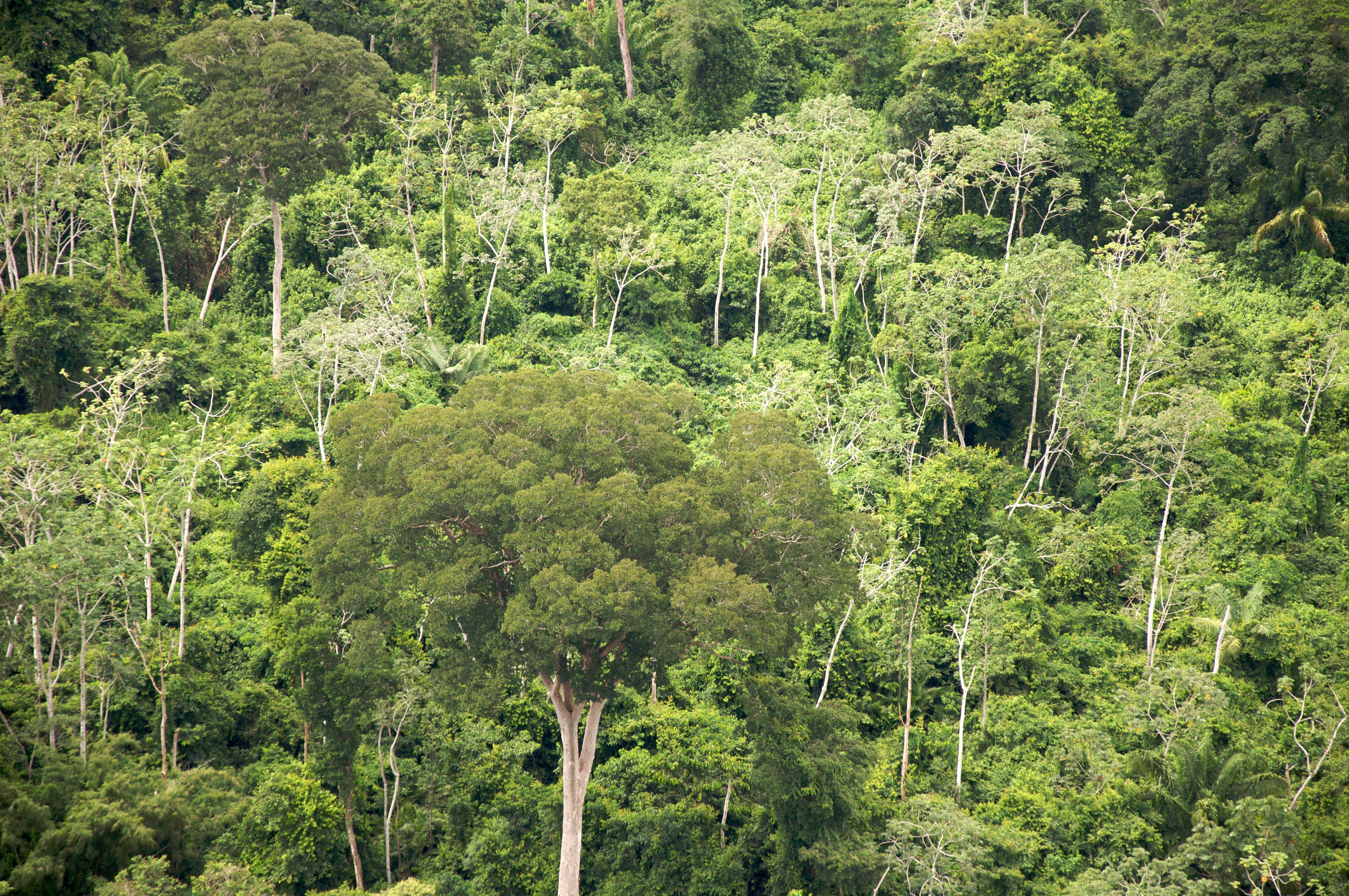
Chiquitano Dry Forests
Every winter, the Chiquitano dry forests shed their leaves. Across a vast sweep of eastern Bolivia and western Brazil, trees that spend the wet season in dense green canopy strip themselves bare, letting light flood to the forest floor. It is one of the largest tropical dry broadleaf forest ecoregions on the planet, and unlike the Amazon rainforest to its north -- which commands global attention and fundraising -- the Chiquitano forests burn and shrink with far less notice. In 2019, fires consumed 1.4 million hectares of this forest, an estimated twelve percent of its total area, and much of that burning was deliberate.
A Forest of Two Faces
The Chiquitano dry forests occupy a transitional zone between the Amazon basin and the drier Gran Chaco to the south. Their character shifts with soil and elevation. On well-drained, nutrient-rich soils, the soto association dominates: soto trees, curupau, momoqui, morado, roble, and cedro form a canopy averaging 20 meters high, with emergent giants reaching 30 meters. The canopy closes to about 80 percent, sheltering an understory of shrubs and herbs in dappled light. Where soils are poorer -- rocky mountain slopes, sandy lowlands -- the cuchi association takes over. Here curupau or cuchi trees predominate, the canopy drops to 10 or 15 meters, and the closure thins to 65 percent. Deciduousness increases toward the semi-arid south, where the dry season bites hardest. The forest breathes with the seasons, its rhythm written in the annual shedding and regrowth of millions of leaves.
The Chiquitano and Their Land
The ecoregion takes its name from the Chiquitano people, who have lived in this landscape for centuries and whose political struggle for territorial control has shaped Bolivian land policy. In 1990, responding to indigenous demands, the Bolivian government issued a decree designating indigenous territories in the lowlands and acknowledging the right of indigenous peoples to collective self-governance. A 1993 agrarian reform law formalized Native Community Lands -- Tierras Comunitarias de Origen, or TCOs -- as the legal vehicle for collective ownership. The 1995 constitutional reform further guaranteed these rights. Portions of the Chiquitano dry forests lie within TCOs, and a 1996 forestry law reform established harvest limits while guaranteeing indigenous communities the right to manage timber on their lands and to harvest forest products through customary practices without requiring central government approval.
The Fires of 2019
The legal protections proved fragile. Earlier in 2019, the Bolivian government issued a decree supporting the clearance of forest lands in both the Chiquitano and Amazon regions for cattle ranching and soya production. Between August and November of that year, fires swept through the dry forests, burning 1.4 million hectares -- roughly twelve percent of the Chiquitano forest area. Civil society organizations concluded that the fires were mostly set deliberately by people seeking to clear land, and they linked the surge in burning directly to the government's pro-clearance policies. Indigenous leaders and environmental organizations petitioned the government to repeal those policies, strengthen forest protections, and uphold indigenous land rights. The Chiquitano fires received a fraction of the international coverage devoted to the simultaneous Amazon fires, despite the scale of destruction in a forest type that is rarer and, in many ways, more vulnerable than rainforest.
What Remains Protected
A 2017 assessment found that 55,861 square kilometers -- about 24 percent -- of the Chiquitano dry forest ecoregion falls within protected areas. The most significant of these is Noel Kempff Mercado National Park, a UNESCO World Heritage Site at the ecoregion's northeastern edge, and the Rios Blanco y Negro Wildlife Reserve. But protection on paper has not always translated to protection on the ground, as the 2019 fires demonstrated. The Chiquitano dry forests represent something increasingly scarce in the tropics: a large, relatively intact example of a forest type that has been devastated elsewhere. Tropical dry forests worldwide have been cleared at rates far exceeding those of wet rainforests, because their seasonal leaf drop and relatively flat terrain make them easier to convert to agriculture. What remains in Bolivia and Brazil is not just an ecoregion -- it is a last stand.
From the Air
Located at approximately 15.00S, 62.00W in eastern Bolivia, spanning into western Brazil. The ecoregion covers a vast area east of the Andes foothills and south of the Amazon basin. Nearest major airports include Viru Viru International (SLVR) at Santa Cruz de la Sierra, approximately 300 km to the west. From cruising altitude, the forest appears as a broad band of green transitioning to brown during the dry season, distinctly different from the darker green of Amazonian rainforest to the north and the lighter grasslands of the Gran Chaco to the south. Noel Kempff Mercado National Park and the Huanchaca Plateau are visible landmarks at the northeastern edge.