Chirk Castle
Most of Edward I's castles in Wales stand empty, their walls open to the sky and their floors long since rotted away. Chirk is the exception. Built in 1295 by Roger Mortimer de Chirk as part of Edward's chain of fortresses across North Wales, it has been continuously inhabited for more than seven centuries, an unbroken thread of domestic life running through a building designed for war. The castle guards the entrance to the Ceiriog Valley, and from its towers the border between England and Wales feels less like a political line than a geological fact, the hills folding westward into a landscape that resisted conquest long before anyone built walls against it.
The Myddelton Centuries
In 1595, Sir Thomas Myddelton purchased Chirk for five thousand pounds, a sum equivalent to roughly eighteen million pounds today. What the Myddeltons did over the next four centuries was remarkable: they domesticated a fortress. Mullioned windows replaced arrow slits. Transomed glass let light flood rooms that had been designed for defense. The family's allegiance during the English Civil War tells its own story of the era's confusion. Thomas Myddelton the younger began as a Parliamentarian, then switched sides to become a Royalist during the Cheshire rising of 1659. The castle was partly demolished during the conflict and then rebuilt, its scars patched over with each generation's improvements. The Myddeltons held Chirk until 1981, when they transferred it to the National Trust, nearly four hundred years after Sir Thomas first walked through the gates.
Gardens Where Armies Once Marched
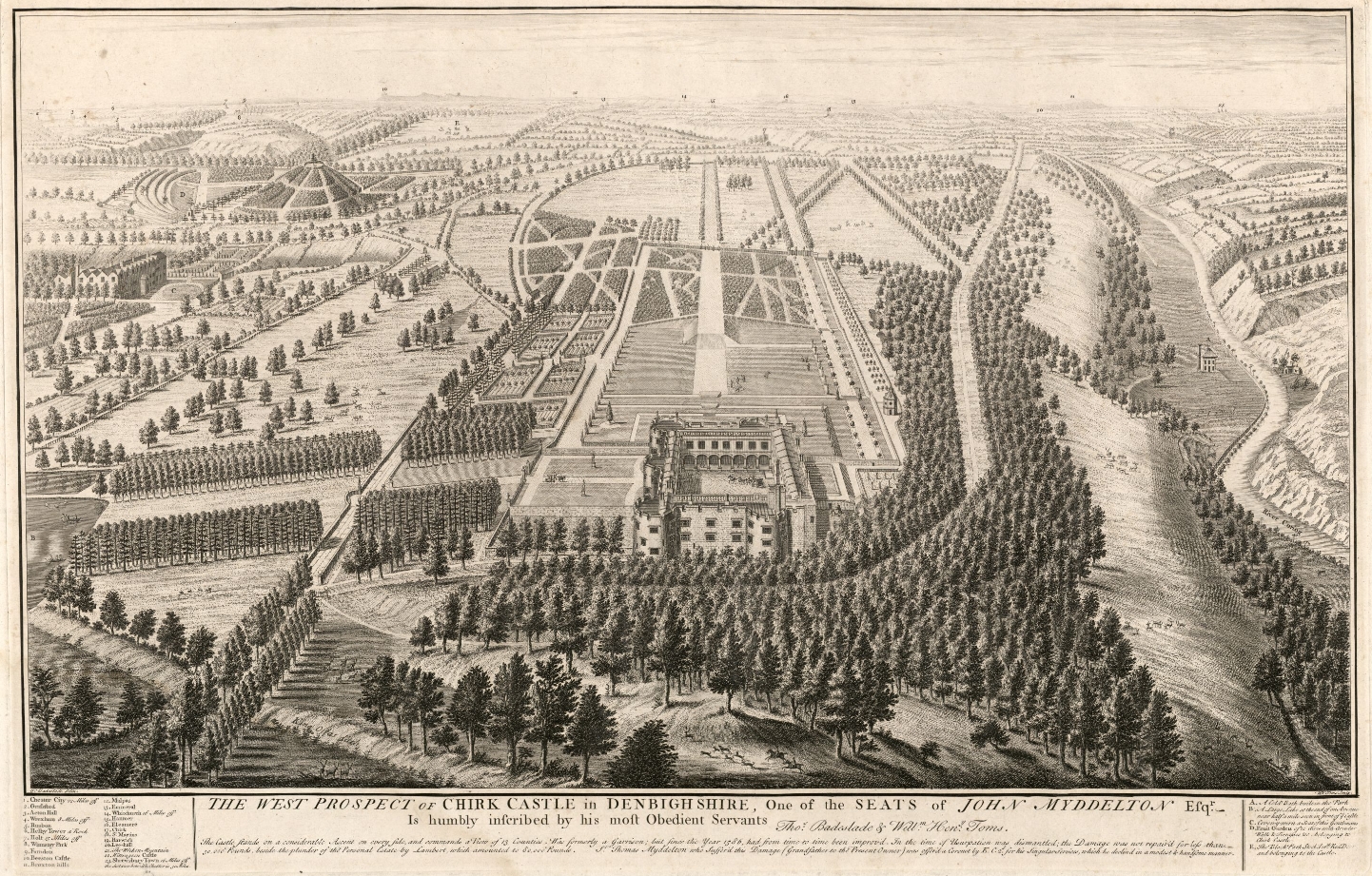
The grounds at Chirk are as layered as the castle itself. A panoramic view of the park painted by Thomas Badeslade in 1742 shows a grand baroque layout of formal gardens and avenues stretching east from the castle walls. Most of that formality was swept away in the 1760s and 1770s, when the landscape architect William Emes transformed the grounds on behalf of Richard Myddelton. He built a ha-ha, that ingeniously concealed ditch that gives the illusion of unbroken parkland, and relocated the ornate Davies gates to the New Hall entrance. The gardens today layer these centuries together: clipped yew hedges and herbaceous borders sit within eighteenth-century parkland where deer still graze. The parks and gardens hold Grade I listing in the Cadw Register of Parks and Gardens of Special Historic Interest in Wales.
Echoes Before the Castle
Three hundred yards from the castle walls stands the Oak at the Gate of the Dead, marking the site of the 1165 Battle of Crogen. The name alone carries the weight of what happened here, centuries before Roger Mortimer laid his first stone. Beneath the parkland, a section of Offa's Dyke runs through the grounds, its ditch and bank partly preserved by the very landscape that hid them. Excavations by the Clwyd-Powys Archaeological Trust in 2018 found substantial remains of the earthwork, a reminder that this borderland was contested territory long before the Normans, long before Edward I, long before anyone thought to build in stone. The castle sits on ground where the English-Welsh frontier has been negotiated, fought over, and redrawn for more than a thousand years.
A Castle That Sheltered
During the two World Wars, the castle took on roles that Roger Mortimer could never have imagined. Thomas Scott-Ellis, the 8th Baron Howard de Walden, leased Chirk from before the First World War until after the Second. A prominent patron of the arts and champion of Welsh culture, he opened parts of the castle to evacuees during the later years of the Second World War, children from bombed cities finding refuge in rooms that had housed medieval lords. In 1918, the castle served as a film location for Victory and Peace. Lieutenant-Colonel Ririd Myddleton, one of the last family members to live at Chirk, served as an extra equerry to Queen Elizabeth II from 1952 until his death in 1988. The family finally left in 2004, but the National Trust keeps the castle open, its rooms furnished, its fires lit, seven centuries of continuous habitation still legible in every doorway and staircase.
From the Air
Located at 52.935N, 3.090W in the Welsh borderlands near Wrexham. The castle sits prominently on high ground guarding the Ceiriog Valley entrance, visible from medium altitude. Look for the distinctive round towers and extensive parkland. Nearby airports include Hawarden (EGNR) and Welshpool (EGCW). The Pontcysyllte Aqueduct UNESCO World Heritage Site is just 2 miles to the north.