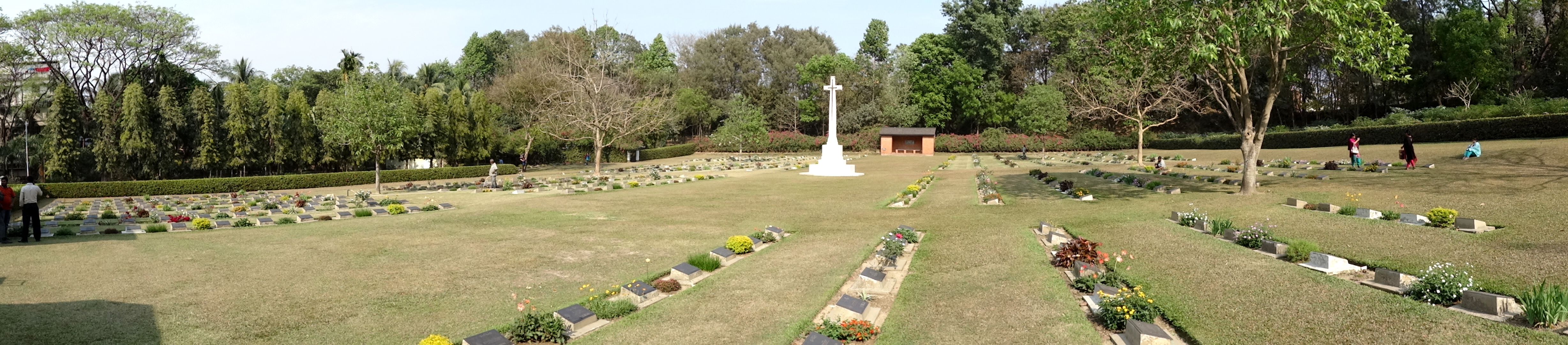
Chittagong War Cemetery
Seven hundred and thirty-one headstones stand in ordered rows at the bottom of a gentle slope in Chittagong, each one marking a life cut short in the Burma campaign. The Chittagong War Cemetery occupies what were once paddy fields at Dampara, on Badsha Mia Road, surrounded now by a city that has grown up around its quiet perimeter. Jungle trees, fruit trees, and flowering shrubs enclose the burial ground in a canopy that filters the subtropical light into something softer, more deliberate, as though the landscape itself has agreed to stand at attention. There is no Commonwealth War Graves Commission direction sign on the road. You have to know to look for it, or stumble upon it, which somehow makes the arrival feel more personal.
Gathered from Scattered Ground
The British Army established this cemetery during World War II, beginning with roughly 400 burials. But the fighting in this corner of South Asia was dispersed across difficult terrain -- hill tracks in the Lushai Hills of Assam, coastal positions near Cox's Bazar, airfields at Dohazari, river crossings at Rangamati. When the war ended, graves lay scattered across dozens of isolated sites, from Baptist mission cemeteries at Chandragona to Muslim burial grounds at Dhuapolong, from the RAF cemetery at Dohazari to Khurushkul Island. The decision was made to consolidate. Bodies were exhumed and transferred to Chittagong, one by one, from more than twenty cemeteries and burial grounds across what is now Bangladesh. The gathering took years. By the time it was complete, 731 Commonwealth service members rested here, 17 of them never identified.
Beyond the Commonwealth Rows
Walk past the neat lines of Commonwealth headstones and you find twenty additional graves that complicate the narrative. Nineteen belong to Japanese soldiers, one of whom remains unidentified. The twentieth belongs to a seaman of the Royal Netherlands Navy. Their inclusion is deliberate -- the Commission's mandate extends to maintaining the graves of all who fell, regardless of which side they fought on. The Japanese graves, in particular, carry a weight that the tidy rows cannot quite contain. These were the soldiers the Commonwealth troops were fighting. Now they share the same soil, the same carefully tended grass, the same tropical rain. Four additional non-war British military burials round out the cemetery's population, their stories quieter but no less final.
A Landscape of Remembrance
The cemetery's design follows the Commission's signature approach: understated, immaculate, and deeply intentional. A tarmac lane leads from the entrance gate down to the burial area, which is entered through a metal gate flanked by two small brick chapels. The Cross of Sacrifice -- that distinctive stone cross with a bronze sword embedded in its face -- stands above the headstones, visible from across the grounds. The surrounding land has been planted not as a formal garden but as something closer to a managed grove, mixing jungle species with fruit trees and flowering trees that attract birds and butterflies. The effect is not manicured but alive, a place where nature participates in the act of remembrance rather than being held at bay by it.
Chittagong's Forgotten Landmark
The cemetery sits 22 kilometers north of Shah Amanat International Airport and 8 kilometers from the Port of Chittagong, near the arts college and the well-known Chatteshwari Road that leads to the Chatteshwari Temple. In a city of more than five million people, the cemetery registers as a curious pause -- a pocket of deliberate silence amid the noise and density of urban Bangladesh. The Daily Star has called it one of Chittagong's uncommon tourist attractions, and uncommon is the right word. Visitors who find their way here often describe the experience as unexpectedly moving, not because the cemetery is grand but because it is so carefully maintained in a city that has little reason to remember a war fought eighty years ago on behalf of a colonial power that no longer governs here.
From the Air
Located at 22.36N, 91.83E in central Chittagong, Bangladesh. The cemetery is difficult to spot from altitude as it blends into the urban canopy, but it lies roughly 22 km north of Shah Amanat International Airport (VGEG). The Port of Chittagong, 8 km to the south, provides a useful visual reference. Best viewed at low altitude (1,000-2,000 ft AGL) approaching from the south along the Karnaphuli River corridor.