Choga Mami
Before the first cities of Sumer, before Babylon was a name anyone spoke, a cluster of mud-brick houses stood on the plains of eastern Iraq about seventy miles northeast of where Baghdad would one day rise. The people who lived at Choga Mami around 6000 BCE did something no human community had done before: they dug canals to bring river water to their fields. Some of those channels stretched more than five kilometers, requiring the coordinated labor of dozens, perhaps hundreds, of workers. It was not monumental architecture. It was not conquest. It was plumbing -- and it changed everything.
Where Civilization Rehearsed
Choga Mami belongs to the Samarran culture, a late Neolithic tradition that flourished in Mesopotamia during the sixth millennium BCE. The site lies in the Mandali region of Diyala Province, near the Iranian border, at a crossroads between northern and southern Mesopotamian traditions. Archaeologists value it precisely for this position. The pottery styles, agricultural techniques, and architectural plans found here reveal how innovations moved between regions -- how ideas born in the lowlands migrated upstream, and how communities at the margins absorbed and adapted them. The settlement was occupied in phases, from the Samarran period through the later Ubaid, each generation building directly on the foundations of the last.
Mud Brick and Careful Rooms
The houses were rectangular, built of locally sourced mud brick, and organized with a precision that suggests planning rather than improvisation. Most followed what archaeologists call a tripartite plan: two or three rows of small rooms flanking a central hall, a layout common across Mesopotamia for both homes and public buildings. External buttresses reinforced the walls at corners and junctions. The largest structure excavated measured ten by seven meters and contained twelve rooms in three rows. A guard tower stood at the settlement entrance. Archaeologist Joan Oates, who directed excavations beginning in 1967 with David Oates serving as field director, also discovered a jar containing the fragmentary remains of an infant burial -- a small, private grief sealed in clay and forgotten for eight millennia.
Figures of Clay and Paint
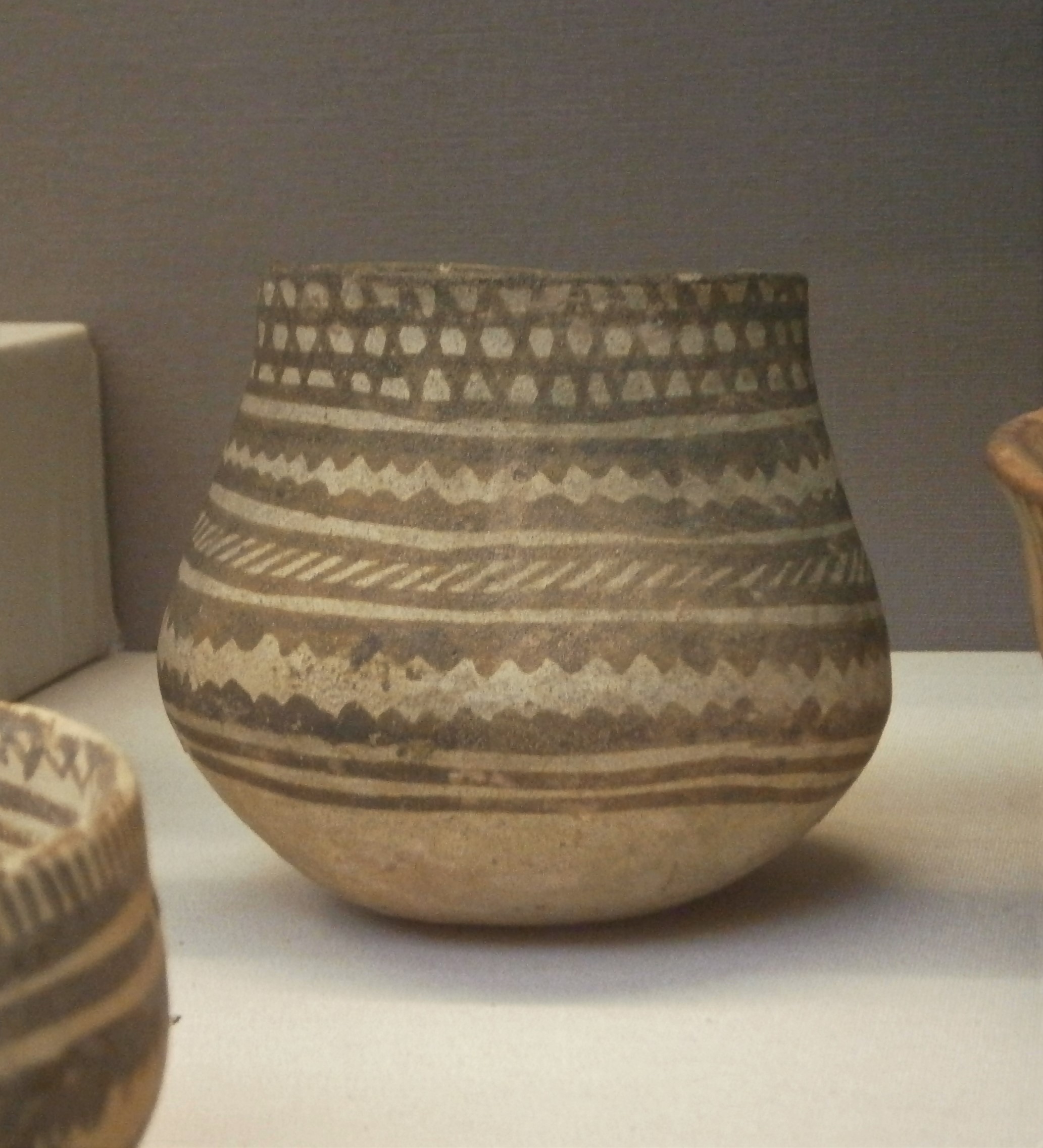
Among the most striking finds at Choga Mami are the small baked terracotta figurines, both male and female, depicted standing with their hands at their waists. Their bodies are exaggerated in proportion, their eyes made of applied clay pellets, their hairstyles rendered in scalloped patterns. Beauty marks dot their faces. Few have survived intact because they were assembled from separately formed pieces that broke apart at the joins over time. The painted pottery is equally distinctive: Samarran designs in geometric patterns that link this site to a broader artistic tradition stretching across the region. These were not merely decorative objects. The figurines, associated with religious ritual in sixth-millennium Mesopotamia, suggest a community whose spiritual life was as carefully tended as its irrigation canals.
The Innovation That Outlasted Everything
Wheat, barley, and flax grew in the irrigated fields around Choga Mami. Cattle, sheep, and goats grazed nearby. The residents hunted gazelles and other wild animals to supplement their diet. None of this was unique to Choga Mami -- farming communities existed across the ancient Near East by this period. What set this place apart was the infrastructure. Canal irrigation required forethought: someone had to survey the terrain, calculate the gradient, organize the labor, and maintain the channels season after season. The cooperative effort implied by five-kilometer canals hints at social organization far more complex than a simple village. Choga Mami may have looked modest, a handful of mud-brick houses on a dusty plain, but the idea born here -- controlling water to control the land -- would become the foundation of every Mesopotamian civilization that followed.
From the Air
Located at 33.88N, 45.45E in the Mandali region of Diyala Province, eastern Iraq, approximately 70 miles northeast of Baghdad. The archaeological site sits on flat Mesopotamian plains near the Iranian border. Nearest major airport is Baghdad International Airport (ORBI), roughly 115 km to the southwest. The terrain is arid and flat, with the site appearing as low mounds typical of ancient tells. Best viewed below 3,000 feet AGL; at higher altitudes the site blends into the surrounding landscape.