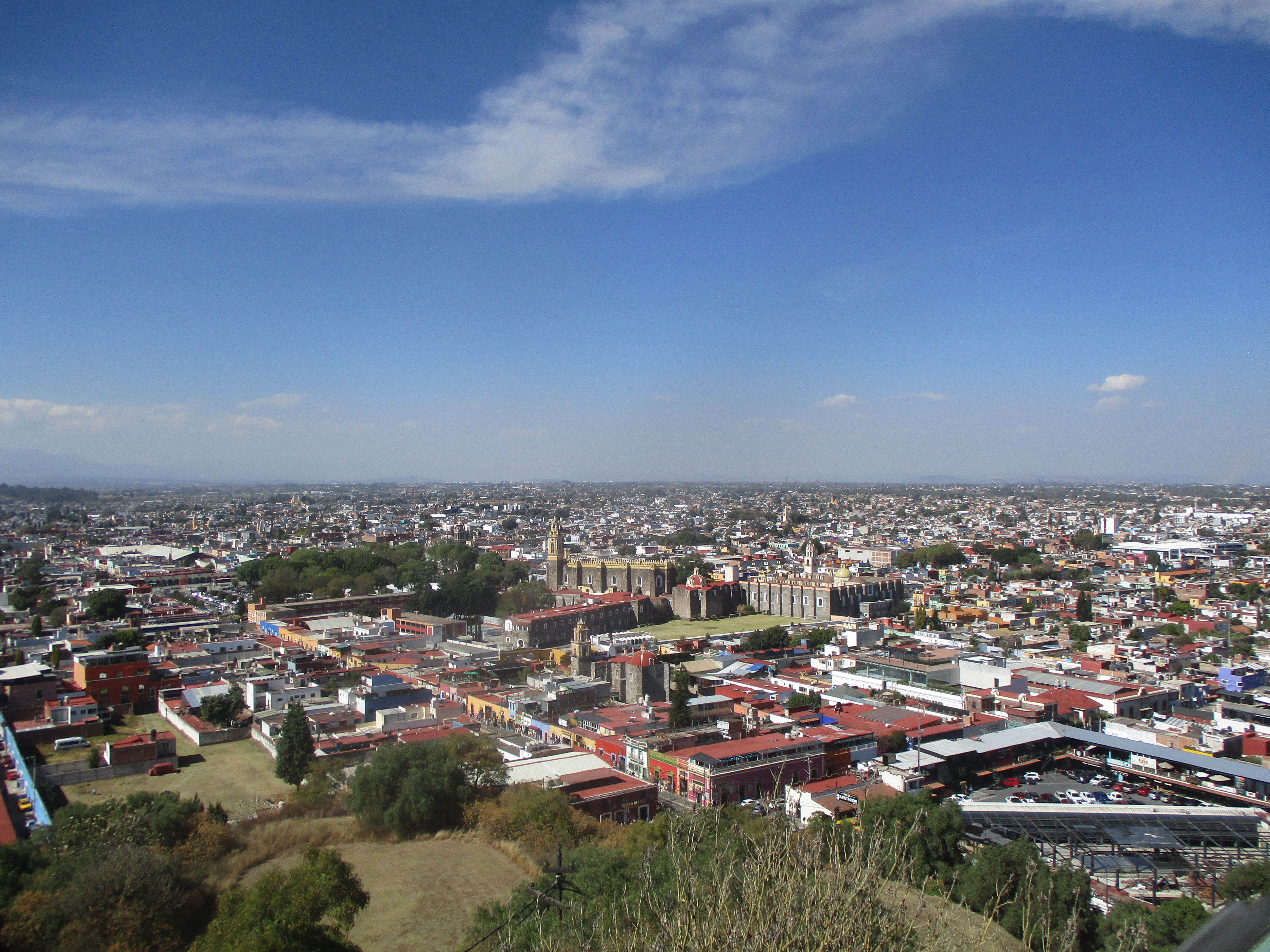
Cholula, Puebla
A local saying claims Cholula has 365 churches — one for every day of the year. The real number is closer to 37, which is still remarkable for a city of roughly 120,000 people. But the count misses the point. Cholula's churches are built on something older and larger than any of them: the Great Pyramid of Cholula, the biggest pyramid by volume anywhere on Earth. From the air, it does not look like a pyramid at all. Centuries of accumulated earth and vegetation have turned it into a broad green hill, crowned since the sixteenth century by the Iglesia de Nuestra Senora de los Remedios, a white-and-yellow sanctuary that catches the Puebla Valley sunlight like a beacon. Beneath that hill, eight kilometers of tunnels wind through the ancient structure, revealing layer upon layer of construction spanning more than a thousand years.
A City Older Than Memory
Cholula is one of the oldest continuously inhabited cities on Earth and the oldest still-inhabited city in the Americas. Its origins stretch back to at least the second century BCE, when it began as a small village in the shadow of the volcanoes Popocatepetl and Iztaccihuatl. By the seventh century, it had grown into a major regional center. The city's pre-Columbian residents expanded the Great Pyramid in stages, each generation encasing the previous structure in a new layer of adobe and earth — like nesting dolls made of mud brick. At its peak, the pyramid's base covered roughly 300 by 315 meters, surpassing the Great Pyramid of Giza in total volume. When the Toltecs and later the Aztecs arrived, Cholula was already a pilgrimage destination, its temple of Quetzalcoatl drawing worshippers from across Mesoamerica.
The Conquest and the Cross
In October 1519, Hernan Cortes arrived in Cholula on his march toward the Aztec capital of Tenochtitlan. What followed was a massacre. Spanish soldiers and their Tlaxcalan allies killed thousands of Cholulans in what Cortes claimed was a preemptive response to a planned ambush. The population was devastated, and the Spanish moved quickly to replace the city's religious landscape. Franciscan friars arrived soon after, reorganizing Cholula's pre-Hispanic neighborhoods — called capullis — around parish churches, each assigned a patron saint. The church atop the Great Pyramid, the Iglesia de Nuestra Senora de los Remedios, was constructed in the sixteenth century, though the current structure dates to the nineteenth. Whether the Spanish knew they were building on the hemisphere's largest pyramid is debated. What is certain is that the act transformed Cholula's skyline into a statement: indigenous sacred ground physically supporting a Christian sanctuary.
Eighteen Neighborhoods, One Calendar
Modern Cholula is divided between two municipalities — San Pedro Cholula and San Andres Cholula — but the more meaningful division is its eighteen barrios, each named for its patron saint affixed to the original pre-Hispanic neighborhood name: San Miguel Tianguisnahuac, Santiago Mixquitla, Santa Maria Xixitla, and so on. These neighborhoods are bound together by a system of shared religious responsibilities called cargas, which sustain a festival calendar so dense that some celebration is occurring in some part of the city almost every week of the year. The most important is the festival of the Virgin of the Remedies in early September, honoring the patron of the entire city. The neighborhoods closest to the center are fully urbanized; those on the periphery retain a more rural character, their economies still rooted in agriculture and brick making. The cargas system traces back nearly 500 years to the first Franciscan missionaries.
Between the Volcanoes and the University
Cholula sits at the western edge of the city of Puebla's metropolitan area, at an elevation of approximately 2,150 meters. To the west, the snow-capped volcanoes Popocatepetl and Iztaccihuatl dominate the horizon. The city's street grid, laid out in the early colonial period, is oriented to the cardinal directions — most streets numbered with indications of their position relative to the center. On the west side of the main plaza stands the city hall, built over the former Xiuhcalli — the 'House of Turquoise' — where a council of nobles met in pre-Hispanic times. The Universidad de las Americas Puebla, a private university, is located in San Andres Cholula and brings a student population that fills the city's cafes and bars, particularly along the streets near the Zocalo. The 2017 Puebla earthquake caused significant damage, including the collapse of the dome of a church in the neighboring municipality.
From the Air
Cholula sits at 19.061°N, 98.306°W, just west of Puebla in the Puebla Valley, at approximately 7,050 feet elevation. From 3,000–5,000 feet AGL, the Great Pyramid is visible as an unusually broad, flat-topped hill with a white church on its summit — distinctly different from the surrounding terrain. The volcanoes Popocatepetl (active, restricted airspace) and Iztaccihuatl rise to the west. Puebla's Hermanos Serdan International Airport (MMHC/PBC) is approximately 20 km east. Expect clear conditions in the dry season; volcanic haze possible when Popocatepetl is active.