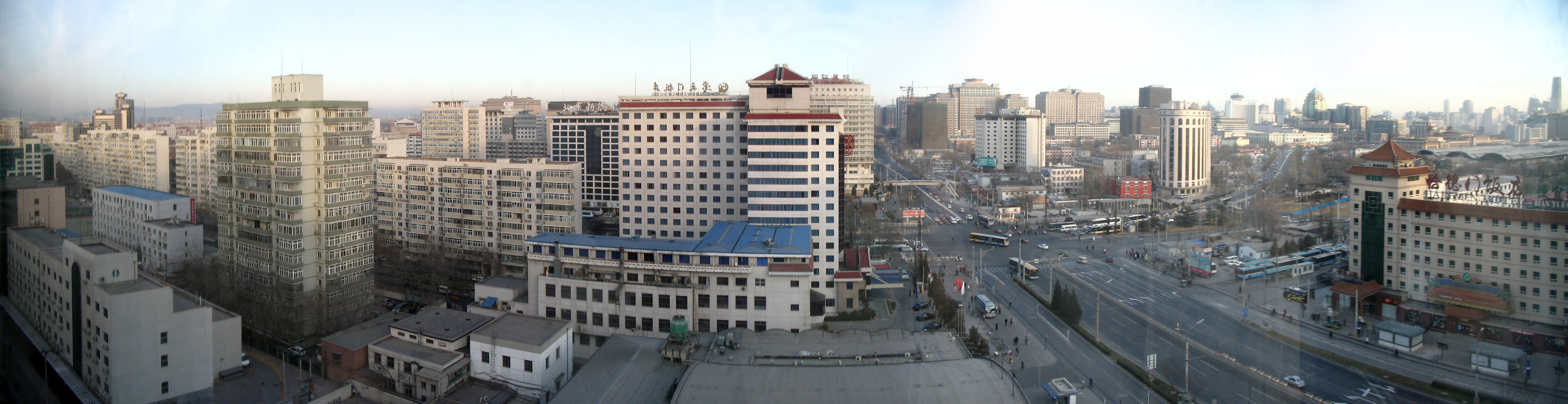
Chongwenmen
There is a hotel called the Hademen overlooking an intersection where no gate stands. The cigarette brand that shared the name is gone too. But for centuries, Chongwenmen was one of the defining gates in Beijing's inner city wall, standing at the southeastern corner where the Imperial City met the world beyond. When the bulldozers came in the 1960s to clear space for Beijing's second ring road, Chongwenmen vanished in a generation's worth of urban modernization. What remains is a name, scattered across street signs and subway maps like a ghost refusing to leave.
Names That Outlast Walls
During the Yuan dynasty, the gate was called Wenmingmen -- the Gate of Civilization. But because the residence of the Mongol prince Hada stood nearby, locals knew it as Hadamen or Hademen. That informal name proved remarkably durable. It outlasted the Yuan dynasty, survived the Ming and Qing, and persisted well into the twentieth century as the name of a popular cigarette brand. The official name Chongwenmen, meaning roughly "Gate of Exalted Literature," carried its own weight in Manchu as well -- transliterated as "shu be wesihulere duka." An entire administrative district, Chongwen District, took its name from the gate and existed as a division of the city from 1952 until it was folded into Dongcheng District in 2010.
The Wall Comes Down
In the 1960s, Beijing embarked on a vast infrastructure project that would define its modern form: the construction of the second ring road. The road traced the path of the old city wall, which meant the wall had to go. Gate by gate, section by section, the Ming-era fortifications were dismantled. Chongwenmen was among the casualties. The gate had stood immediately south of the old Beijing Legation Quarter, where foreign diplomatic missions had clustered since the nineteenth century. Its demolition erased one of the city's architectural anchors, replacing stone and history with asphalt and traffic flow. Today, the spot is a busy intersection where Chongwenmen Inner and Outer Streets run north-south through the phantom gate, crossed by east-west streets that follow the wall's former path.
What the Wall Left Behind
Not everything was lost. To the east of where Chongwenmen once stood, the Ming City Wall Relics Park preserves the best remaining section of Beijing's Ming-era city wall. The park offers a physical reminder of the fortifications that once encircled the inner city -- walls that were thick enough to ride horses along their tops, punctuated by gates that controlled the flow of people, goods, and military power. Chongwenmen Station, an interchange on Lines 2 and 5 of the Beijing Subway, now sits where the gate once filtered traffic of a different kind. The station handles hundreds of thousands of commuters daily, a volume of movement the gate's Ming-era builders could never have imagined. A diagonal street runs northwest from the intersection to Beijing Railway Station, connecting the old gate's location to one of the city's modern transit hubs.
From the Air
Located at 39.898N, 116.418E in Dongcheng District, Beijing. The former gate site is at the intersection of Chongwenmen Inner/Outer Streets and the second ring road. The nearby Ming City Wall Relics Park is visible as a green strip along the old wall alignment. Nearest airports: ZBAA (Beijing Capital International, 25 km NE) and ZBAD (Beijing Daxing International, 46 km S). Best viewed at 2,000-4,000 ft AGL.