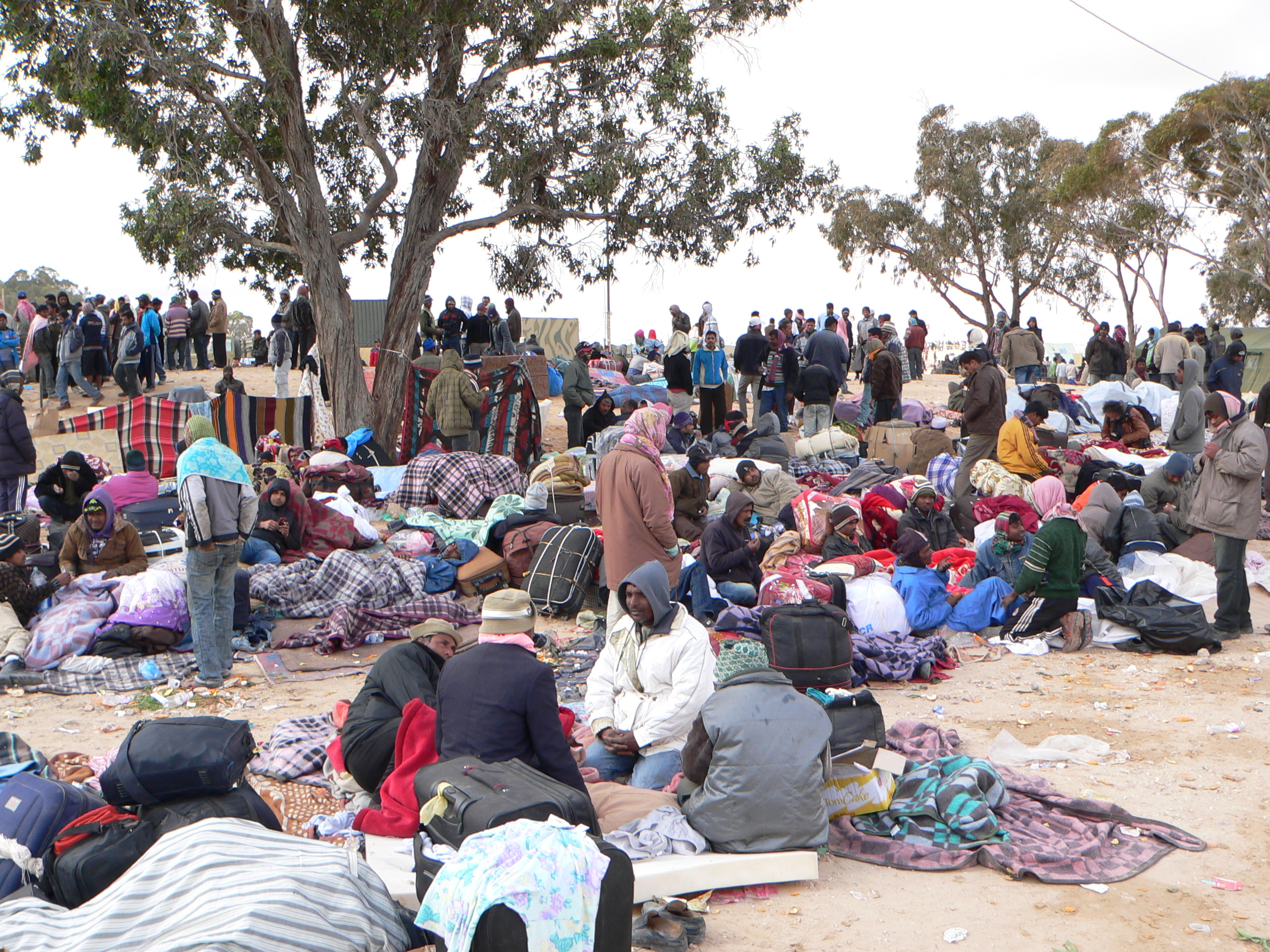
Choucha Refugee Camp
Ten kilometers from the Libyan border, on a stretch of flat Tunisian scrubland near the Ras Ajdir crossing, a city of white tents appeared almost overnight in February 2011. Choucha refugee camp did not exist on any map before the Arab Spring reached Libya. Within weeks, it held more people than many Tunisian towns -- up to 18,000 arrivals in a single day at its peak, according to the UNHCR. By the time it was officially shuttered in mid-2013, the camp had sheltered a rotating population of tens of thousands and become a symbol of the human cost of the Libyan civil war.
Born from Revolution
The chain of events that created Choucha began not in Libya but in neighboring Tunisia, where the Jasmine Revolution toppled President Ben Ali in January 2011. That uprising ignited the broader Arab Spring, and by February 2011, Libya was in open revolt against Muammar Gaddafi. As fighting intensified, migrant workers and refugees fled across the border in staggering numbers. The Tunisian authorities, working alongside the UNHCR and other international organizations, opened seven camps in the border region. Choucha quickly became the largest. Early arrivals were predominantly Bangladeshi migrants who had been working in Libya. Most were repatriated within weeks through the Humanitarian Evacuation Cell set up by the IOM and UNHCR. By April, the camp's population had shifted to predominantly sub-Saharan African nationals -- people from Chad, Sudan, Eritrea, Somalia, and elsewhere who had neither the means to return home nor a clear path forward.
A Desert in Distress
Conditions in those first weeks were grim. There were no showers and only a handful of water points for thousands of people. As NGOs arrived in greater numbers, the UNHCR established a Sanitary Alert system that convened daily meetings with health officials, the Tunisian Ministry of Health, and EU representatives to stave off epidemics. UNICEF launched a vaccination campaign for children under five. The Danish Refugee Council provided pediatric care. But the situation remained fragile. Tunisia had no legal framework for asylum seekers, which meant residents could only seek international protection through the UNHCR itself -- and with that came agreement to resettle in a safe third country. European nations expressed willingness to accept refugees, yet actual resettlements remained painfully few. Those denied protection had no avenue for appeal, a gap that drew sharp criticism from human rights organizations.
Fire and Fury
The camp's fragility erupted into violence more than once. In May 2011, a major fire swept through the tents, killing several residents and injuring many more. Desperate migrants demanded immediate resettlement from the UNHCR, and the resulting unrest spilled beyond the camp's perimeter, drawing in local Tunisian communities whose own resources were strained. The situation turned violent, and in the days that followed, much of Choucha was destroyed. Another fire struck in March 2012, claiming additional lives. These incidents laid bare the fundamental tension at the camp's heart: thousands of people trapped in legal and geographic limbo, unable to go back and unable to move forward, with an international community slow to offer concrete solutions.
The Closure That Wasn't
The UNHCR officially closed Choucha in June 2013, but the reality on the ground told a different story. Several hundred residents -- mostly sub-Saharan Africans who had been denied refugee status or were still awaiting resolution -- simply stayed. With no electricity and no running water, they lived among the remnants of the camp while organizations like Medecins Sans Frontieres maintained a nearby presence, providing food and basic medical care. The Tunisian government offered temporary residence to the roughly 250 people still counted at closure, but many aid organizations condemned the abrupt shutdown as a violation of the residents' human rights. France 24 reported on the camp's remaining inhabitants in 2014, calling them the "forgotten refugees" of Libya's conflict. Al Jazeera told similar stories in 2017, documenting lives suspended indefinitely in the Tunisian desert.
Echoes in the Sand
From the air, the site near Ras Ajdir offers little to see today -- flat terrain, a border crossing, the faint outlines of a place that once throbbed with desperation and improvised community. Choucha's legacy, though, persists in academic studies, NGO reports, and the ongoing debate about how the international system handles displacement crises. The camp demonstrated both the speed with which humanitarian infrastructure can materialize and the difficulty of dismantling it when the people it shelters have nowhere left to go. For the sub-Saharan Africans who passed through Choucha, the camp was a way station between two forms of precariousness -- the violence they fled in Libya and the uncertain futures that awaited them in Tunisia, in Europe, or back in countries they had left years before.
From the Air
Located at 33.14N, 11.46E in southern Tunisia, approximately 10 km from the Ras Ajdir border crossing with Libya. The site sits on flat desert terrain in the Medenine Governorate. Nearest major airport is Djerba-Zarzis International Airport (DTTJ), about 80 km to the north. The Libyan border is clearly visible as a line of infrastructure running east-west. Best viewed at 3,000-5,000 feet AGL for terrain context.